AI agents that run your back-office processes. And escalate where their authority ends.

Handle more work with the team you have, and catch costly mistakes before they’re paid.

Claims, invoices, compliance reviews, new hires. Regisseur reads the documents, chases what is missing and updates your systems. When a decision goes past the limit you set, it stops and asks the right person, with everything attached.

Book a walkthrough

Bring a process. Map it live.

Private deployment · Every step recorded · SOC 2-aligned controls

FIG. 01 · ONE INVOICEILLUSTRATION · FICTIONALMARIA’S LINEAI MAY ACCEPT DIFFERENCES UP TO $1,000AI · ACCOUNTS PAYABLEMARIA · CONTROLLERSTOPPED$2,400 OVER THE ORDERREQUEST · INVOICE 4471$2,400 over the order.Receipt confirmed on day 3.INVOICEORDERRECEIPTAPPROVEREJECT
  1. Meet the team. Past the line, Maria decides.
  2. An invoice arrives. It checks it against the order.
  3. No receipt yet. It asks the warehouse, and follows up.
  4. Day 3. The receipt arrives. The work carries on.
  5. $2,400 is over its $1,000 limit. It stops and asks Maria.
  6. Maria approves. It pays, files and records every step.
FIG. 01FICTIONALMARIA’S LINELIMIT $1,000AI · PAYABLESMARIASTOPPED$2,400 OVER THE ORDERREQUEST · INVOICE 4471$2,400 OVERReceipt confirmed on day 3.APPROVE
  1. Meet the team. Past the line, Maria decides.
  2. An invoice arrives. It checks it against the order.
  3. No receipt yet. It asks the warehouse, and follows up.
  4. Day 3. The receipt arrives. The work carries on.
  5. $2,400 is over its $1,000 limit. It stops and asks Maria.
  6. Maria approves. It pays, files and records every step.
Any process

Every step of every process gets its own specialist agent. You decide how much authority each one has.

Claims, new hires, 1035 exchanges, retailer deductions. Each gets agents built for its own steps: seven in the hiring chain alone. Every one works inside the limits you set, sends the decisions above them to a person, and leaves a record behind both.

FIG. 02 · EVERY PROCESSILLUSTRATION · FICTIONALINVOICESMATCHCHASEPAYDIFFERENCESOVER $1,000MARIACLAIMSINTAKEVERIFYPAYOUTPAYOUTSOVER $10,000JONASNEW HIRESSCREENOFFERSET UPEVERYOFFER LETTERANAANNUITIESFORMSCARRIERFUNDSEVERYSUITABILITY CALLDEVEVERY PROCESS: A LINE · A PERSON · A RECORD
  1. Invoices. Agents built for its steps. Maria decides differences over $1,000.
  2. Claims. Its own agents. Jonas decides payouts over $10,000.
  3. New hires. Its own agents. Ana signs every offer letter.
  4. 1035 exchanges. Its own agents. Dev decides every suitability review.
  5. Different agents. One way of working. Your processes, your people, your limits.
FIG. 02FICTIONALINVOICESDIFFERENCESOVER $1,000MARIACLAIMSPAYOUTSOVER $10,000JONASNEW HIRESEVERYOFFER LETTERANAANNUITIESEVERYSUITABILITY CALLDEVEACH: A LINE · A PERSON · A RECORD
  1. Invoices. Agents built for its steps. Maria decides differences over $1,000.
  2. Claims. Its own agents. Jonas decides payouts over $10,000.
  3. New hires. Its own agents. Ana signs every offer letter.
  4. 1035 exchanges. Its own agents. Dev decides every suitability review.
  5. Different agents. One way of working. Your processes, your people, your limits.
InvoicesMaria decides differences over $1,000.
ClaimsJonas decides payouts over $10,000.
New hiresAna signs every offer letter.
1035 exchangesDev decides every suitability review.
Retailer deductionsAn auditor decides every over-cap promotional deduction.
Your processYour steps, your people, your limits.
InsuranceCPG & retail
Not a chat assistant

A chat assistant tells you what to do. Regisseur does it.

A chat assistant can tell you an invoice is over. Someone still has to chase the warehouse, follow up, get the approval, pay and file. Regisseur does that part, and its limits are set outside the AI, so no email can talk it past them.

FIG. 03 · TWO WAYSILLUSTRATION · FICTIONALMARIA’S LINESET OUTSIDE THE AIA CHAT ASSISTANTREGISSEURAI · PAYABLESMARIAIt’s $2,400 over the order.STILL YOURSChase the warehouseFollow up on day 2Get the approvalPay itFile itERPPAIDYOUR TEAM’S TIME1 MINEVERY STEP RECORDED
  1. Same invoice. A chat assistant on the left, Regisseur on the right.
  2. The chat gives an answer. The rest of the work is still yours.
  3. An email says “pay today”. The line does not move.
  4. One tells you what to do. The other does it, with a record.
FIG. 03FICTIONALMARIA’S LINEOUTSIDE THE AIA CHAT ASSISTANTREGISSEURAIMARIAIt’s $2,400 over the order.5 JOBSSTILL YOURSERPPAIDYOUR TEAM’S TIME1 MINEVERY STEP RECORDED
  1. Same invoice. A chat assistant above, Regisseur below.
  2. The chat gives an answer. The rest of the work is still yours.
  3. An email says “pay today”. The line does not move.
  4. One tells you what to do. The other does it, with a record.
A chat assistant

Answers, then hands the work back.

  • Tells you the invoice is over
  • You chase the warehouse
  • You follow up on day two
  • You get the approval
  • You pay and file it
Regisseur

Finishes the work, and leaves a record.

  • Checks the invoice against the order
  • Asks the warehouse itself
  • Follows up on its own schedule
  • Stops and asks the person who decides
  • Pays, files, and records every step
The limits you set

You decide what it may send and spend on its own.

Some limits are about money: an adjustment above your review threshold waits for a reviewer. Some are about who it talks to: an email to a vendor can wait for the case owner to read it, while routine messages go straight out. You set this per process and per step, and it is enforced every time.

FIG. 04 · TWO LINESILLUSTRATION · FICTIONALDANA · CASE OWNERDISPUTE EMAILS WAIT FOR HERPRIYA · REVIEWERADJUSTMENTS OVER $750DANAVENDORAI · ACCOUNTS PAYABLEPRIYAERPPOSTEDEMAIL · TO VENDORDISPUTEInvoice 2208 is short.SENDADJUSTMENT$1,900Over the $750 limit.APPROVE
  1. Two lines. Each names its owner and exactly what it limits.
  2. Routine work goes straight out: a receipt request, a $180 credit.
  3. A dispute email waits for Dana. A $1,900 adjustment waits for Priya.
  4. Dana sends it. Priya approves it. Both are on the record.
FIG. 04FICTIONALDANA’S LINEDISPUTE EMAILSPRIYA’S LINEOVER $750VENDORAI · EMAILSDANAERPPOSTEDAI · CREDITSPRIYAEMAIL · TO VENDORDISPUTESENDADJUSTMENT$1,900APPROVE
  1. Two lines. Each names its owner and exactly what it limits.
  2. Routine work goes straight out: a receipt request, a $180 credit.
  3. A dispute email waits for Dana. A $1,900 adjustment waits for Priya.
  4. Dana sends it. Priya approves it. Both are on the record.
Set outside the AI

The model reasons inside the box. Regisseur controls the box.

The limits are not instructions in a prompt. They sit outside the model, so nothing the model reads can talk it past them.

FIG. 05 · THE BOXILLUSTRATION · FICTIONALMARIA’S LINEPAYMENTS OVER $5,000VENDORTHE BOX · SET BY REGISSEURCHECKS INCHECKS OUTTHE MODELMARIAPAY $9,400STOPPEDREQUEST · INVOICE 7310$9,400Over the $5,000 limit.APPROVE
  1. The model works inside a box. Regisseur sets its walls.
  2. What comes in is checked first: the fields, the format, the rules.
  3. An email tells the model to ignore its limit and pay today.
  4. Even if the email persuades the model, the wall holds. Maria decides.
FIG. 05FICTIONALMARIA’S LINEOVER $5,000VENDORREGISSEUR’S BOXTHE MODELMARIASTOPPEDPAYREQUEST · 7310$9,400Over $5,000.APPROVE
  1. The model works inside a box. Regisseur sets its walls.
  2. What comes in is checked first: the fields, the format, the rules.
  3. An email tells the model to ignore its limit and pay today.
  4. Even if the email persuades the model, the wall holds. Maria decides.
Before model judgmentConstrain the inputs.Required data, approved tools, explicit schemas, business rules, and allowed actions.
Model judgmentReason where reasoning is useful.The model handles the cognitive step. It does not get to redefine the process around it.
After model judgmentVerify before action.Validation, thresholds, spend ceilings, the person who decides, recovery paths, and a record you can replay.
Watch the run

A $1,350 variance against a $500 limit, decided by a person.

Contract math applied to a real vendor invoice on real SharePoint. The variance goes past the limit, so an examiner decides. If they let the full invoice stand, the platform refuses to record it until a reason is stated.

Over time

Start strict. Loosen only on evidence.

Every case records how much of the work finished without a person. Where the record shows the AI gets a kind of decision right, you can raise its limit for that decision. Where it does not, the person stays in.

Illustrative run historyIndependent completion
Week 1
44%
Week 4
68%
Week 8
86%
Illustrative only. Raising a limit is a decision you make from the record, not something the platform does on its own.
Waiting, and failing

When nobody replies, it chases. When a system fails, it picks back up.

Follow-ups go out on your schedule, and after the last one the case goes to a person with the whole history. If a system drops mid-step, the case resumes where it stopped and nothing is done twice.

Four reminders, nobody askedIn the claims run, a silent beneficiary was chased four times on the policy cadence before the case reached a person. Manual follow-ups: zero.
Silence, escalated to one personIn the 1035 run, the ceding carrier never answered. After four reminders the platform escalated to one person, who closed the case from Teams.
Nothing done twiceA step that fails part-way resumes from where it stopped. Emails are not re-sent and payments are not re-made on recovery.
What it saves

Your people only handle the moments that need them.

Every case records how much of the work a person touched. In our demo runs, a complete case took under a minute of a person’s time. The case itself stayed open for minutes, and the record keeps those two figures apart rather than blending them into one number.

Inside Regisseur

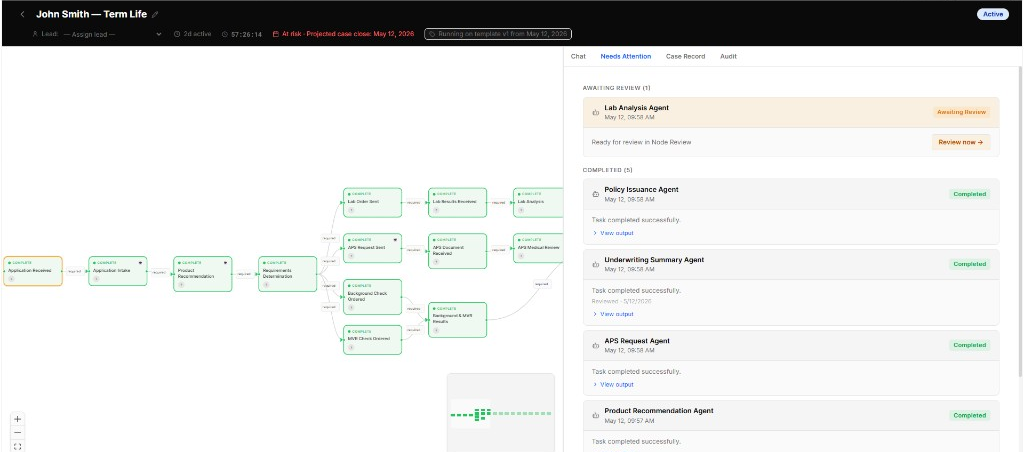
See the process, the work, and the handoffs in one place.

Each case keeps the process, AI work, human decisions, and record connected from start to finish.

Regisseur
Workspace / Cases / Case workspace
LivePrivate deployment
Regisseur case workspace showing a process graph on the left and agent work with a human review queue on the right
Process graphCase steps stay visible from intake through completion.
Human reviewWork that crosses a limit waits for the right person.
Case recordHuman and agent activity stays attached to the same case.
How you start

Bring one process. We map it live.

Bring one real process. Map how it runs today, put AI team members to work inside explicit limits, and use the record to decide what should happen next.

01

Map it

Draw how the process really runs today.

The documents, systems, decisions and people. Including the steps nobody wrote down.

02

Run it

AI team members take the routine work.

Inside the limits you set. Your people keep the decisions you reserve for them.

03

Prove it

Measure what actually happened.

Completion, time and cost per case, from the record. Expand only where the numbers support it.

OutputProcess map
OutputFirst running process
OutputPerformance record
Next step

Bring one process you run every week.

In the walkthrough we map it together: what the AI can own, where your people stay in, and what it would take to run it.

Book a walkthrough

45 minutes. Bring the process, not a shortlist of questions.