Supplier costs, negotiated by email. A person takes the hard calls.
Litware Negotiation Partners asks the suppliers of Lamna Home Goods to cut surcharges, hold back price increases and extend payment terms, by email. AI agents read the replies, people decide the hard calls, and every figure below is read from the run’s own screens.
- Agents read replies, counter inside the limits, write back and check invoices
- A negotiator decides anything outside the limits, any hedge and any silence
- The suppliers reply by email and send credit notes
- Chapter 4Outside the limits
- Chapter 5A hedge
- Chapter 5Silence
- Chapter 3Billed the old price
What this shows
Litware Negotiation Partners (fictional) renegotiates prices, tariff surcharges and payment terms with the long-tail suppliers of Lamna Home Goods (fictional). Litware negotiates in Lamna's name, so the emails speak for Lamna: "Lamna's final offer", "your Lamna negotiator".
Every supplier conversation here is an email exchange. The platform sent each message, the supplier's reply came back into the case through a mailbox, and the platform read it, decided the next move and wrote the agreed price into the buyer's procurement system. Then it watched the next invoice to make sure the saving actually arrived.
At a glance
What the totals count: only the 7 finished negotiations: landed on an invoice (Harbor Corrugated Co, Hollis Brass & Fittings); landed after a credit (Tradewind Forwarding, Skyward Freight Partners); payment terms written back (Ridgeway Janitorial, Sagebrush Direct Mail); and a price increase held back (Inkwell Press Group). Not in the totals: Cobalt Fastener Depot (awaiting the supplier's reply to a $26.05 final offer), Axiom Display Systems (with a negotiator after no reply) and Larkspur Catalogs (with a negotiator after a counter on payment terms); and the 14 other warm-up negotiations (11 still open, 3 cancelled), none of which has reached a first invoice at a new price.
One exchange: Hollis Brass & Fittings
Brass cabinet pulls, 61,000 a year. Supplier lines and the final offer are quoted from the emails.
The back-and-forth, step by step
- The ask.The firm's own negotiation engine sets an ask, a target and a walk-away price. The platform sends a fixed-wording email with the case's numbers; nothing a supplier reads is written by an AI model.
- Reading the reply.The agent that reads supplier replies turns the free-text reply into facts: accept, counter (with its price), refuse, question or unsure; how firm it is; conditions, currency, extra prices, attachments. Quoted earlier emails are ignored.
- Checked against the email.The price the agent read must be written in the email. A hedge ("should be fine, let me check Monday"), a condition, a second price, or an acceptance quoting a different price goes to a person.
- Counter-offers.Inside the limits, the engine accepts or counters; the platform sends the counter and waits for the next reply.
- The negotiator.Outside the limits, or after two rounds, a negotiator approves the supplier's written price, sends a final offer (the engine's suggestion is filled in, can be changed and can carry a personal note) or walks away.
- Agreement only in writing.The price written back is always one the supplier stated in writing: their own counter, or our offer they explicitly accepted.
- Silence and acknowledgements.Every reply gets a short acknowledgement. No reply gets one reminder, then a negotiator picks it up.
- After the handshake.A confirmation goes out, the new price is written into the procurement system and read back, and the next invoice is checked. If it still bills the old price, the billing contact is asked for a credit note, checked on its content (right invoice, enough credit, right currency); a wrong document goes to a person with a drafted reply they can send.
The controls
- People decide anything outside the limits, and every decision is recorded with who made it and why.
- Autonomy is earned per supplier class. The agent that reads supplier replies worked under review first: 13 of 13 reviewed reads approved before promotion, after which the negotiation lead let it work on its own. Other supplier classes stay reviewed until they earn it.
- Nothing invented on the wire. Supplier emails are fixed wording with the case's numbers; a person's note can go out; a drafted reply only after a person sends it.
- Every value is checked against its source: prices against the supplier's email, credit notes against the invoice.
- Full audit trail: every message, read, decision and check is on the record and can be exported.
- Value reported honestly: price reductions, cost avoided and cash freed are counted separately, never added together.
How this was made
- The platform and emails. The supplier side was played by an AI model writing each supplier's replies from a test mailbox.
- The negotiation engine and the procurement system are simulated stand-ins built for this demo. Invoices and the increase letter entered through feed scripts; waiting time was compressed for the silence scenario.
- Dates in the invoice feed are scenario dates (the Inkwell Press Group invoice is dated April 2027).
- All companies are fictional. Names in screenshots belong to the demo workspace's fictional team.
- Email addresses in the screenshots are blurred for privacy.
1. A supervised first case
Litware asks a packaging supplier, Harbor Corrugated Co, to remove a tariff surcharge. The supplier answers by email and an AI agent reads the answer. The agent has no track record yet, so a negotiator checks the reading before anything moves. The agreed price goes into the procurement system, and the first invoice at the new price closes the case.
Harbor Corrugated Co: remove the surcharge outright

Harbor Corrugated Co's reply as it arrived in the case by email: the tariff situation has changed since the surcharge was added, so it can drop it and invoice $1.03 per unit from the first of next month. Litware's original ask is quoted below.

Harbor Corrugated Co's reply, with the agent's reading beside it: an explicit acceptance of $1.03 per carton, no conditions, no other price. The agent had no track record yet, so a negotiator approved this reading before the case moved on.

The confirmation sent to the supplier once the agreement passed its checks: $1.03 per unit for invoices dated on or after 1 November 2026, with the price record updated to match.

The procurement system (a labelled stand-in for this demo) after the write-back: the price record reads $1.03 from 1 November 2026, and the old $1.0856 stays in its history.

The finished case: the first invoice billed 14,958 cartons at exactly $1.03 with nothing over-billed, so the saving is confirmed on paper: $9,980.20 a year.
2. Earning autonomy
Before the reply-reading agent may work alone, it has to earn it. Twelve warm-up replies came back (acceptances, counter-offers, refusals, a one-word yes) and a negotiator checked each reading against the supplier's own words. Every reading was right. With 13 reviewed reads, all approved (these twelve and Harbor Corrugated Co's in chapter 1), the negotiation lead promoted the agent to work on its own.
Supplier replies checked by a person, then a promotion

Tidewater Poly Bags cannot remove the whole surcharge and counters at $1.82 instead of the $1.76 asked. The reading records a counter-offer and its price, both taken straight from the email.

Granite Peak Shelving refuses: its steel costs still carry the tariff, so the price stays. The reading records a refusal with no price, and nothing moves until a person has checked it.

Kestrel Carton Works replies with one word: "Agreed." The reading records an explicit acceptance of the price Litware offered and, rightly, no price of its own, because the reply states none.

The reply-reading agent's page. Its instructions forbid it to compute or round a price, to guess, or to write anything a supplier reads. Its history records the negotiation lead promoting it to work on its own after 13 reviewed reads, all approved.
3. Over-billing becomes a credit
Two freight forwarders agree to meet Litware halfway on their surcharges, and the promoted agent reads their replies on its own. Both next invoices still bill the old price. The case notices, asks the supplier's billing desk for a credit note, and checks the document that comes back. At Tradewind Forwarding the first document returned was the invoice itself: it was refused and handed to a person with a drafted reply. The credit note was then accepted because of what it says, not because a file was attached.
Skyward Freight Partners: half the surcharge, read without a review

Skyward Freight Partners' reply: part of the surcharge is still a cost on the container legs, so it cannot take it all off, but it can meet Litware halfway and bill $49.21 per pallet from the first of next month. Litware had asked for $47.87.

The activity record shows the promoted agent reading Skyward's reply on its own, with no review entry. The case header sums up the rest: $49.21 per pallet agreed, the first invoice still billed the old price, and a $201.11 credit was requested and received.

For comparison, the same record on a warm-up case from before the promotion (Fennimore Mailers): there, the negotiator's approval of the reading is on the record before the case moved on.
Tradewind Forwarding: the over-billed invoice and the credit request

Tradewind Forwarding's first invoice after the agreement bills $69.1104 per cubic metre instead of the agreed $62.60. The case writes to the supplier's billing desk: 40 units, $260.42 over-billed, please send a credit note.
Tradewind Forwarding: the wrong document goes to a person, with a drafted reply

The document that came back was the invoice itself, not a credit note. The check refuses it, and the case's Needs Attention tab shows why a person is needed and who it is queued for.

The drafted reply, waiting in the case's Open Requests: the document received was an invoice, $260.42 is over-billed across 40 units, please send a credit note. A model drafted it; a person can send it, edit it first or take over, and nothing reaches the supplier until they do. It went out as drafted.
Tradewind Forwarding: the credit note, accepted on its content

Tradewind's billing desk answers: it had attached the invoice by mistake, and now attaches credit note CN-TWF-2026-0042 for $260.42 against invoice INV-LHG-S016-001, to be applied against the next payment. The header shows one attachment, a credit note, and that it passed its checks.

The credit note is accepted on what it says, not because a file was attached: it is a credit note, it names the over-billed invoice, it credits $260.42 in US dollars, each checked against the attached PDF. The case closed with the credit and $9,765.60 a year saved.
4. Two rounds, a final offer, a written acceptance
A components maker, Hollis Brass & Fittings, holds at $14.75 through two rounds. A negotiator gets a task with the negotiation engine's suggested price, turns it into a final offer of $14.30 with a personal note, and sends it. The supplier accepts in writing, and only then is the price written into the procurement system.
Hollis Brass & Fittings: the second reply

The negotiator's inbox: the reading of Hollis Brass & Fittings' second reply waits for review. Second replies are read by a separate agent that has not been promoted, so it still works under review.

Round two: Hollis rejects Litware's $13.85 counter as below its cost and holds at $14.75 as its floor. The reading records a firm counter at $14.75, taken from the email.
Hollis Brass & Fittings: the negotiator's final offer

The negotiator's task: today's price ($15.2378 a unit, 61,000 units a year), the engine's limits (ask $13.39, target $13.852, walk-away $14.3139) and the supplier's written $14.75, the only price that could be approved as it stands. The negotiator chooses a final offer, sets $14.30 where the engine had suggested $14.3139, and adds a note: best and final position, the new price held for the next 12 months of orders.

The final offer as the supplier received it: fixed wording with the case's price, US$ 14.3 per unit from the first of next month, plus the negotiator's note. It asks for acceptance in writing; the price changes only once that arrives. Sent before a formatting fix; the platform now writes $14.30.
Hollis Brass & Fittings: acceptance in writing, write-back, first invoice

Round three: "We accept US$ 14.30 per unit … from the first of next month, and we'll hold it for the next 12 months of orders." The reading records an explicit acceptance of the final offer, with no conditions and no other price.

The case record after the first invoice: 500 units billed at $14.30, nothing over-billed. It keeps the negotiator's decision and note beside the engine's suggestion and the supplier's written price: three rounds, one decision by a person, $57,205.80 a year.
5. A hedge goes to a person; silence gets one reminder
A supplier who says "let me check with my manager" is never treated as a yes: the case goes to a person, with the reason shown. A supplier who goes quiet gets one reminder, and then a person picks it up. (The days of waiting were compressed for this demo.)
Cobalt Fastener Depot: "let me check with my manager"

Cobalt Fastener Depot replies that it cannot approve the change itself and must check with its manager. The reading here is done by the agent working on its own, yet a reply like this never counts as a yes.
Cobalt Fastener Depot: the case goes to a person, with the reason

The negotiator's task, with the reason it is here: the reply was a question, not a commitment, and there is no written price to approve. The engine's limits are shown: ask $25.15, target $26.0428, walk-away $26.9357.

The final offer as sent to Cobalt Fastener Depot: $26.05 per unit from the first of next month, the negotiator's note, and a request to accept in writing.
Cobalt Fastener Depot's case is still open: it is awaiting the supplier's reply to the $26.05 final offer.
Axiom Display Systems: silence, one reminder, then a person

The ask to Axiom Display Systems has gone out and the case waits for the supplier's answer. The step finishes on its own only when a reply arrives and passes its checks.

Two days without an answer (time compressed for this demo), so one reminder goes out: "We wrote about removing the tariff surcharge on this item and have not heard back yet." It is marked reminder 1 of 1.

Still no answer after the reminder: the chase ends, and a high-priority notice tells the negotiator that Axiom Display Systems has not responded.

The negotiations list: Axiom Display Systems is flagged as needing attention. The list shows 23 negotiations because it was taken before the 24th, Sagebrush Direct Mail (chapter 7), opened.
6. A price-increase letter
A printer, Inkwell Press Group, announces a 9 % increase from 1 January 2027. The agent reads the percentage, the date and the stated reason straight from the letter, and Litware asks to keep today's price. The printer counters with 3 % from 1 April 2027; that is inside the limits, so it is agreed, confirmed and written back. The value is recorded as cost avoided ($706.56 a year), never as a saving.
Inkwell Press Group: the letter and its reading

Inkwell Press Group's letter on the case record: a 9 % increase on 16-page product insert booklets from 1 January 2027, $0.23 to $0.2507 a unit, blamed on paper, ink and press-maintenance costs.

The letter-reading agent's reading, waiting for review: 9 %, effective 1 January 2027, raw materials as the stated cause, a new price of $0.2507, and a confirmation that the percentage is written in the letter itself.

Litware's answer, in fixed wording with the case's numbers: Lamna asks Inkwell to defer the increase and keep $0.23 per unit for invoices dated on or after 1 April 2027 as well.
Inkwell Press Group: 3 % from 1 April 2027, recorded as cost avoided

Every message on Inkwell's case is on the record, newest first: Litware's response to the letter, Inkwell's reply arriving by email, and the acknowledgement Litware sends back for every reply. Each entry opens the full message.

Inkwell counters: it cannot hold $0.23 indefinitely, but will move the change to 1 April 2027 and limit it to 3 %, $0.2369 a unit. This reply-reading agent has not earned autonomy yet, so a person reviews it.

The confirmation: $0.2369 per unit for invoices dated on or after 1 April 2027, in place of the $0.2507 in the letter; until then the price stays at $0.23.

The invoice check on this case: the first invoice after the new date (4,000 booklets, 6 April 2027) billed $0.2369, the agreed price, with nothing over-billed.

The case's outcome: $706.56 a year recorded as cost avoided, with negotiated savings and cash freed both at zero. A held-back increase is never reported as a saving.
7. Small suppliers: payment terms become cash freed
Small suppliers are asked for longer payment terms. Ridgeway Janitorial accepts 60 days. Sagebrush Direct Mail counters with 45 days; a counter on terms always goes to a person, who approves the supplier's written 45 days. Both are confirmed and written back. The value is shown as cash freed (working capital), never as a saving.
Ridgeway Janitorial: 60-day terms accepted and written back

Ridgeway Janitorial accepts 60-day payment terms, price unchanged. The terms-reading agent is still supervised (autonomy is earned separately for each kind of supplier conversation), so a person reviews the reading.

The confirmation: 60-day payment terms for invoices dated on or after 1 November 2026, unit price unchanged at $5.

The procurement stand-in after the write-back: 30-day terms before, 60 days from 1 November 2026, price unchanged.

The outcome: $1,643.84 recorded as cash freed (working capital, one-off), with savings and cost avoided at zero. Payment terms do not show on an invoice, so the written terms are read back from the procurement system instead.
Sagebrush Direct Mail: a counter of 45 days

Sagebrush Direct Mail counters: 60 days is a stretch for a print shop its size, but it can do 45 days, price unchanged at $1.16. The reading records a counter on terms of 45 days.

A counter on terms always goes to a person. The negotiator's task shows the reason, the engine's 60 days filled in for a final offer, and the supplier's own written 45 days, the only days that can be approved as they stand.
Sagebrush Direct Mail: the negotiator decides; terms written back
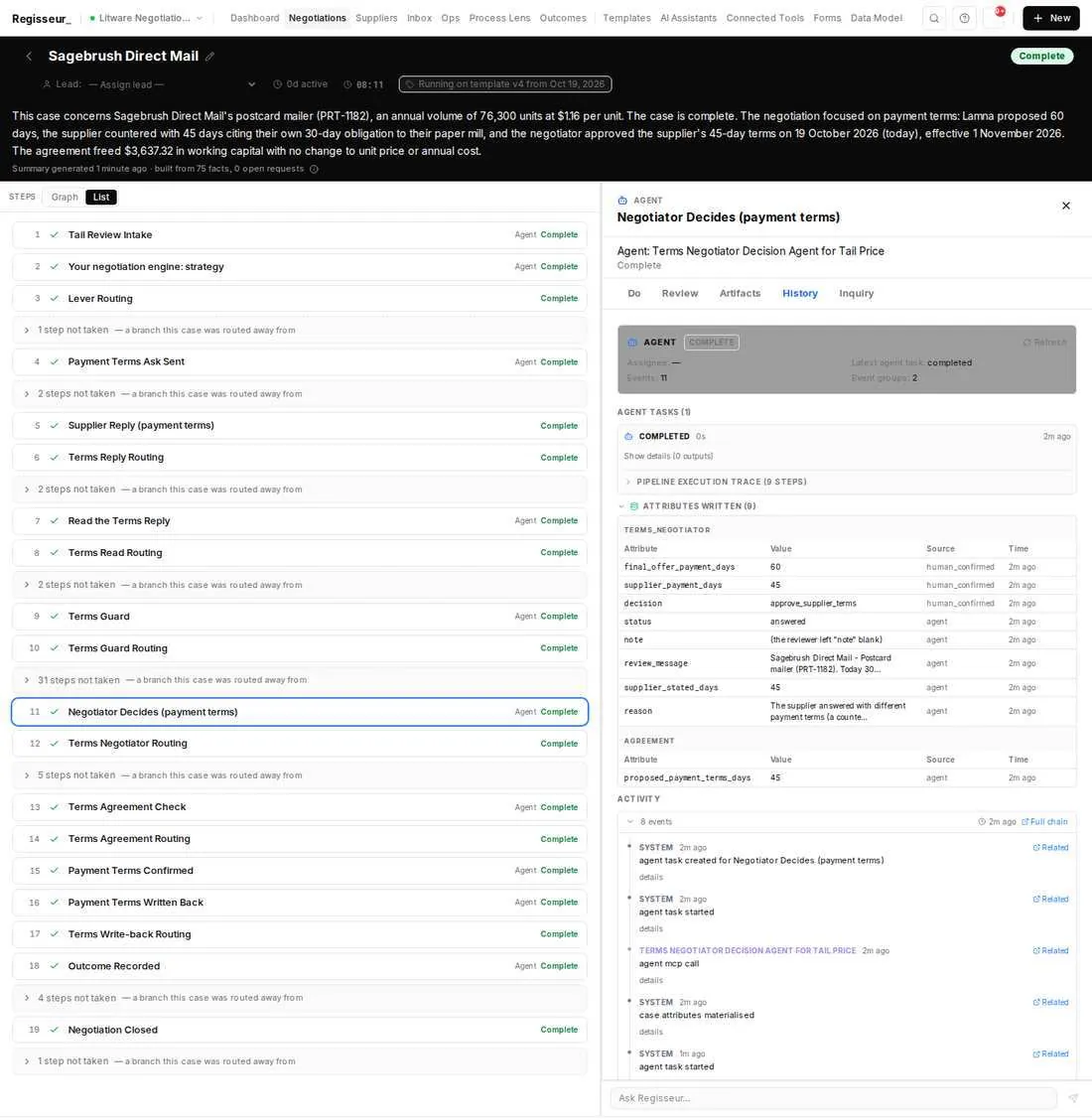
The negotiator approved the supplier's 45 days, and the decision is recorded on the step. The case header sums it up: 45-day terms from 1 November 2026, $3,637.32 of working capital freed, price unchanged.
8. Wrap-up
The value across all cases, each kind counted on its own, and which agents work alone and which are still supervised: trust is earned separately for each kind of supplier conversation.
Outcomes, and autonomy earned per kind of conversation

The Outcomes page across all 24 cases: $79,364.86 a year in negotiated price reductions, $1,300.56 already landed on invoices, $461.53 in credits requested, $706.56 a year of cost avoided and $5,281.16 of cash freed, each in its own column, never added together.

The payment-terms reading agent, by contrast with the agent promoted in chapter 2: 100 % of its readings are sent to a person, and every result is checked before it is used, until it earns the same trust.
Run your process the same way.
Bring one process you run every week. We map it with you: the steps, the decisions that stay with a person, and what agents would do.