Retailer deductions, worked to cash. Autonomy earned, then pulled back.
Regisseur works around your own detection engine. Agents take in each deduction, check it against the rules, gather the evidence, chase what is missing, file the dispute, follow up and reconcile the cash; auditors decide whatever needs judgment. An agent works alone on a kind of claim only once its record earns it, and goes back under review the moment auditors disagree.
- Agents analyse, gather evidence, ask, file and reconcile
- Auditors and the audit lead decide what needs judgment, and what runs alone
- The supplier and the retailers send paperwork and decide disputes
- EarnedA shortage filed with no person
- TimingHeld until the retailer allows a dispute
- MissingThe supplier is asked for a document
- JudgmentOver the cap, no agreement on file
- ValidA fine that was fair
- RulesA retailer changes a rule
- About this run
- A revenue-recovery firm works 18 retailer deductions for a food supplier across Walmart, Target and Amazon. Your own detection engine plugs in at one step; agents check each retailer’s rules, assemble the evidence, chase the supplier for a missing price approval, file and reconcile. The shortage analyst earns autonomy after 11 reviews at 100% and files two disputes with no person at any step. A $7,850 promotional deduction always goes to an auditor. When Walmart changes its rule, the audit lead puts the analyst back under review with one recorded action.
- Measured
- 18 deductions · 16 disputes filed, 15 by the agent · 2 with no human at any step · 0.89 human touches per case · median 1.2 min from opened to filed.
- Who decides
- Auditors approve every supervised recommendation. Over-cap promotional deductions with no agreement always go to a person. Autonomy is earned per claim family and comes back under review with one recorded action.
- Systems
- Your detection engine (one typed tool call) · retailer rules register · retailer portals · supplier upload link · audit export.
- On the record
- Retailer decisions and payments are simulated, so the recovered dollars show a case handled through to cash, not a win rate. The detection engine is a stand-in with scripted scores. One 30-day hold was released by running the timer as if 427 hours had passed. Fictional firm, supplier and data; all email went to a test inbox.
What this accomplishes
Eighteen deductions came in from three retailers. Sixteen were disputed and fifteen reached cash: $9,905 recovered of the $10,086 disputed ($16,027 deducted in all). The median case went from opened to filed in 1.2 minutes, with fewer than one human touch per case (16 across 18 cases, none on the two that ran autonomously). The agents assembled the evidence, chased the missing paperwork, filed, followed up and reconciled; auditors stepped in only where judgment was needed, and every decision is on the record with who made it. The detection engine that decides what is wrong is the firm’s own; the platform is everything after that decision.
Retailer decisions in this demo are simulated, so the recovery figure is not a win rate.
1The result at a glance
Proseware Recovery, a revenue-recovery firm, worked 18 deductions for its supplier client Northwind Foods across Walmart, Target, Amazon. Every figure below comes from the case records and agrees with the Outcomes dashboard.
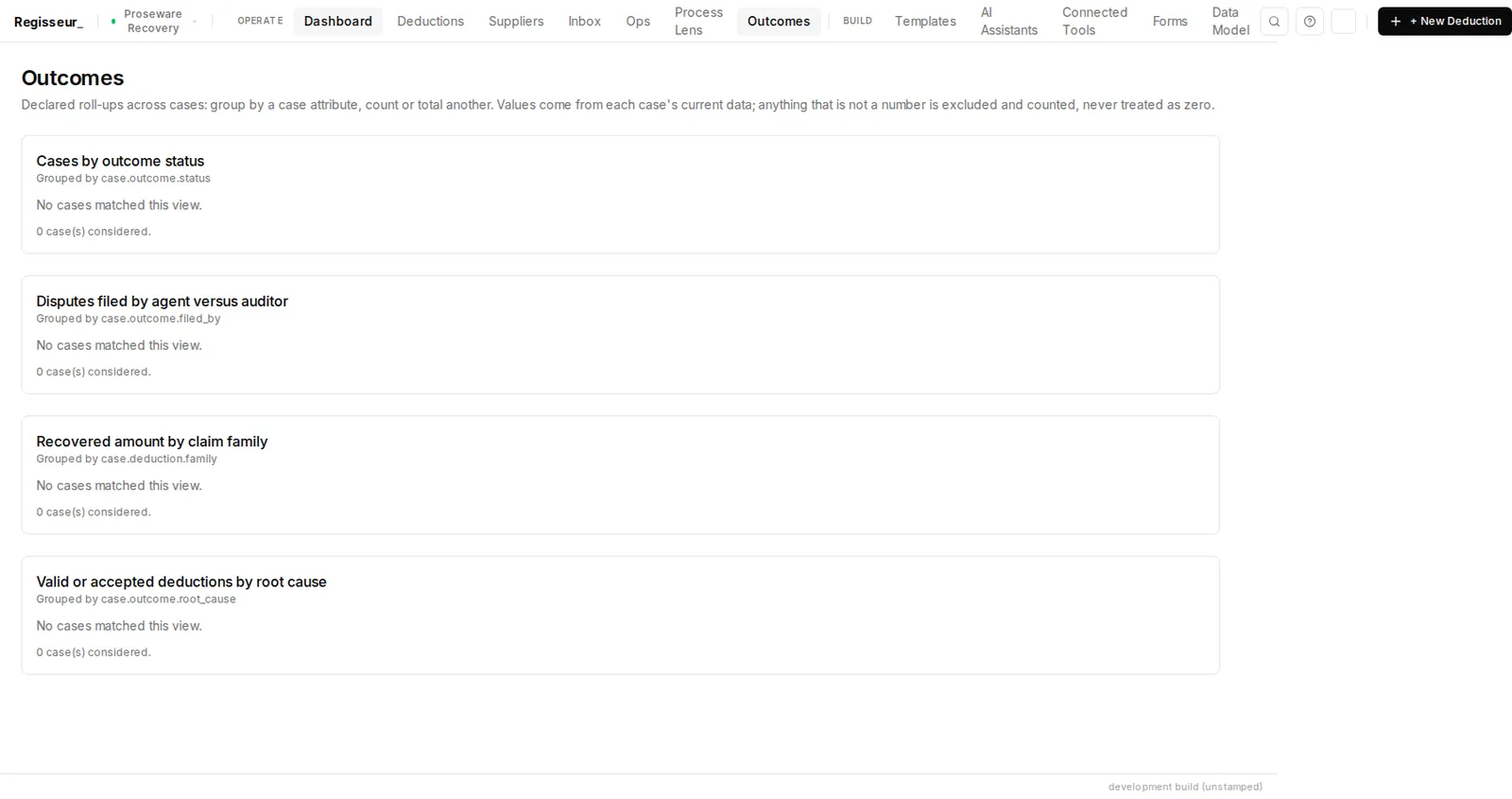
Two things are deliberately not claimed: days to cash (the demo applies the retailer decision and the payment within minutes, so any figure would be meaningless) and a win rate (every retailer decision here is simulated).
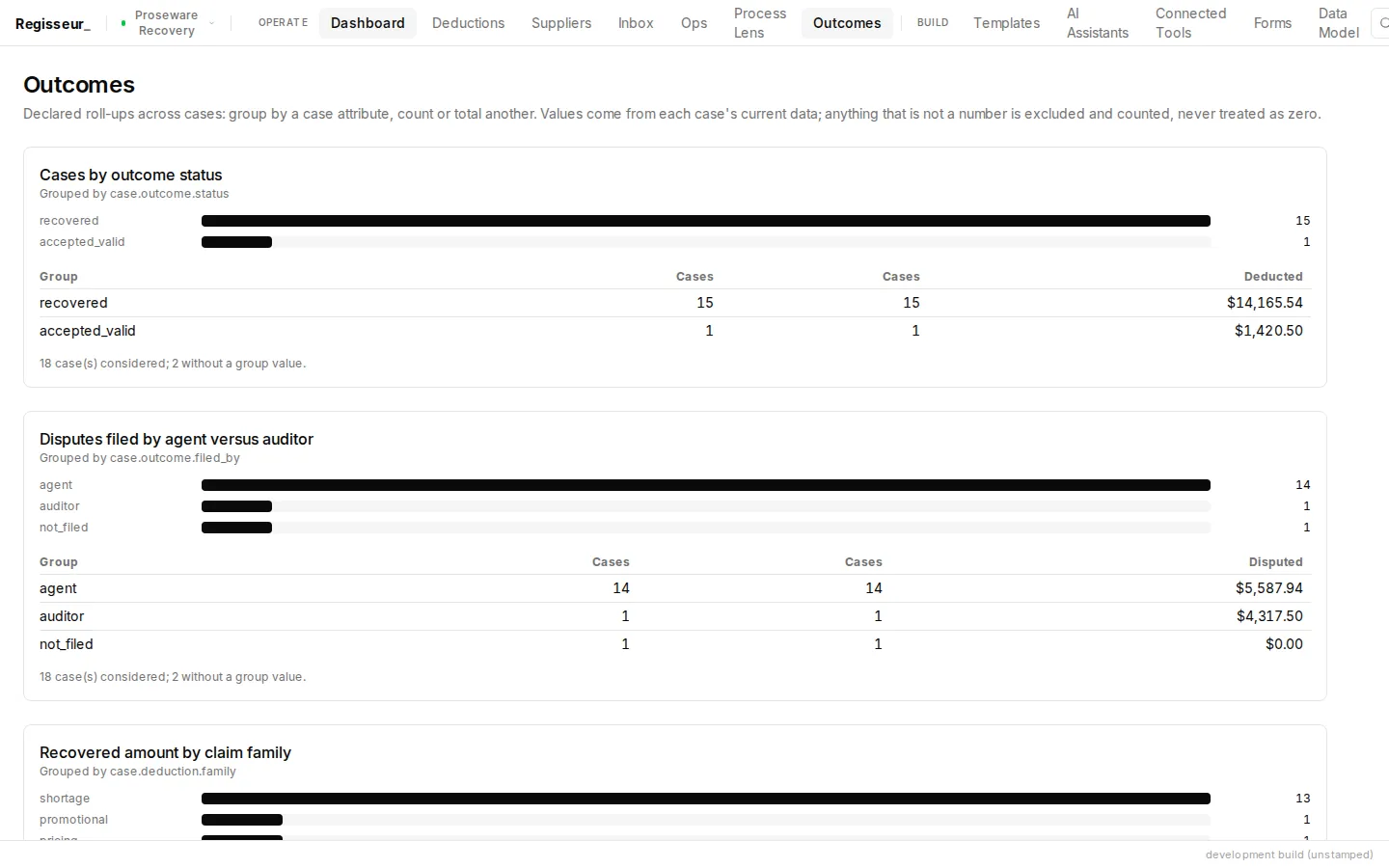
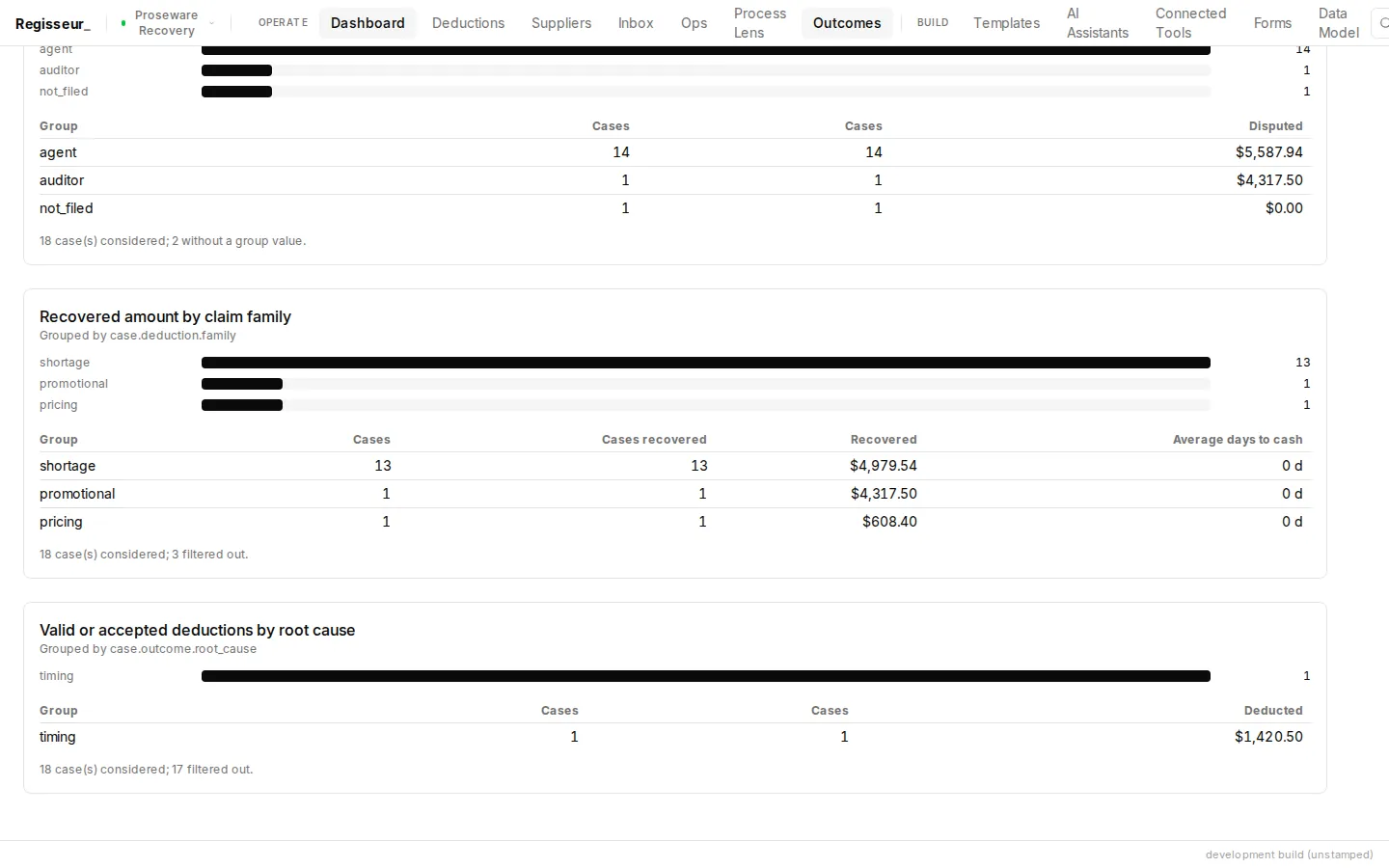
Every case in the run
| Case | Retailer / code | Family | Deducted | Disputed | Portal ref | Filed by | Human touches | Recovered | State |
|---|---|---|---|---|---|---|---|---|---|
| DED-W-01 | Walmart WM-SHORT-01 | shortage | $153.12 | $153.12 | PRT-1001 | agent | 1 | $153.12 | Recovered |
| DED-W-02 | Target TG-SHORT-21 | shortage | $129.00 | $129.00 | PRT-1002 | agent | 1 | $129.00 | Recovered |
| DED-W-03 | Walmart WM-SHORT-01 | shortage | $322.50 | $322.50 | PRT-1003 | agent | 1 | $322.50 | Recovered |
| DED-W-04 | Target TG-SHORT-21 | shortage | $442.00 | $442.00 | PRT-1004 | agent | 1 | $442.00 | Recovered |
| DED-W-05 | Walmart WM-SHORT-01 | shortage | $257.40 | $257.40 | PRT-1005 | agent | 1 | $257.40 | Recovered |
| DED-W-06 | Target TG-SHORT-21 | shortage | $842.40 | $842.40 | PRT-1006 | agent | 1 | $842.40 | Recovered |
| DED-W-07 | Walmart WM-SHORT-01 | shortage | $316.80 | $316.80 | PRT-1007 | agent | 1 | $316.80 | Recovered |
| DED-W-08 | Target TG-SHORT-21 | shortage | $218.40 | $218.40 | PRT-1008 | agent | 1 | $218.40 | Recovered |
| DED-W-09 | Walmart WM-SHORT-01 | shortage | $442.00 | $442.00 | PRT-1009 | agent | 1 | $442.00 | Recovered |
| DED-W-10 | Target TG-SHORT-21 | shortage | $178.64 | $178.64 | PRT-1010 | agent | 1 | $178.64 | Recovered |
| DED-W-11 | Walmart WM-SHORT-01 | shortage | $316.80 | $316.80 | PRT-1011 | agent | 1 | $316.80 | Recovered |
| DED-S1-0001 | Walmart WM-SHORT-01 | shortage | $612.48 | $612.48 | PRT-1012 | agent | 0 | $612.48 | Recovered |
| DED-S2-0001 | Amazon AZ-SHORT-11 | shortage | $1,148.00 | $748.00 | PRT-1013 | agent | 0 | $748.00 | Recovered |
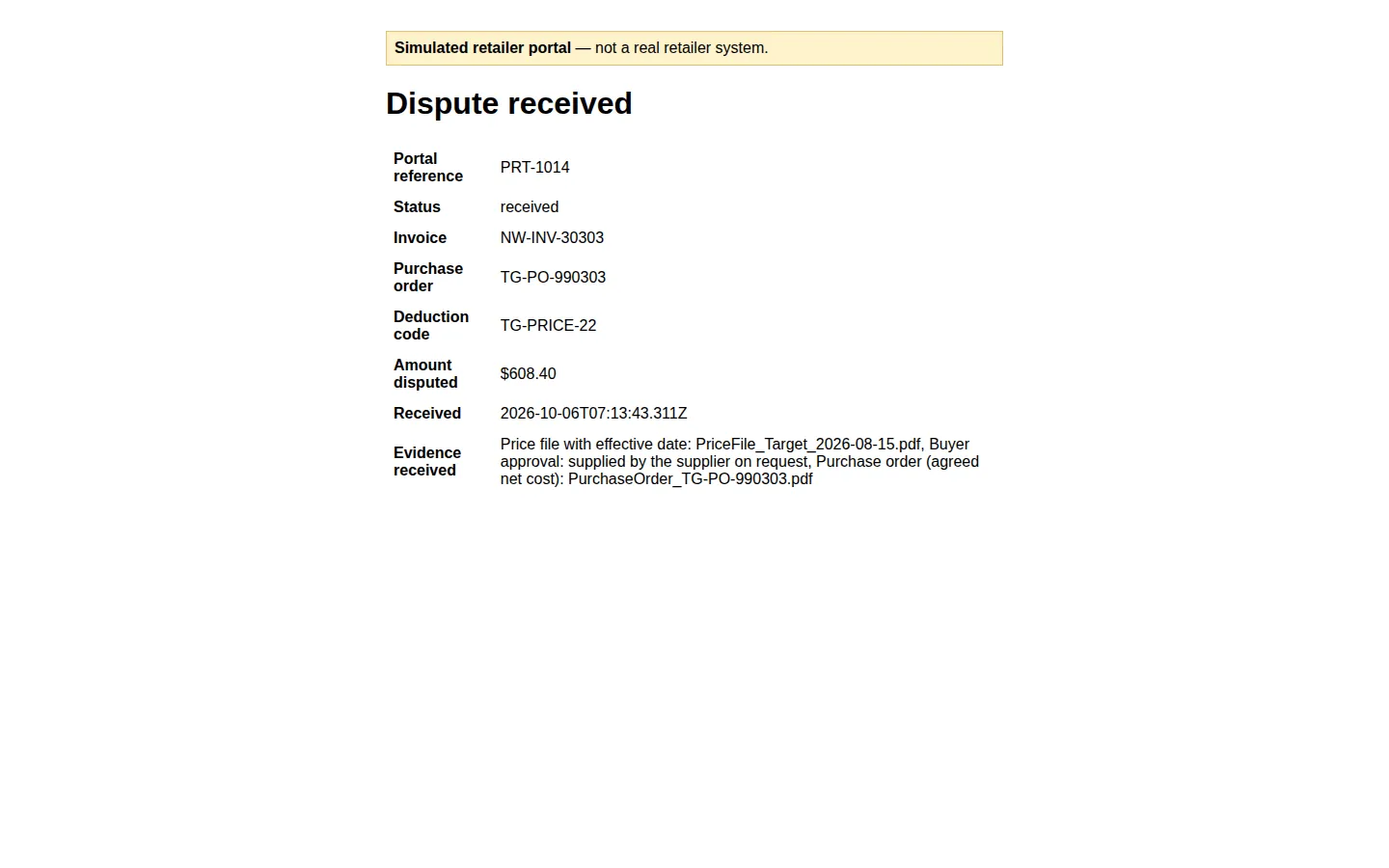
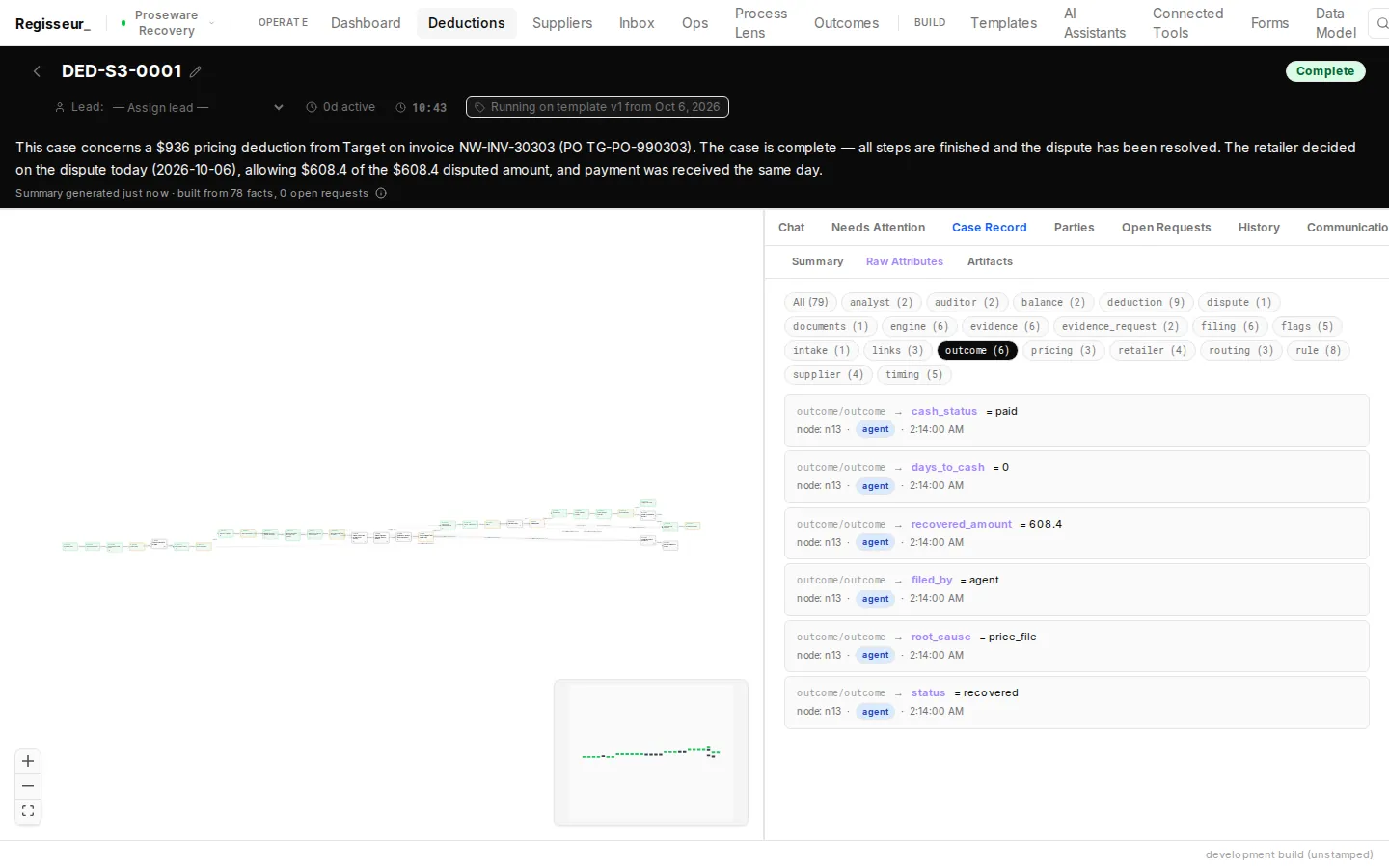
| DED-S3-0001 | Target TG-PRICE-22 | pricing | $936.00 | $608.40 | PRT-1014 | agent | 1 | $608.40 | Recovered |
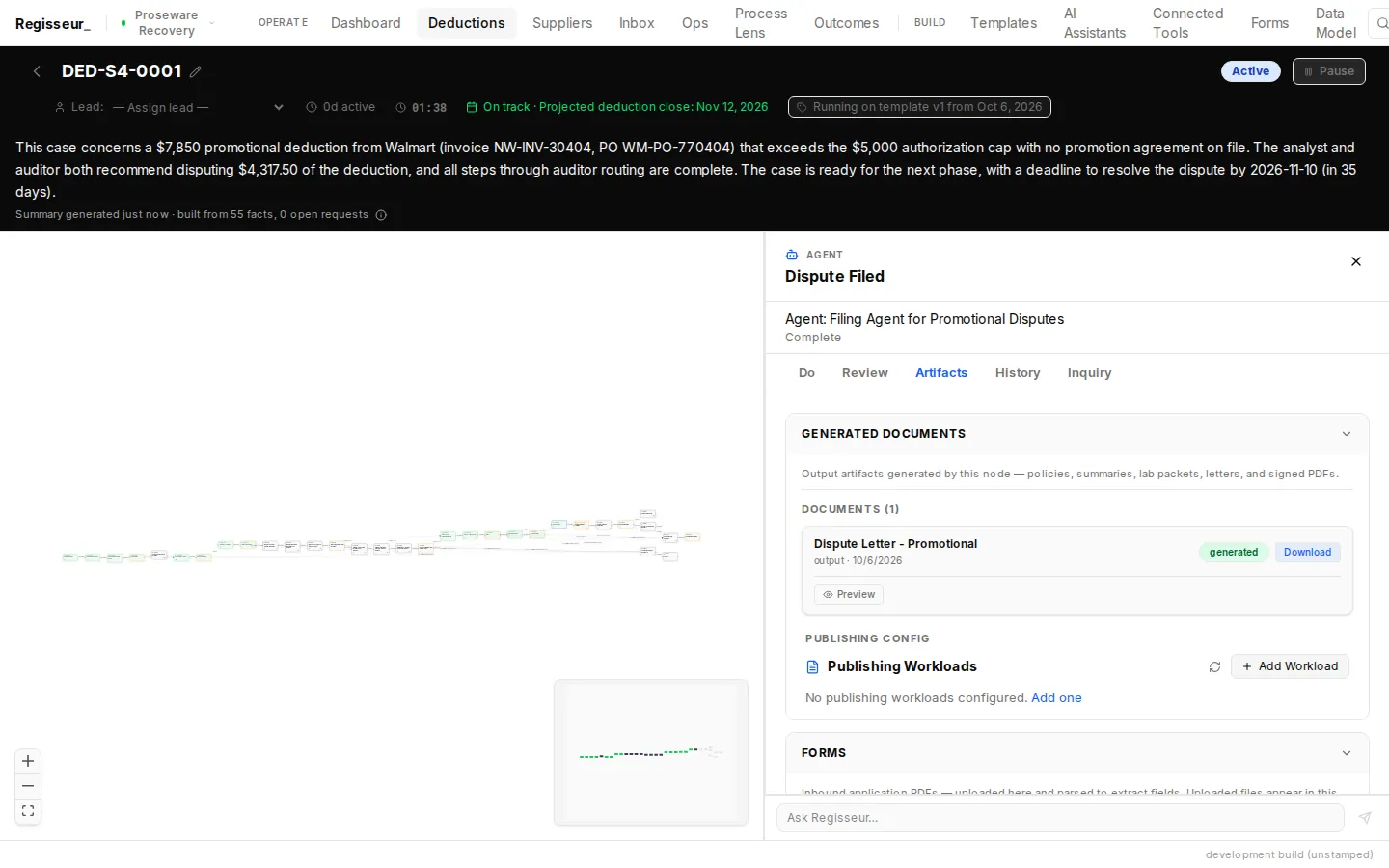
| DED-S4-0001 | Walmart WM-PROMO-03 | promotional | $7,850.00 | $4,317.50 | PRT-1015 | auditor | 2 | $4,317.50 | Recovered |
| DED-S5-0001 | Target TG-OTIF-24 | otif | $1,420.50 | - | - | - | 1 | - | Accepted as valid |
| DED-R-02 | Walmart WM-SHORT-01 | shortage | $260.54 | - | - | - | 0 | - | Chasing supplier documents |
| DED-R-01 | Walmart WM-SHORT-01 | shortage | $180.14 | $180.14 | PRT-1016 | agent | 1 | - | Retailer won; awaiting payment |
| Total | $16,026.72 | $10,085.58 | 16 | $9,905.44 | |||||
A "human touch" is an auditor reviewing the analyst's recommendation or submitting a decision. Cross-checked at build: 7 figures from the shipped Outcome views (deduction-recovery-all.json outcomeViews) equal the same figures derived from case attributes.
2Your detection engine plugs in here
The second step of every case is labelled "Your detection engine". Your firm's own detection engine is called once per case through a typed tool interface, and what it returns is written onto the case. Nothing downstream depends on how the score is produced, so the engine you already have is the engine that plugs in.
- Validity score (0 to 1: how likely the retailer is right)
- Primary reason (short code, shown to the analyst)
- Recoverable amount (dollars)
- Family and retailer code (routes the case to the right workflow)
- Source: stamped on every record so the case shows where the number came from
| Case | Retailer code | Primary reason | Validity score | Recoverable | Source label on the record |
|---|---|---|---|---|---|
| DED-W-01 | WM-SHORT-01 | receipt_count_differs_from_shipment | 0.12 | $153.12 | your detection engine |
| DED-W-02 | TG-SHORT-21 | receipt_count_differs_from_shipment | 0.12 | $129.00 | your detection engine |
| DED-W-03 | WM-SHORT-01 | receipt_count_differs_from_shipment | 0.12 | $322.50 | your detection engine |
| DED-W-04 | TG-SHORT-21 | receipt_count_differs_from_shipment | 0.12 | $442.00 | your detection engine |
| DED-W-05 | WM-SHORT-01 | receipt_count_differs_from_shipment | 0.12 | $257.40 | your detection engine |
| DED-W-06 | TG-SHORT-21 | receipt_count_differs_from_shipment | 0.12 | $842.40 | your detection engine |
| DED-W-07 | WM-SHORT-01 | receipt_count_differs_from_shipment | 0.12 | $316.80 | your detection engine |
| DED-W-08 | TG-SHORT-21 | receipt_count_differs_from_shipment | 0.12 | $218.40 | your detection engine |
| DED-W-09 | WM-SHORT-01 | receipt_count_differs_from_shipment | 0.12 | $442.00 | your detection engine |
| DED-W-10 | TG-SHORT-21 | receipt_count_differs_from_shipment | 0.12 | $178.64 | your detection engine |
| DED-W-11 | WM-SHORT-01 | receipt_count_differs_from_shipment | 0.12 | $316.80 | your detection engine |
| DED-S1-0001 | WM-SHORT-01 | pod_count_matches_asn | 0.08 | $612.48 | your detection engine |
| DED-S2-0001 | AZ-SHORT-11 | pod_count_matches_asn | 0.12 | $1,148.00 | your detection engine |
| DED-S3-0001 | TG-PRICE-22 | price_file_supports_invoice_price | 0.35 | $608.40 | your detection engine |
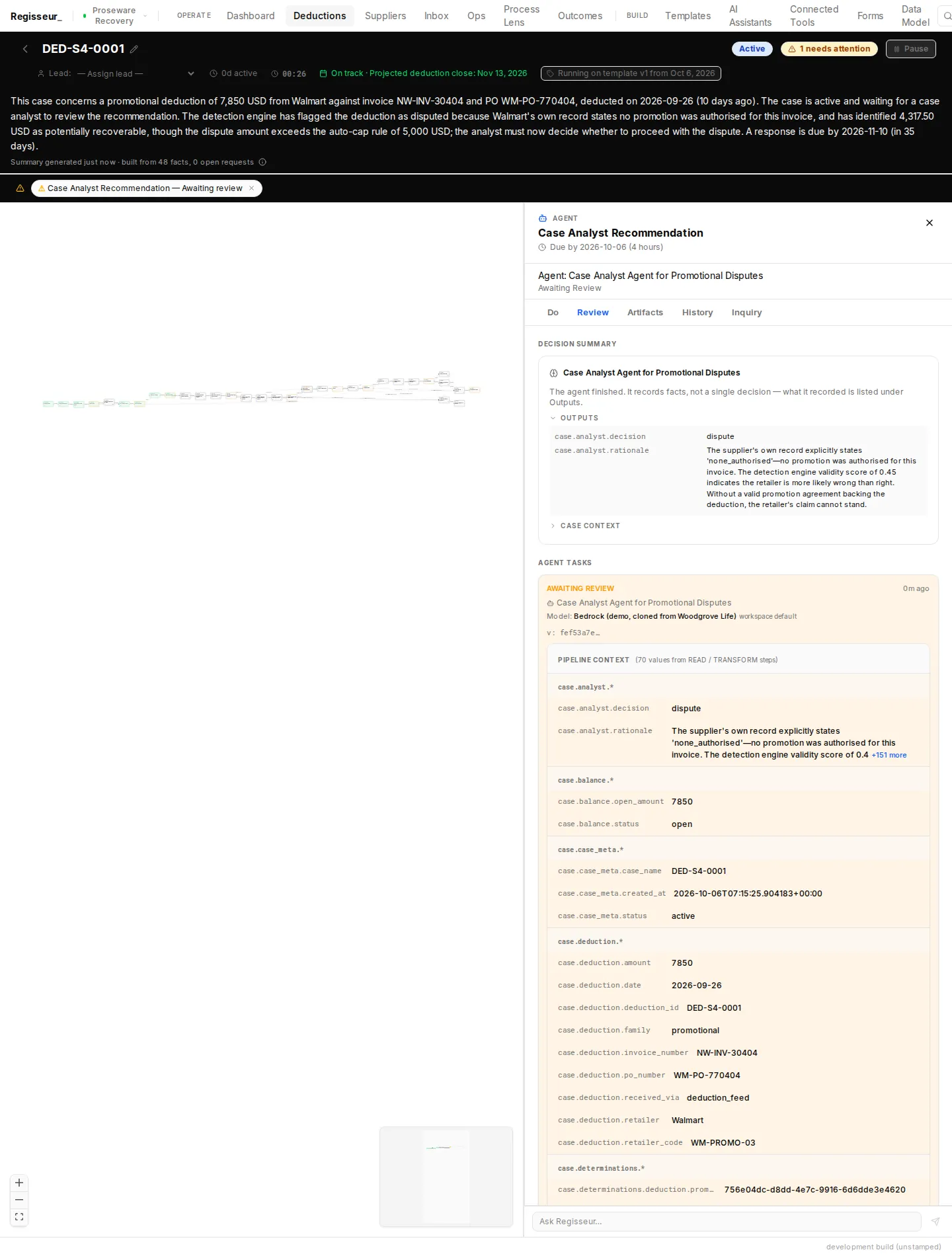
| DED-S4-0001 | WM-PROMO-03 | promotion_terms_not_verified | 0.45 | $4,317.50 | your detection engine |
| DED-S5-0001 | TG-OTIF-24 | delivery_outside_appointment_window | 0.93 | $0.00 | your detection engine |
| DED-R-02 | WM-SHORT-01 | receipt_count_differs_from_shipment | 0.1 | $260.54 | your detection engine |
| DED-R-01 | WM-SHORT-01 | receipt_count_differs_from_shipment | 0.1 | $180.14 | your detection engine |
In this demo the engine is a stand-in with fixed, scripted scores. The point being shown is the connection, not the quality of the scores.
3Autonomy is earned, case by case
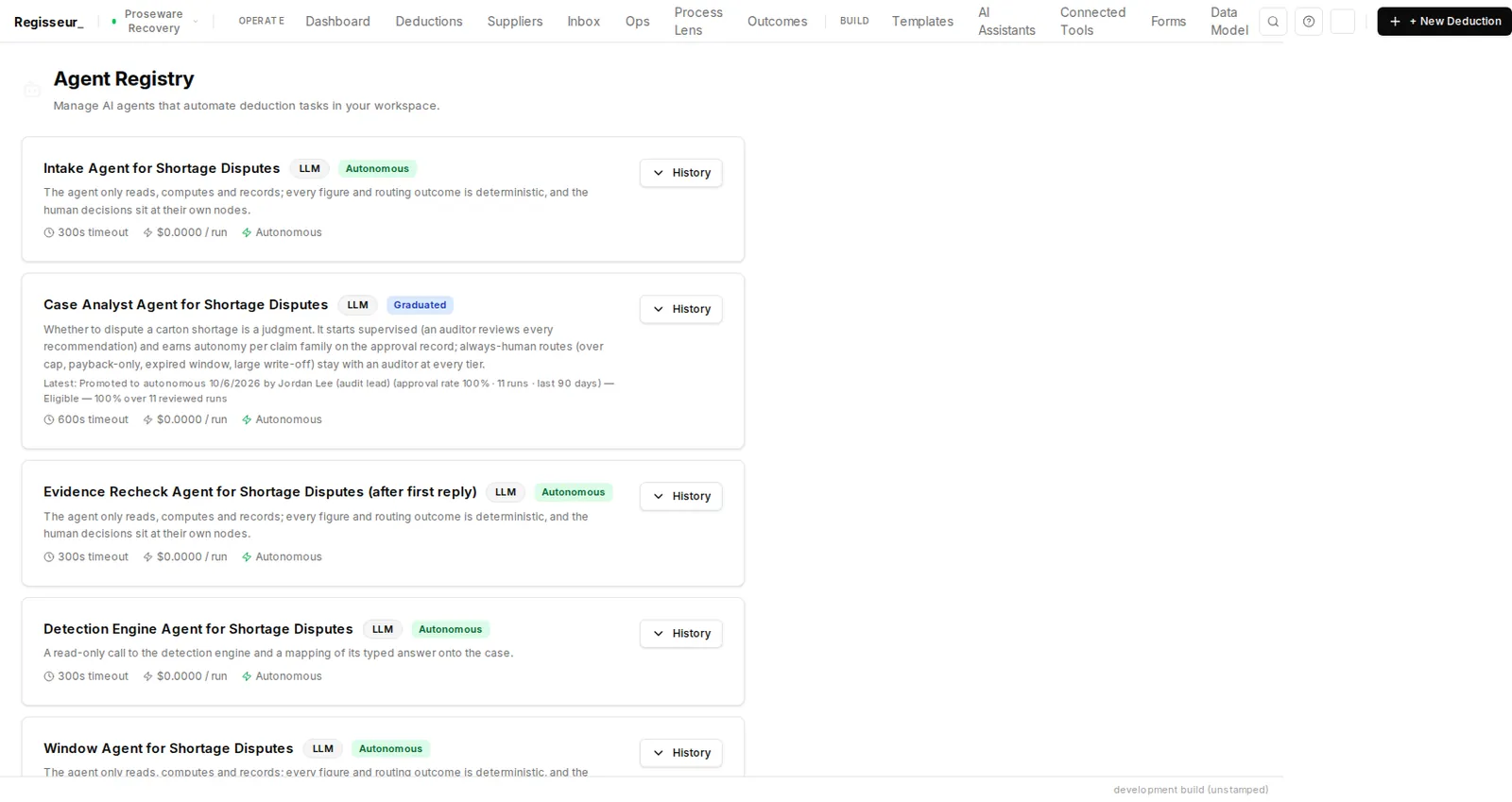
The shortage analyst started supervised: every recommendation waited for an auditor's approval. Eleven shortage cases ran through that review. Each was reviewed by an auditor, each was approved, each dispute was filed and reconciled.
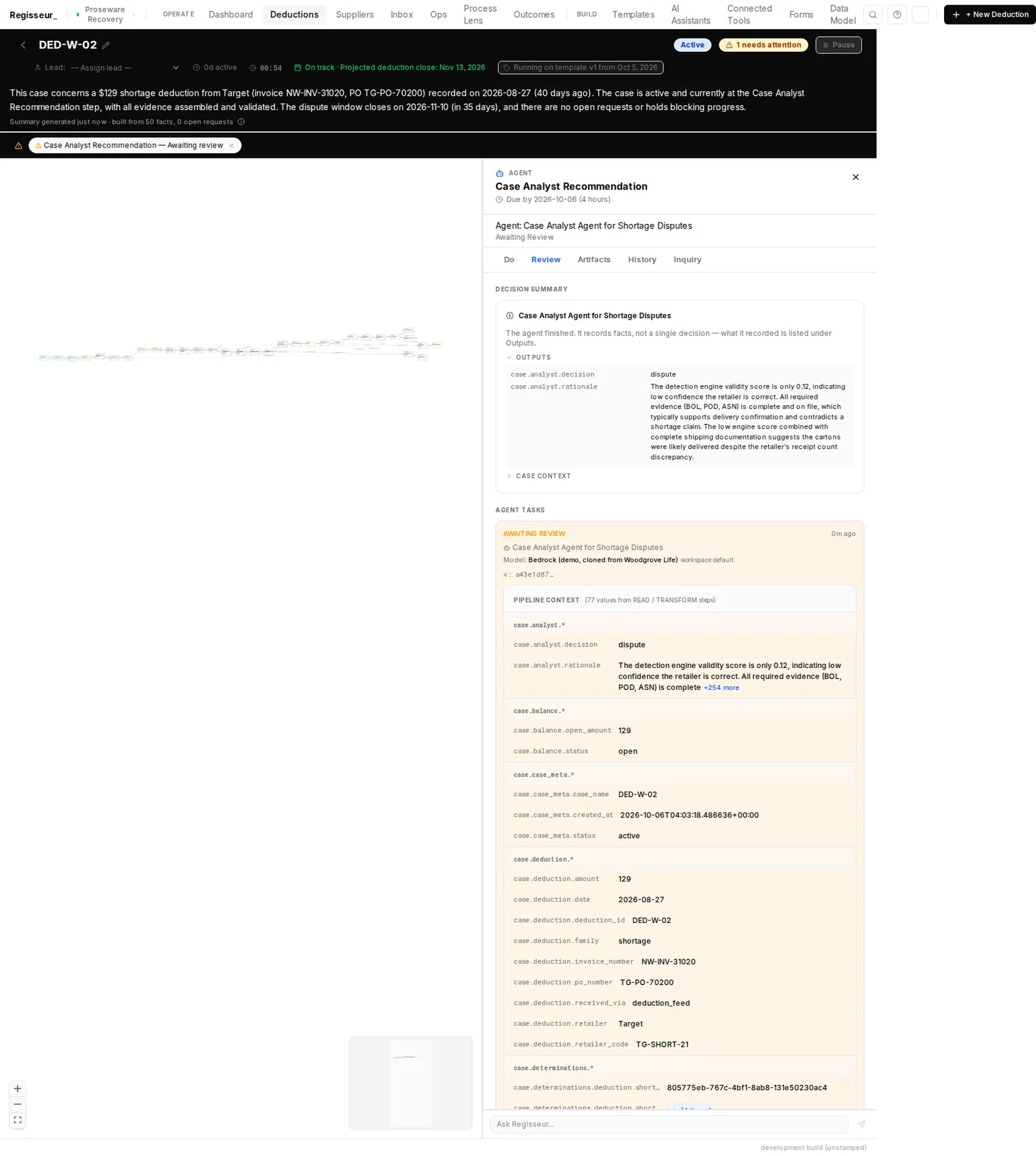
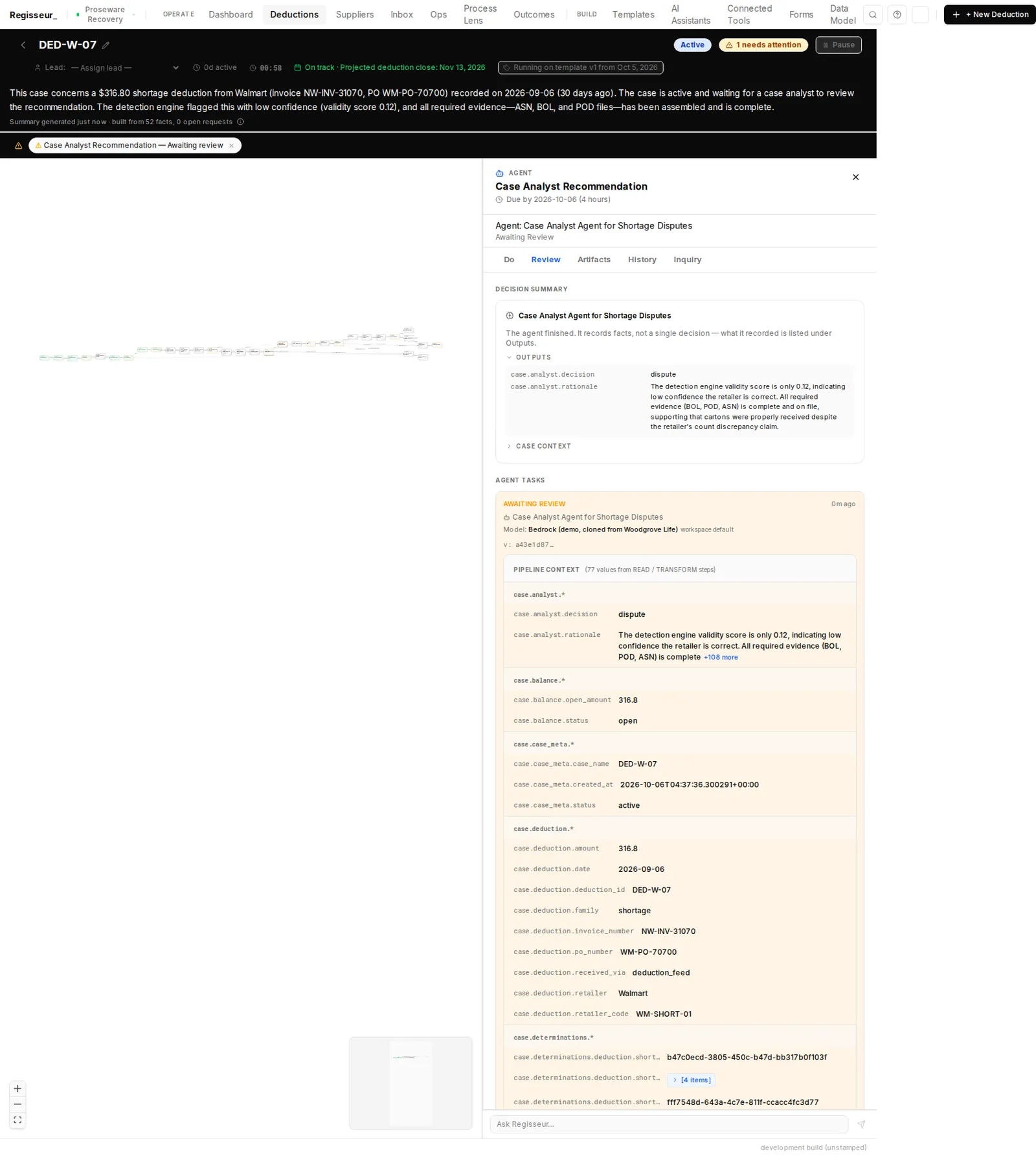
The earned promotion
| Reviewed runs in the window | 11 (minimum required: 10) |
|---|---|
| Approval rate | 100% (threshold 90%), last 90 days |
| Eligibility reading | Eligible - 100% over 11 reviewed runs |
| Promoted | 2026-10-06 05:26:42 UTC by the audit lead, Jordan Lee (an earned promotion, not an override) |
| Analyst version | a43e1d87-341d-4204-a9c4-a88b810226e5 (review required) → 0ed9f818-febc-4122-bec2-a842c0496f05 (review off) |
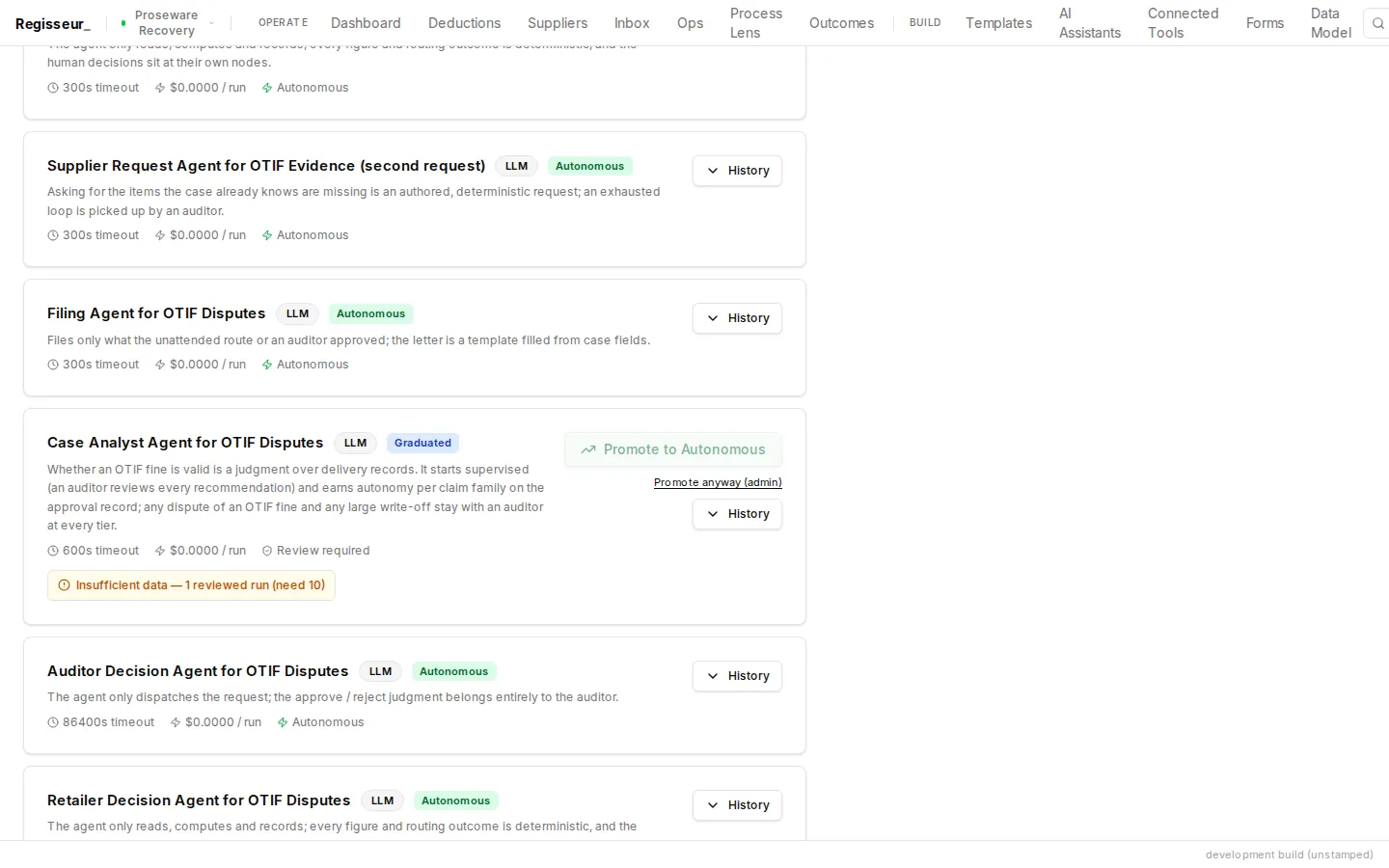
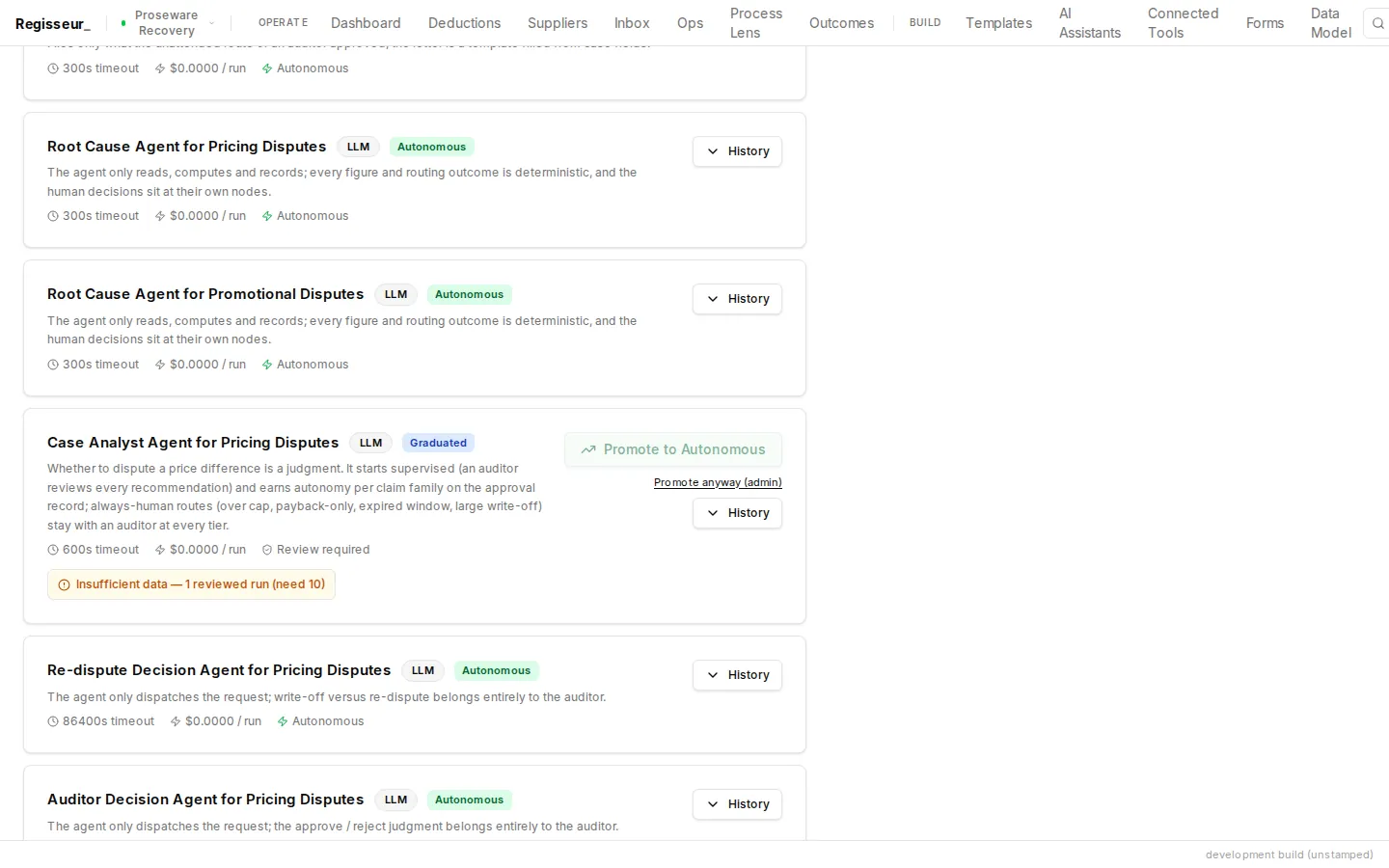
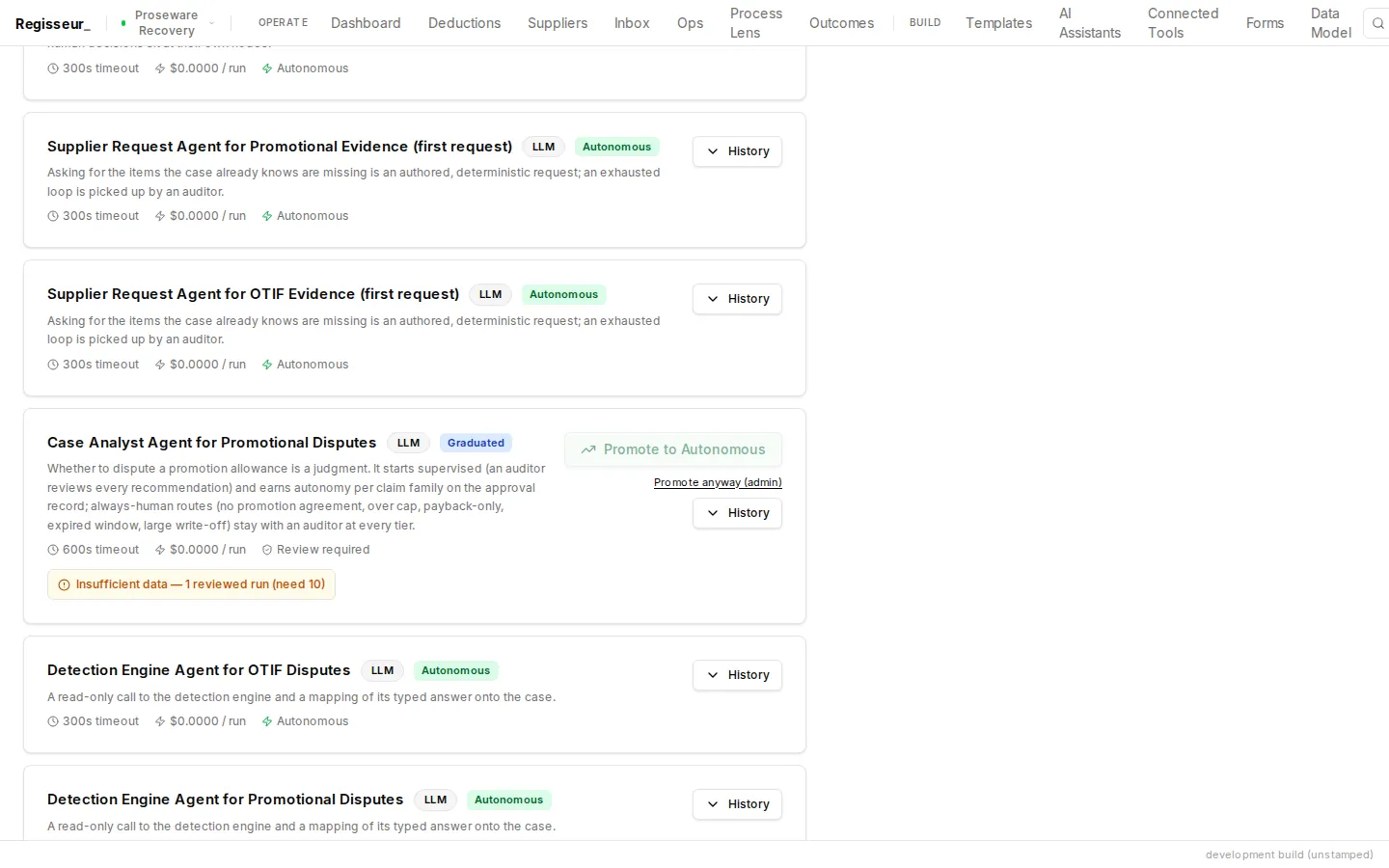
Autonomy is per claim family: the other three analysts (on-time-in-full, pricing, promotional) stay supervised until they earn it on their own record. An earlier promotion attempt did not complete because of a product defect that we then fixed; the history keeps the record of that attempt and of the successful promotion.

4Filing on its own, and waiting for the right moment
Scenario 1: a Walmart carton shortage, filed with no human
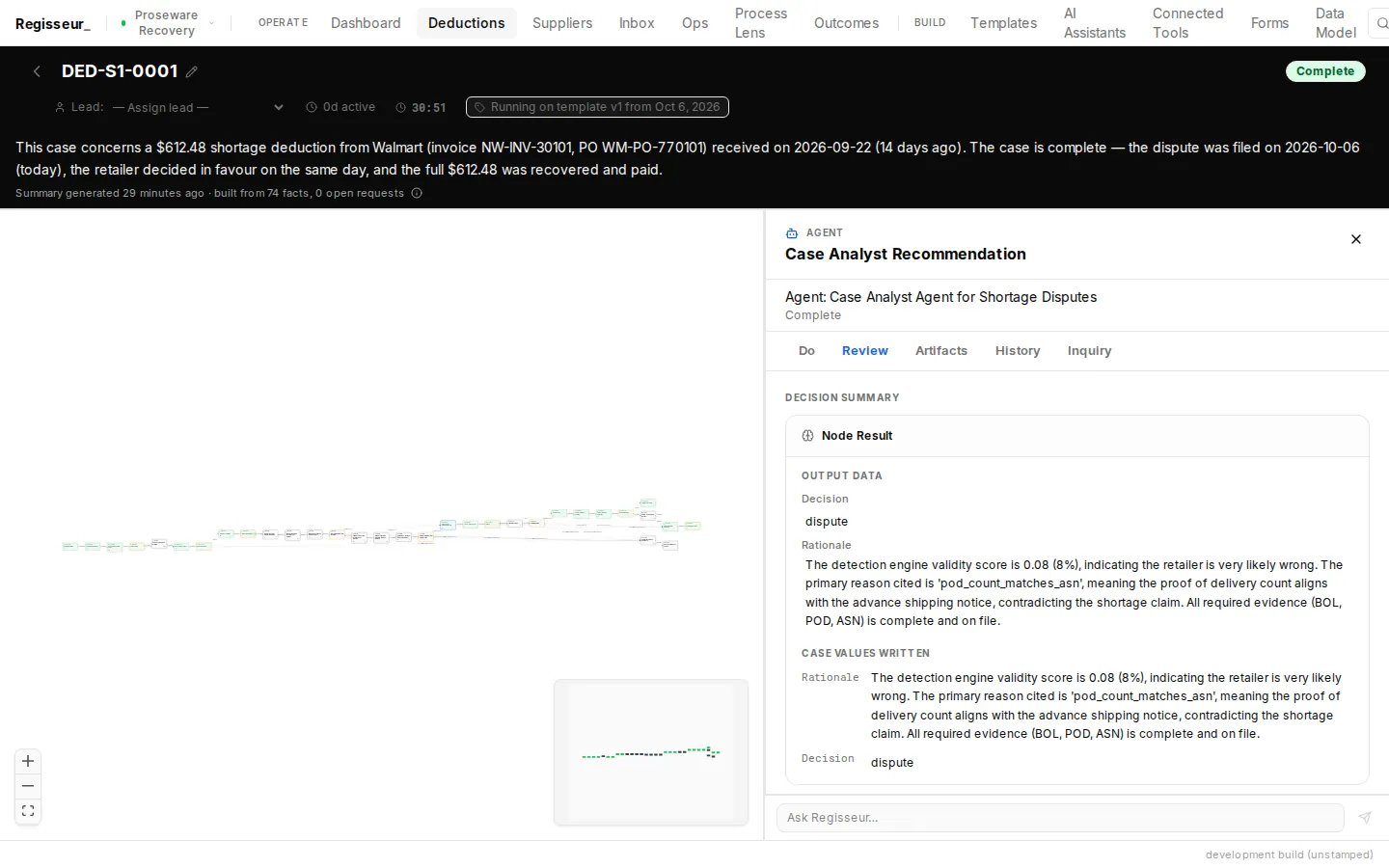
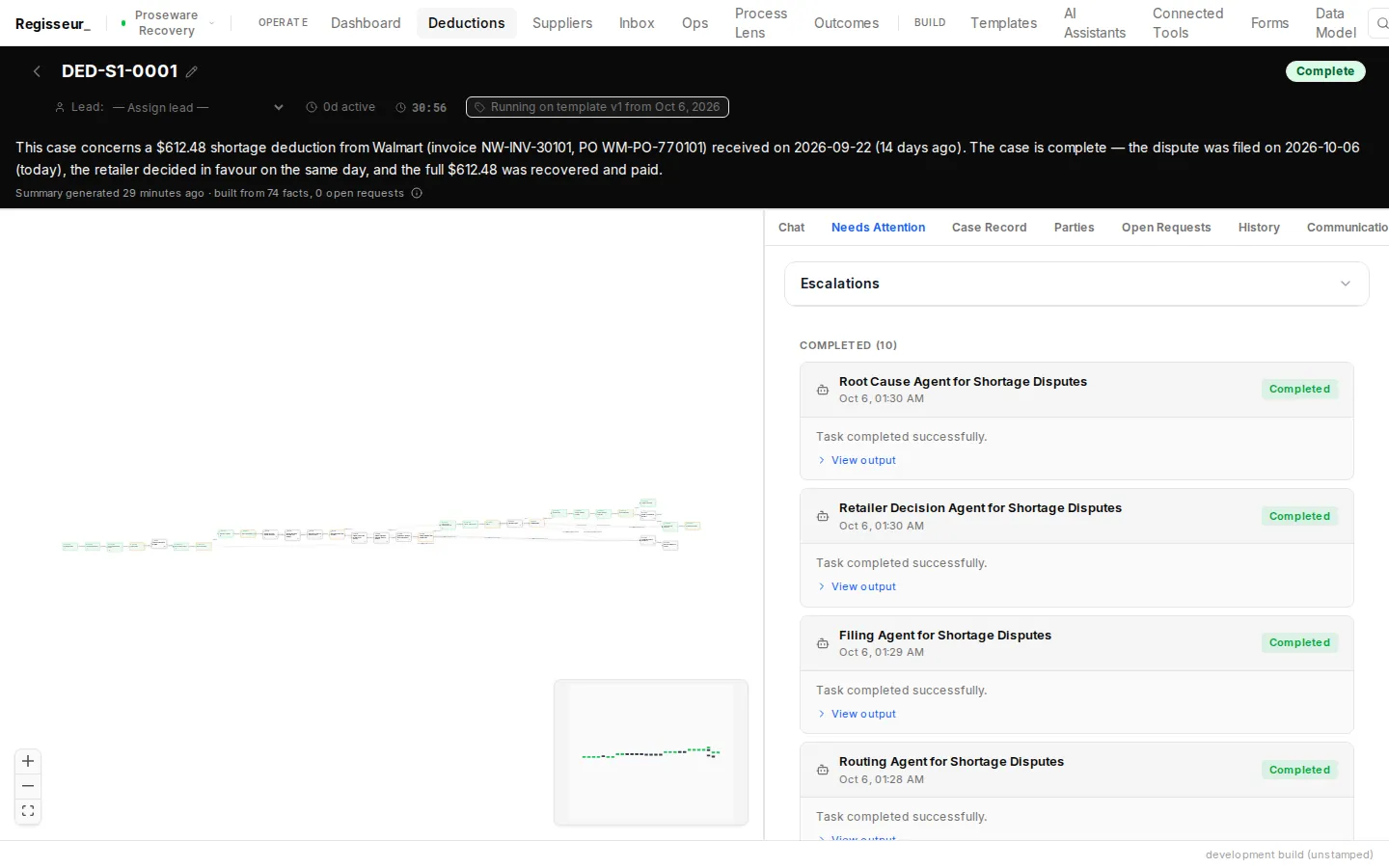
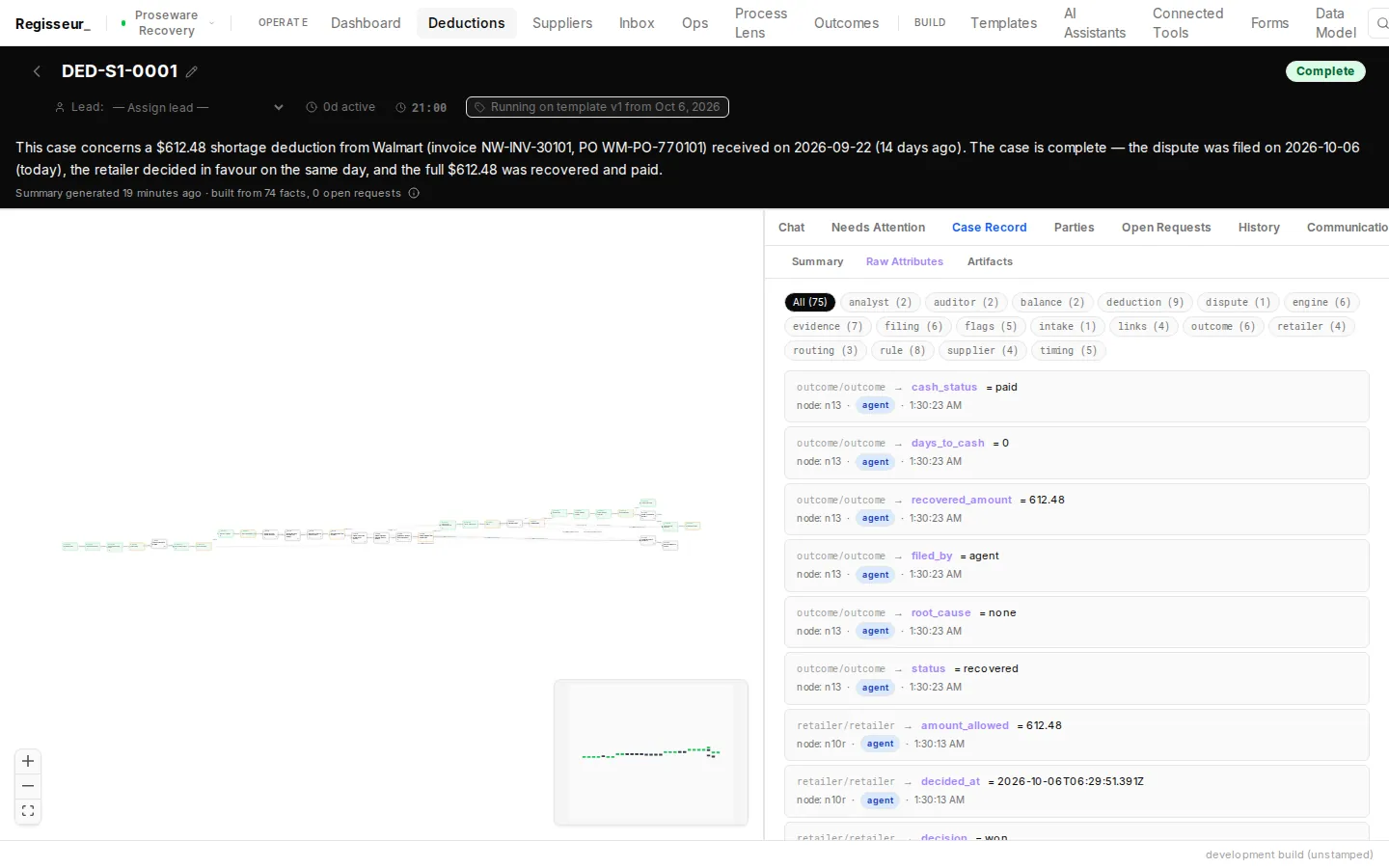
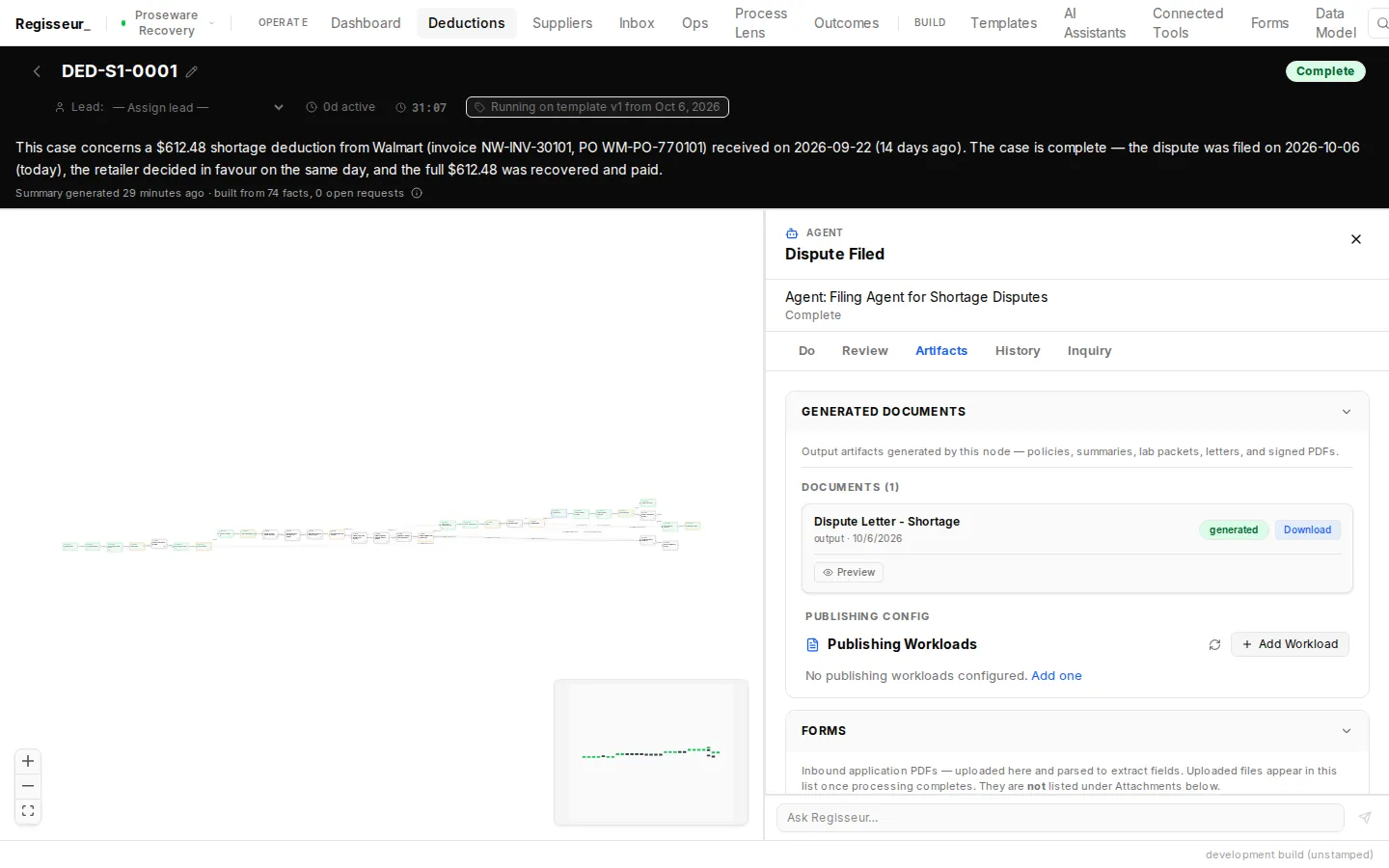
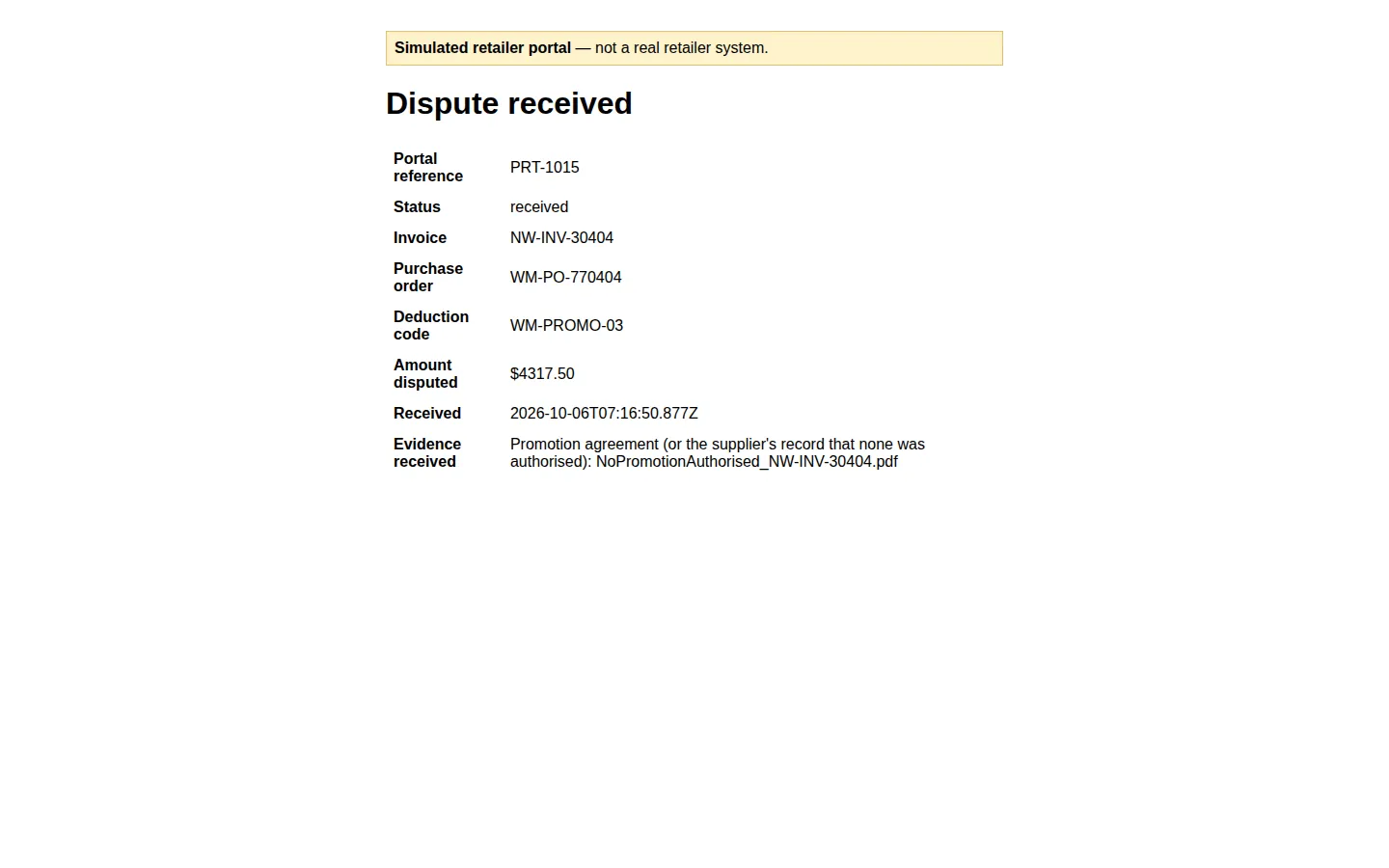
A $612.48 Walmart shortage arrived. The analyst, now earned-autonomous, recommended a dispute, the filing agent filed it with the retailer's portal, the retailer decided in favour, and the payment was matched: $612.48 recovered. No person touched the case. It was filed 43 seconds after it arrived.
What was filed, and what the retailer received
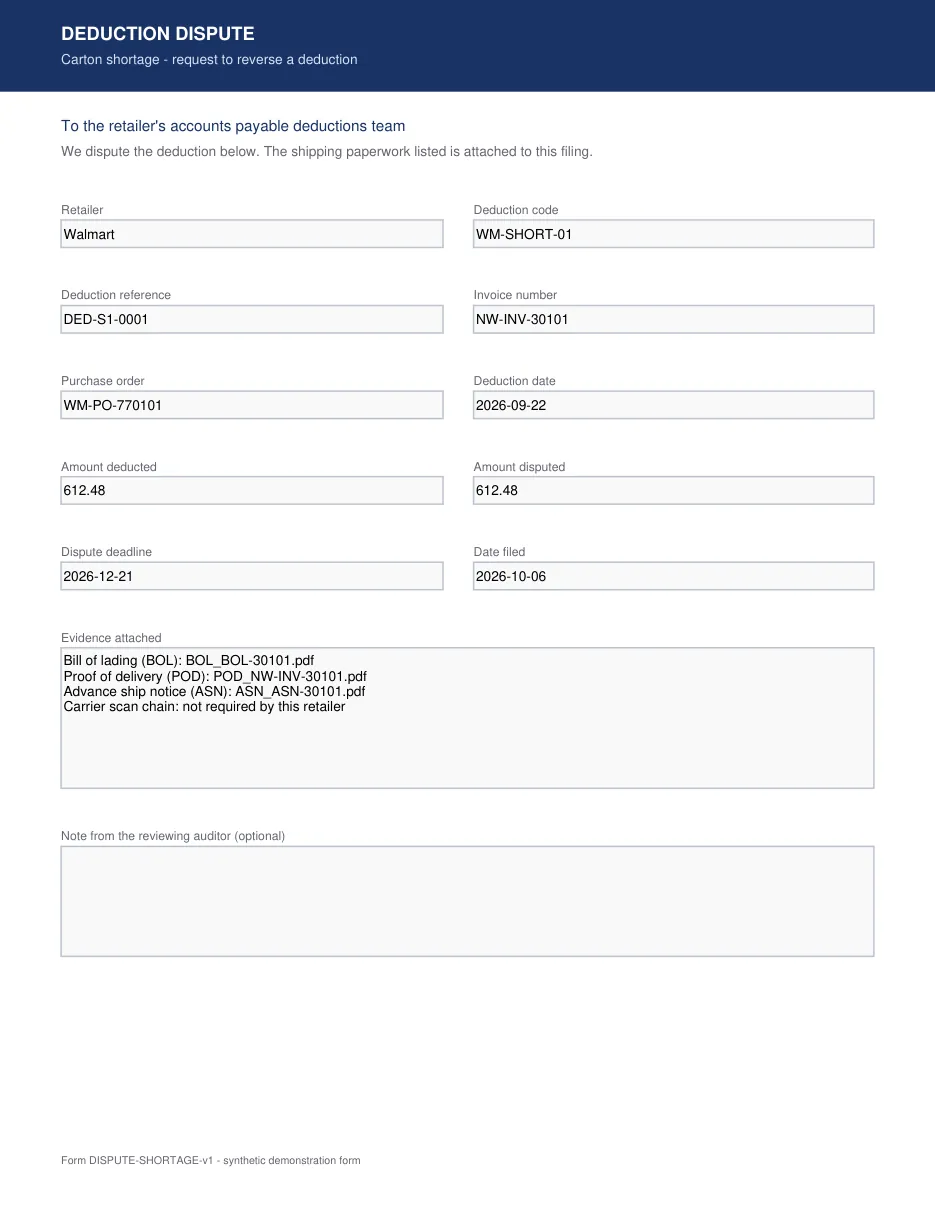
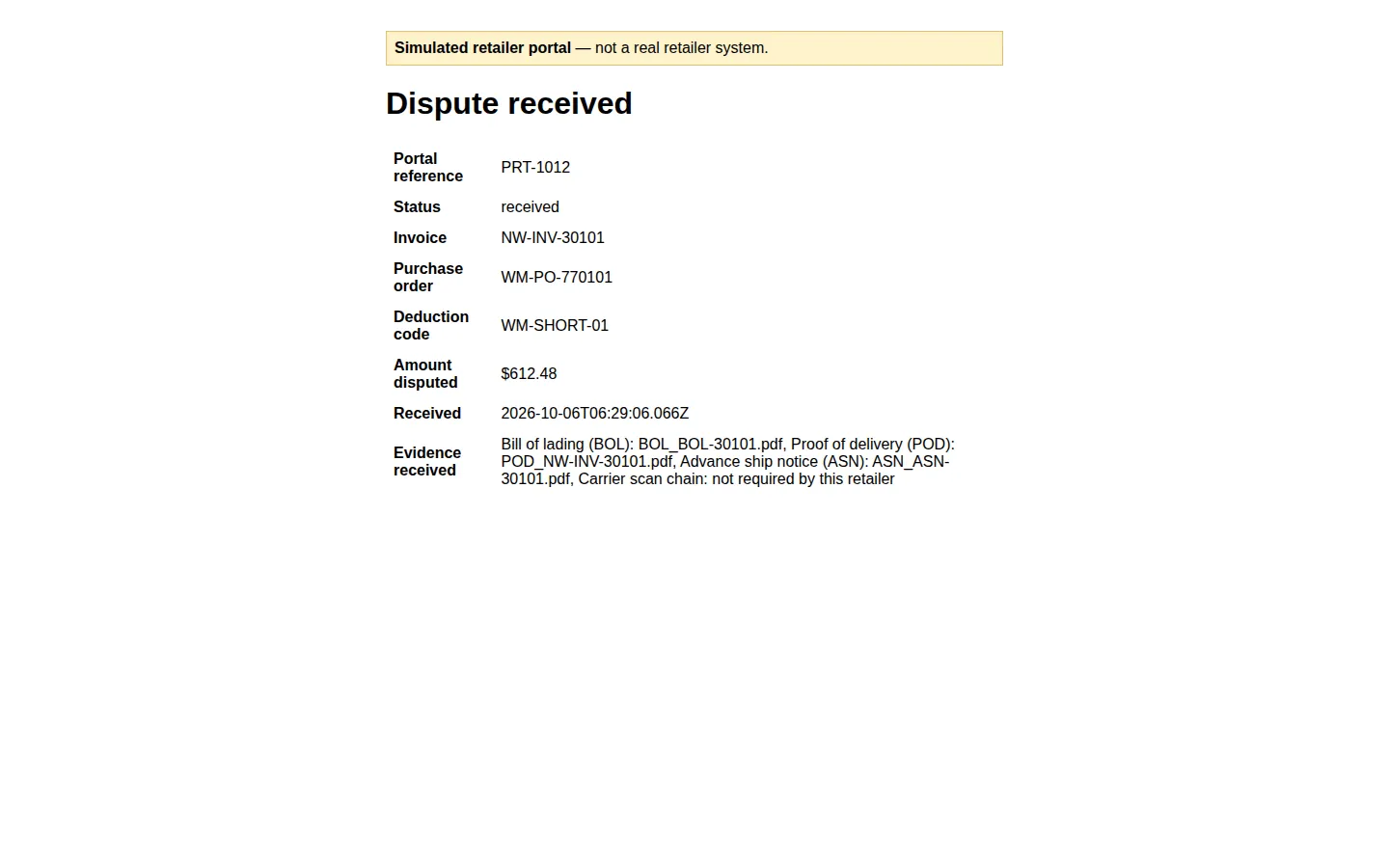
| Letter fields (the filing's recorded values) | |
|---|---|
| Filed by | agent |
| Filed date | 2026-10-06 |
| Portal reference | PRT-1012 |
| Evidence list | Bill of lading (BOL): BOL_BOL-30101.pdf Proof of delivery (POD): POD_NW-INV-30101.pdf Advance ship notice (ASN): ASN_ASN-30101.pdf Carrier scan chain: not required by this retailer |
| Auditor note | (none: no auditor was involved) |

Scenario 2: an Amazon shortage, held until the retailer allows disputes
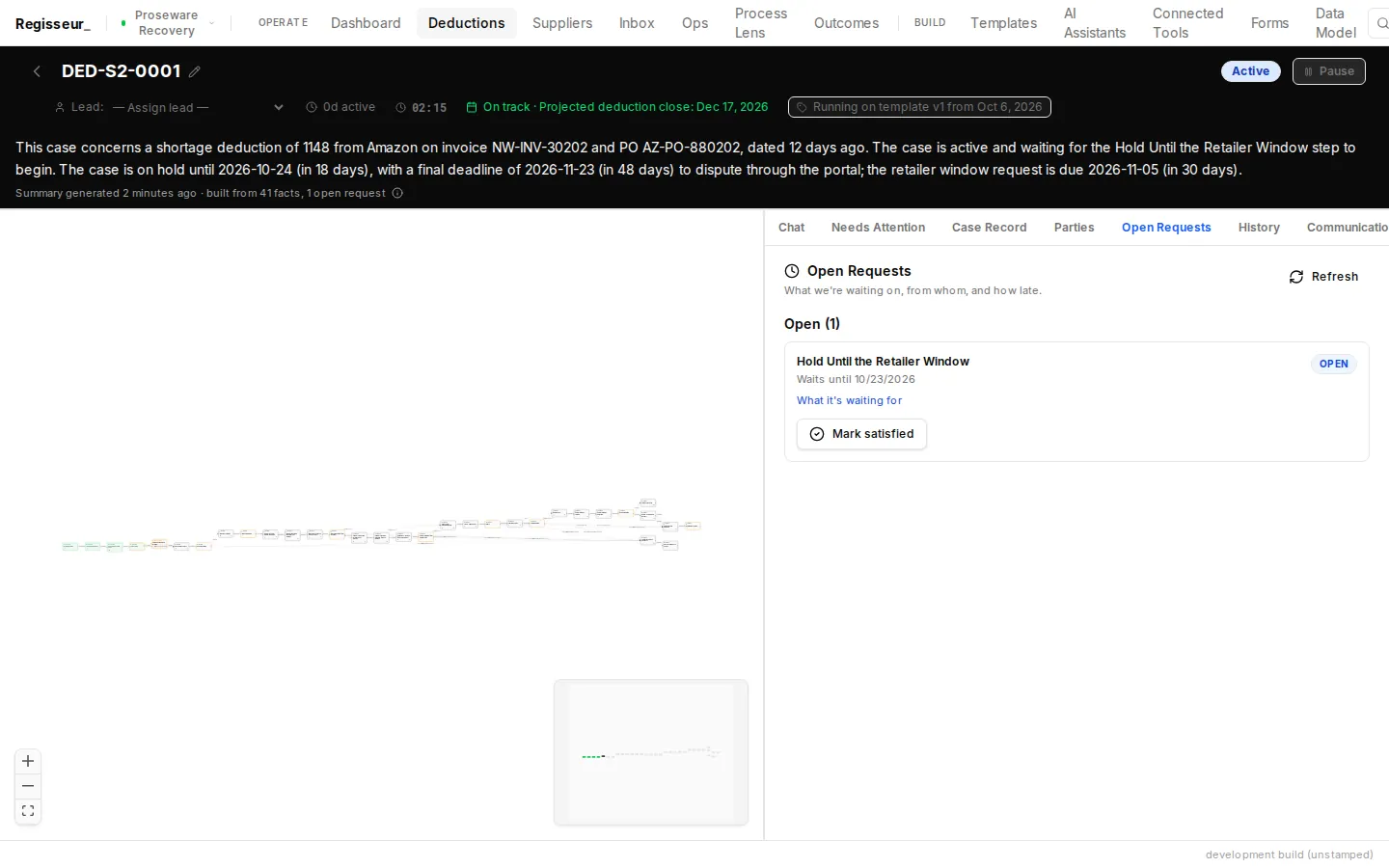
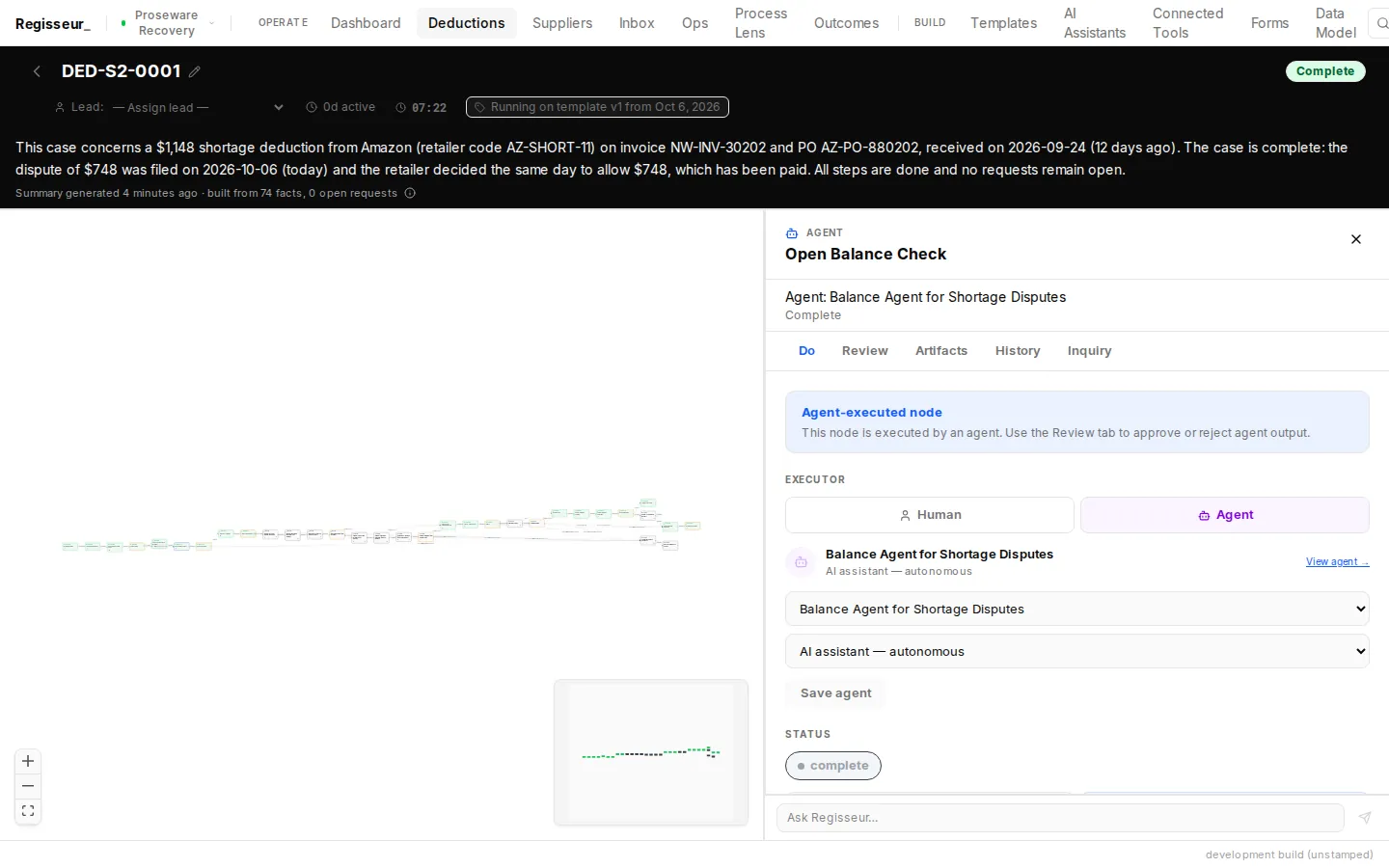
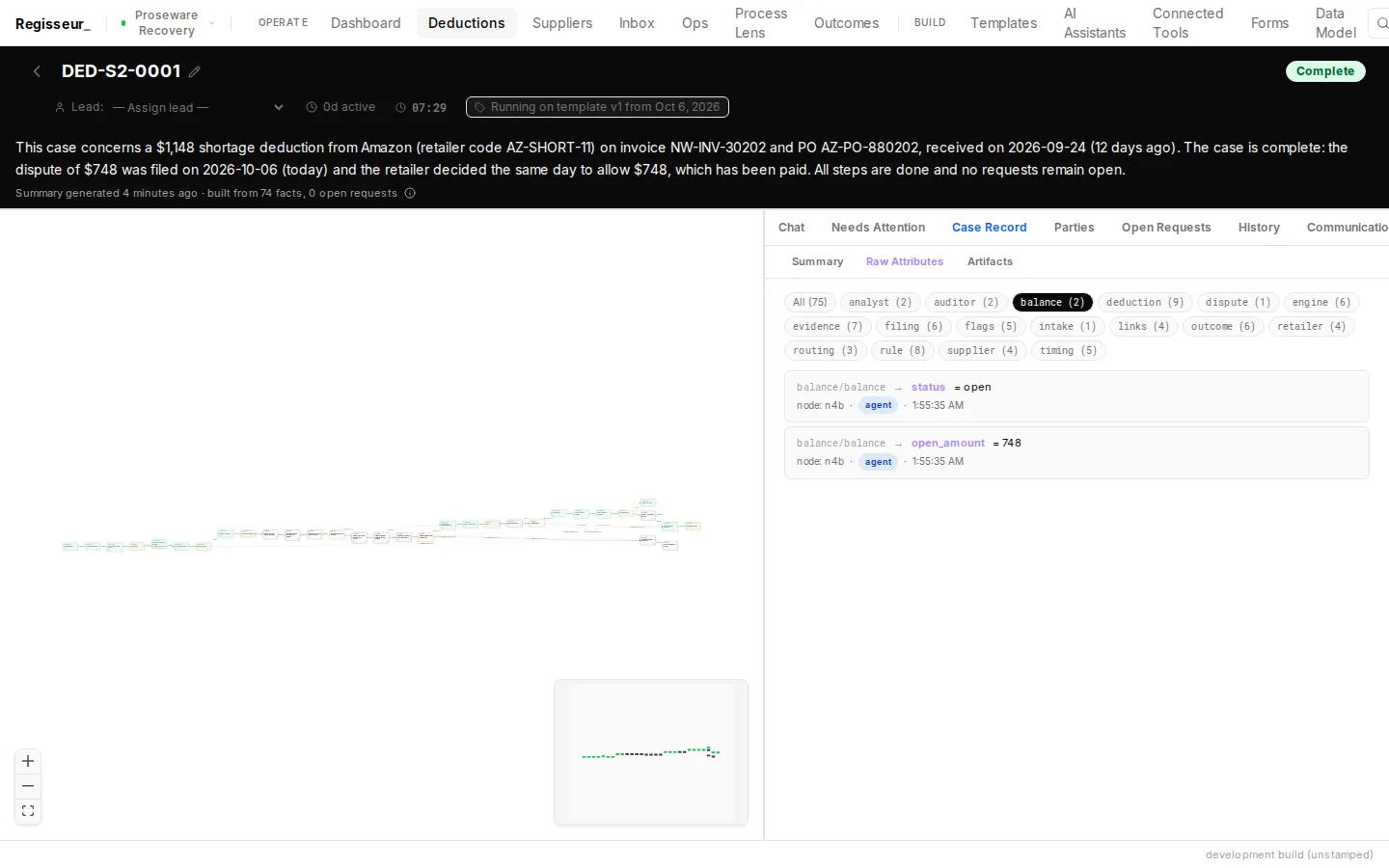
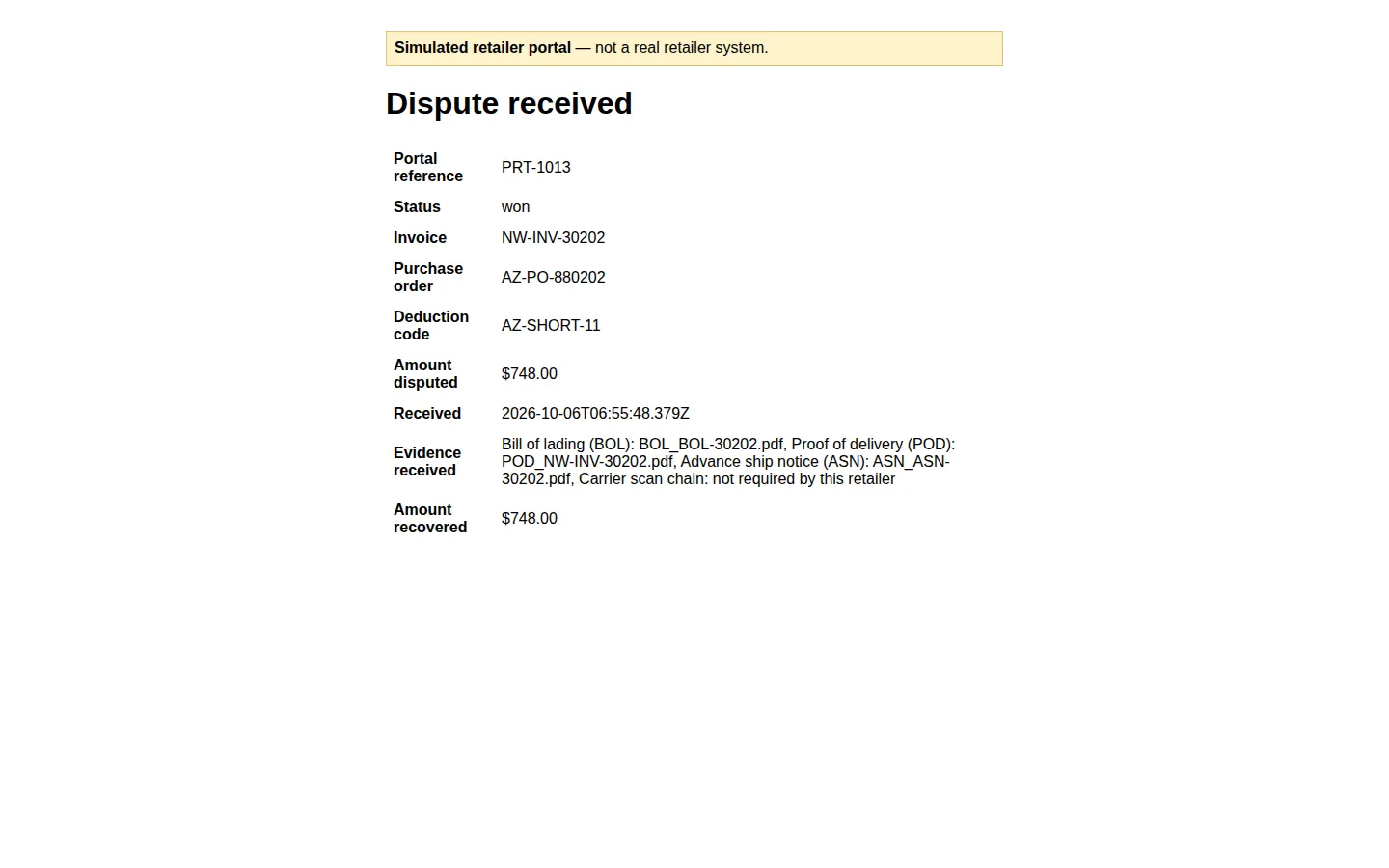
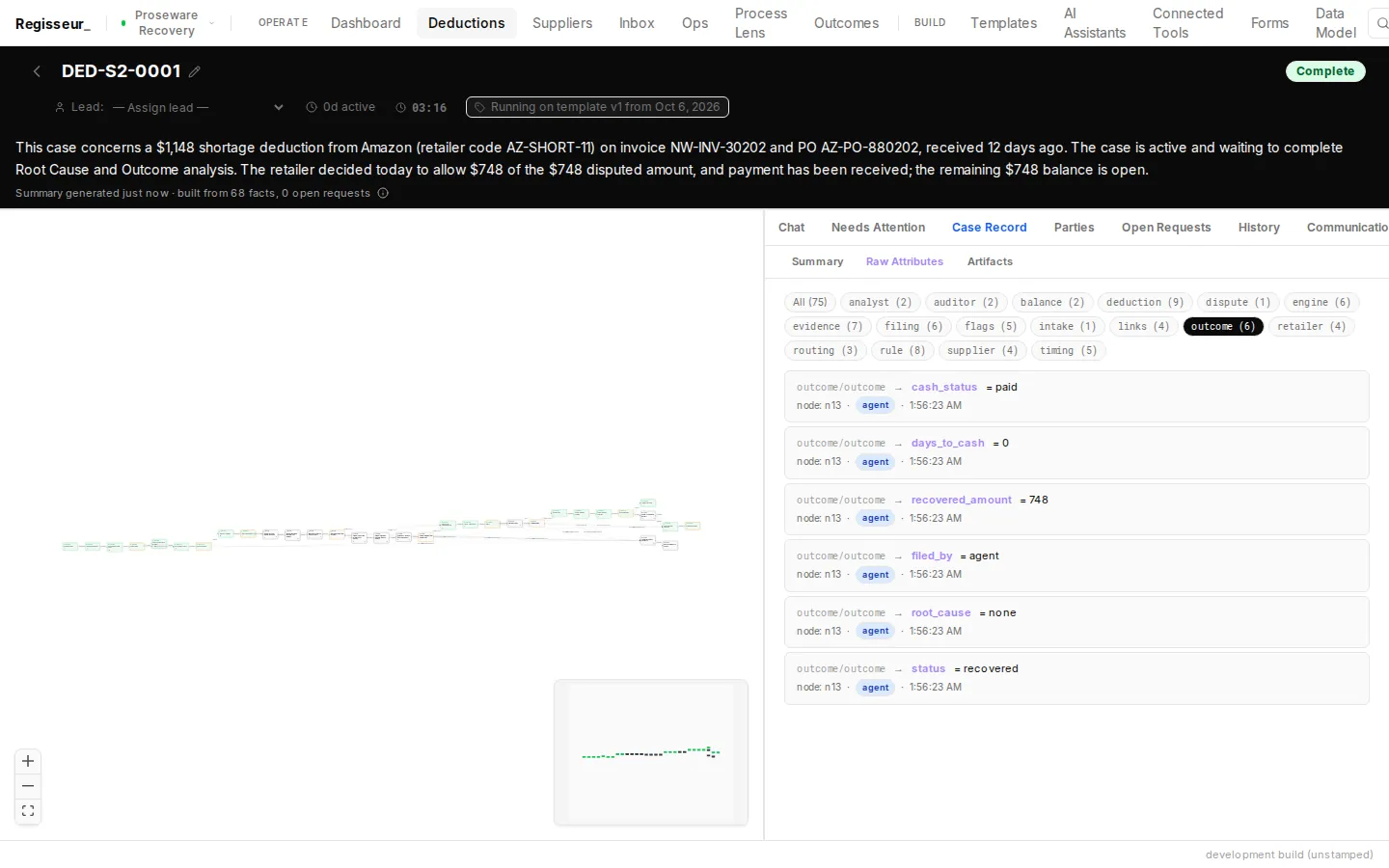
Amazon's rule says to wait 30 days before disputing a shortage, because many resolve themselves. The case waited. To avoid a 30-day demo, the timer process was run once as if 427 hours had passed (disclosed in the honesty note). When the hold released, the case re-read the balance: the retailer had already settled $400.00 on its own, so the agent disputed only the remaining $748.00, and recovered $748.00.
5Missing paperwork: the case asks the supplier
A $936.00 Target price deduction needed a document that was not on file: the buyer's written approval of a price exception. Instead of guessing or stalling, the case asked Northwind's sales contact for it through a protected link.
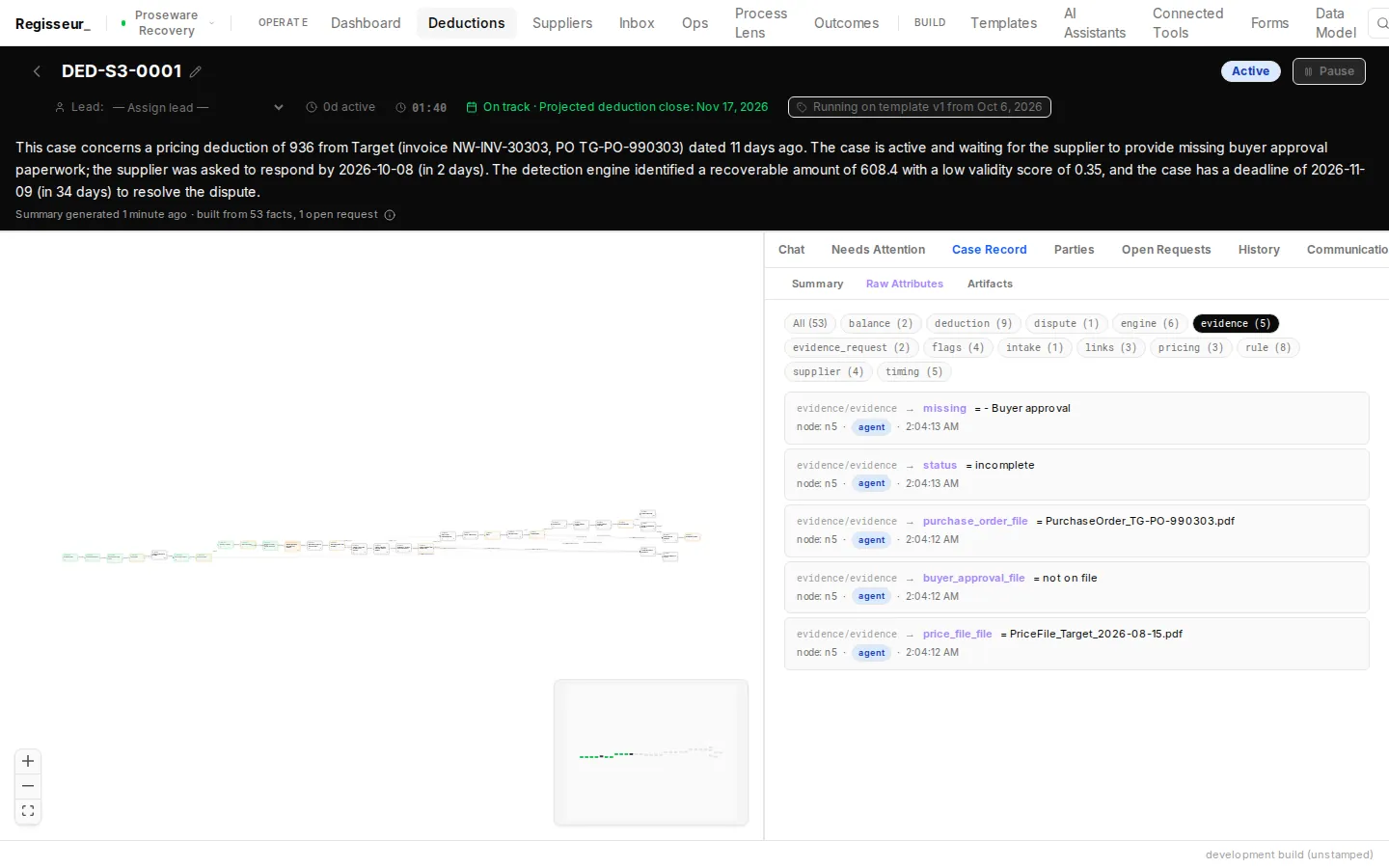
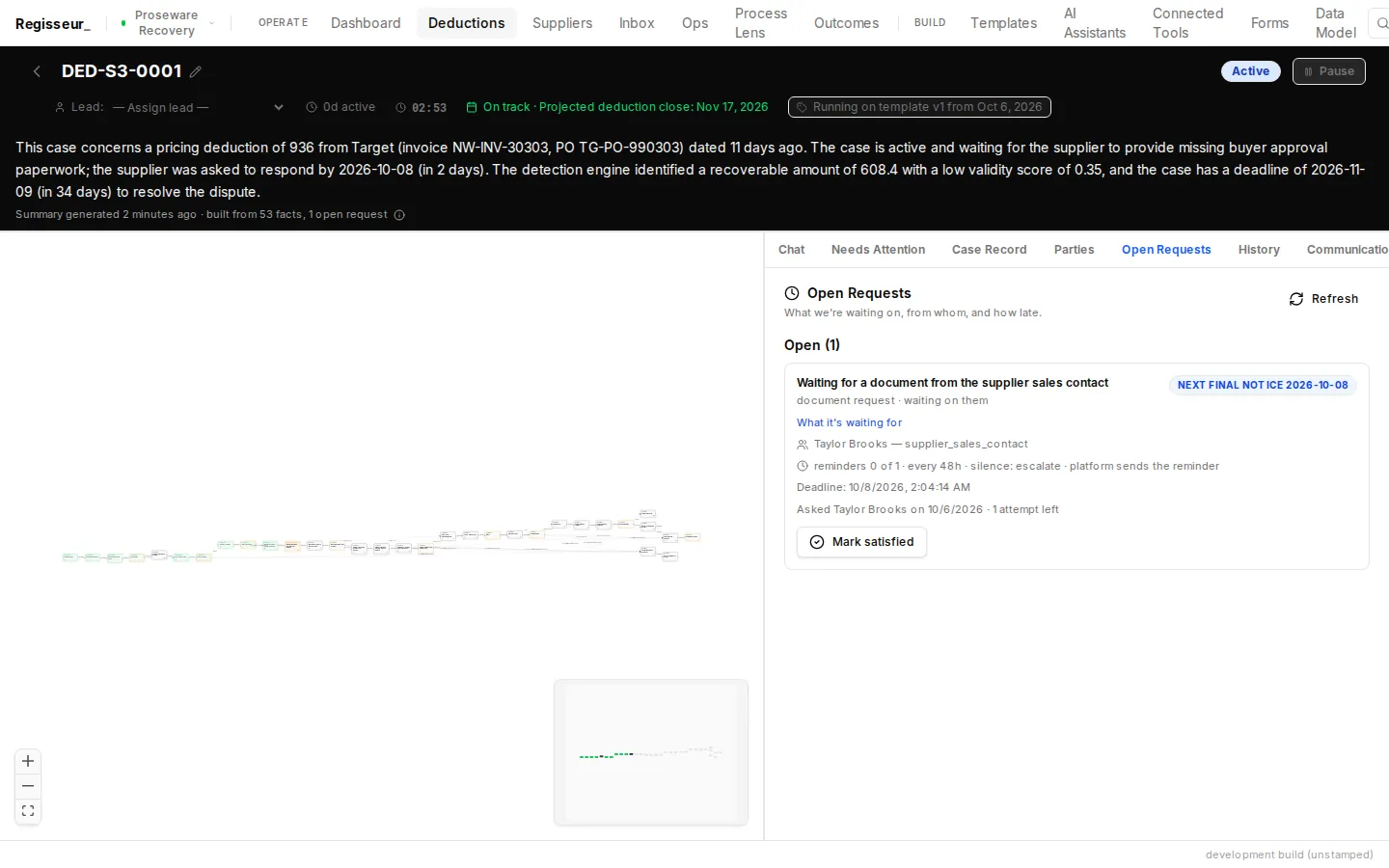
The email
The request went out as an email with the subject "Pricing paperwork needed to dispute a retailer deduction". It was received at 07:04 UTC in the demo's test inbox (all demo email is routed to one test inbox rather than to people).
| Time | Step | Direction | Subject | Recipient | Outcome |
|---|---|---|---|---|---|
| 2026-10-06 07:04:16 UTC | Request to the supplier | outbound | Pricing paperwork needed to dispute a retailer deduction | r***@gmail.com | delivered |
| 2026-10-06 07:10:33 UTC | Supplier answer received | inbound | - | - | received |
| 2026-10-06 07:10:40 UTC | Confirmation shown to the supplier | outbound | - | r***@gmail.com | delivered (shown on the portal page the party submitted from) |
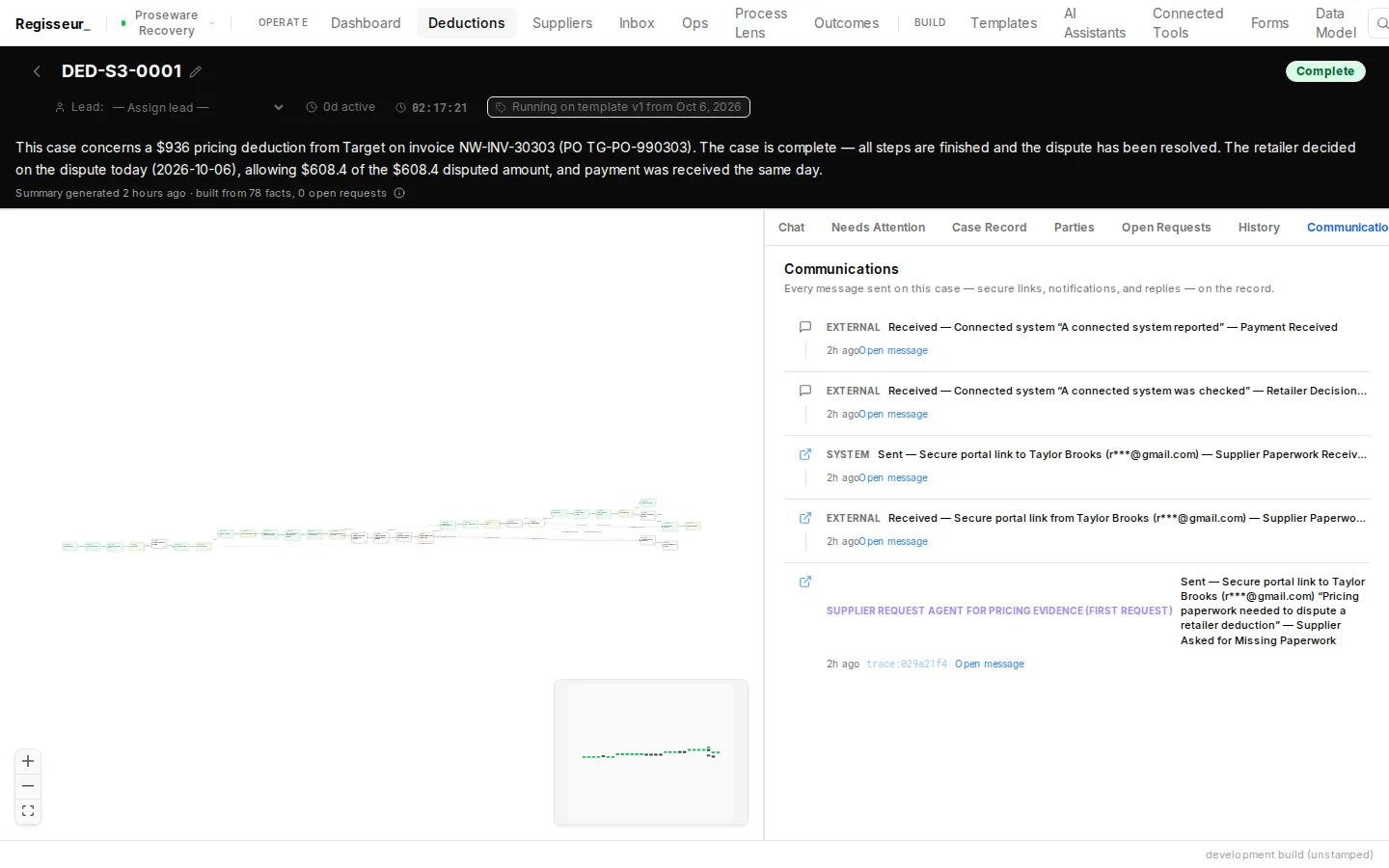
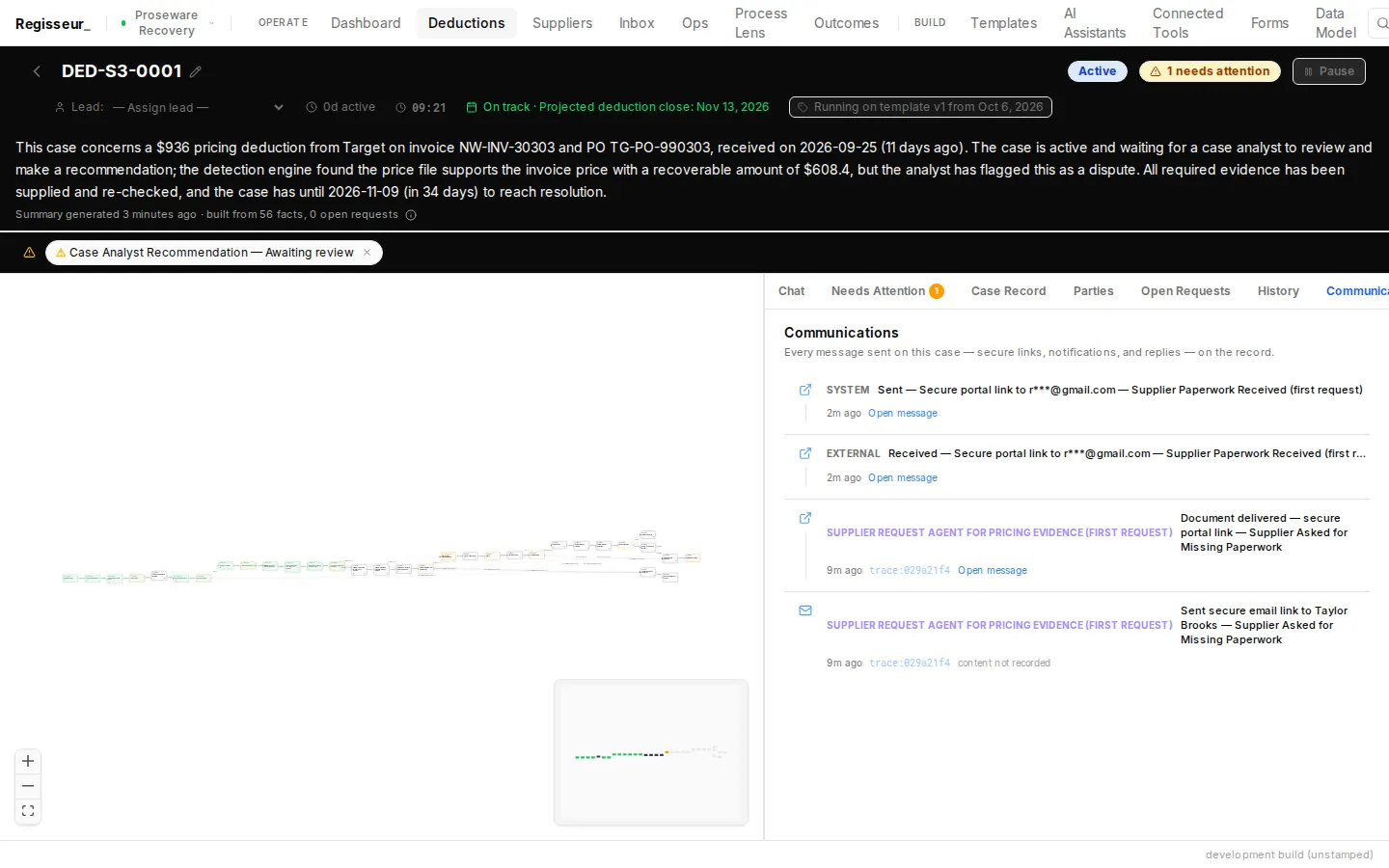
The supplier answers
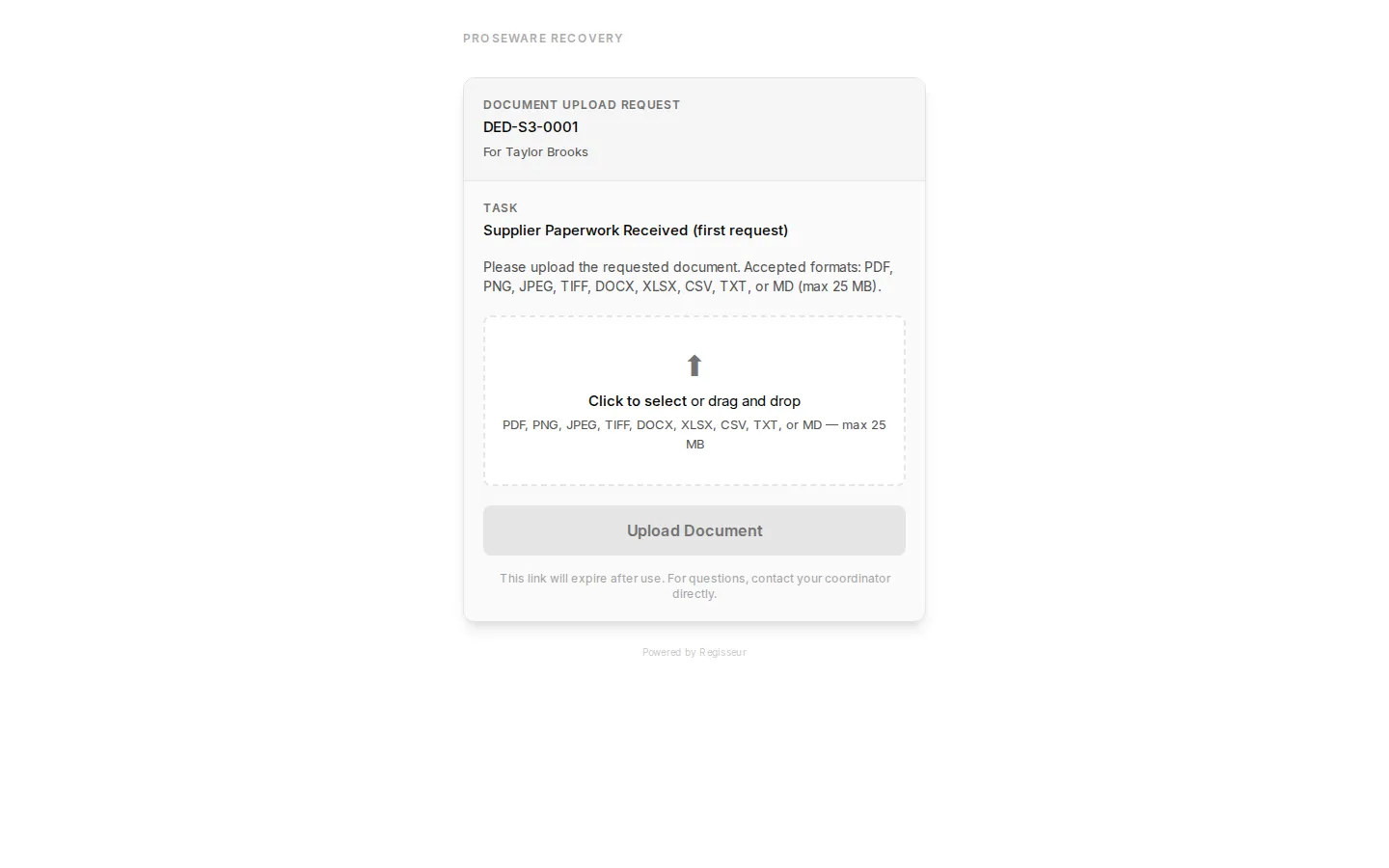
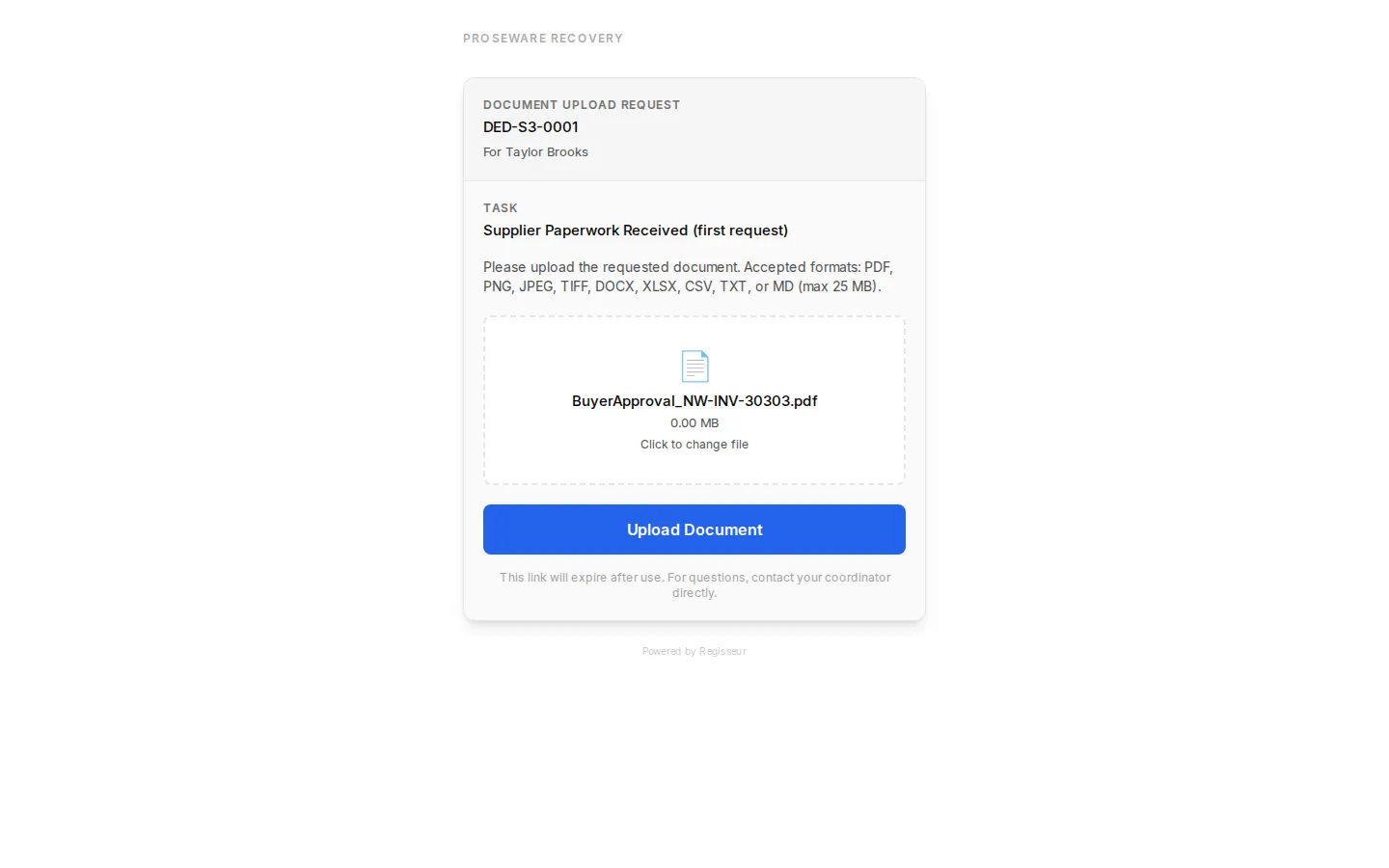
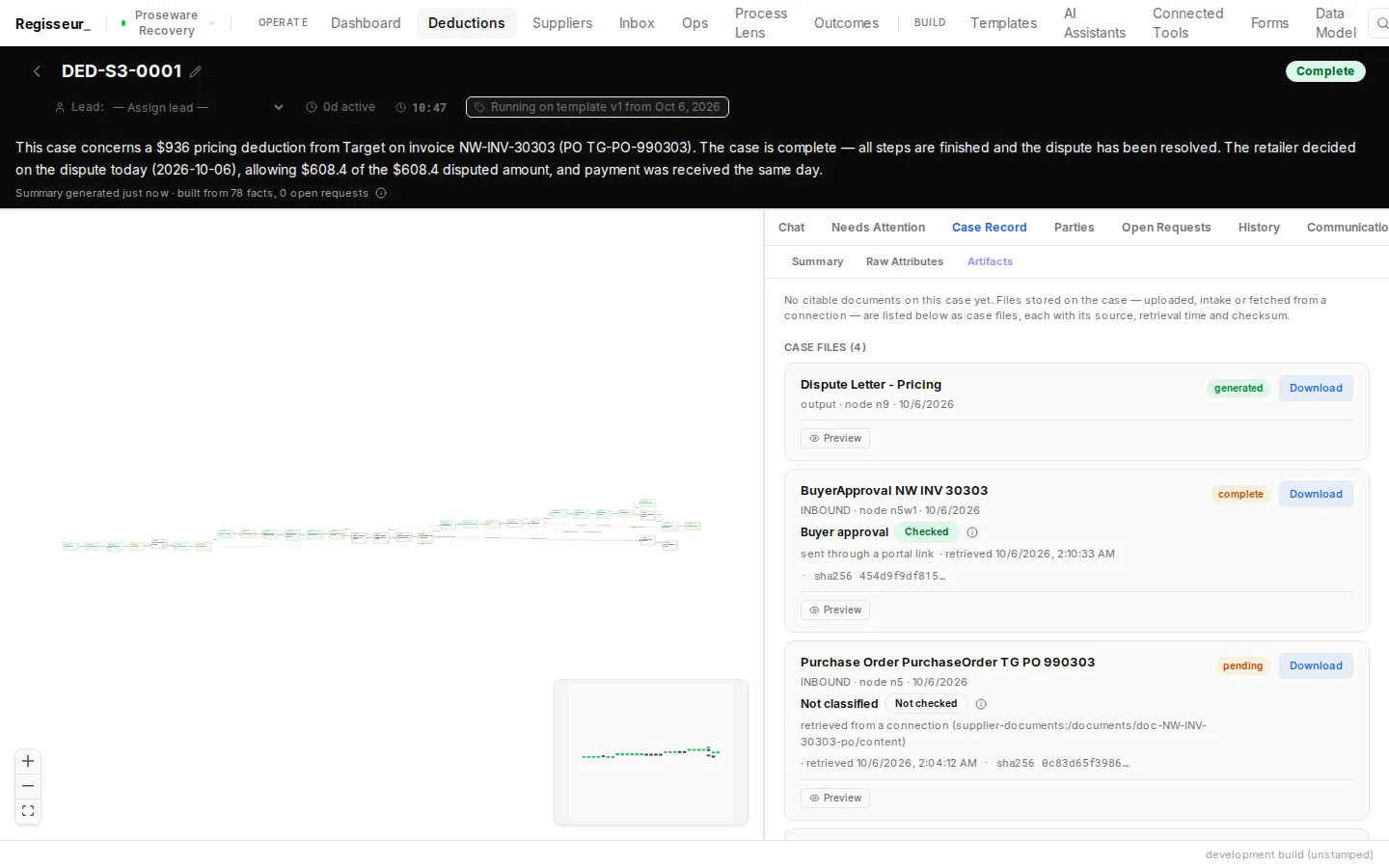
The upload was recorded within seconds, the waiting request closed itself, and the evidence was re-checked automatically.
Evidence with a chain of custody
| Document | Source | Retrieved | SHA-256 |
|---|---|---|---|
| price_file-PriceFile_Target_2026-08-15.pdf | connector | 2026-10-06 07:04:12 UTC | 6aa714d4130b2306e8b7ddb669c192efd02ff639f36caf7203ca68d85e9b717b |
| purchase_order-PurchaseOrder_TG-PO-990303.pdf | connector | 2026-10-06 07:04:12 UTC | 0c83d65f39867395e75eb0a2cce03316fd17ac1fb51ae3cc590b3ea042ca9070 |
| BuyerApproval_NW-INV-30303.pdf | portal | 2026-10-06 07:10:33 UTC | 454d9f9df8157680b2c9306ea56d1a9bebb2bcfef1b2a9bdbab9ed8a24e1110e |
The uploaded file is a synthetic demonstration document, shown below.

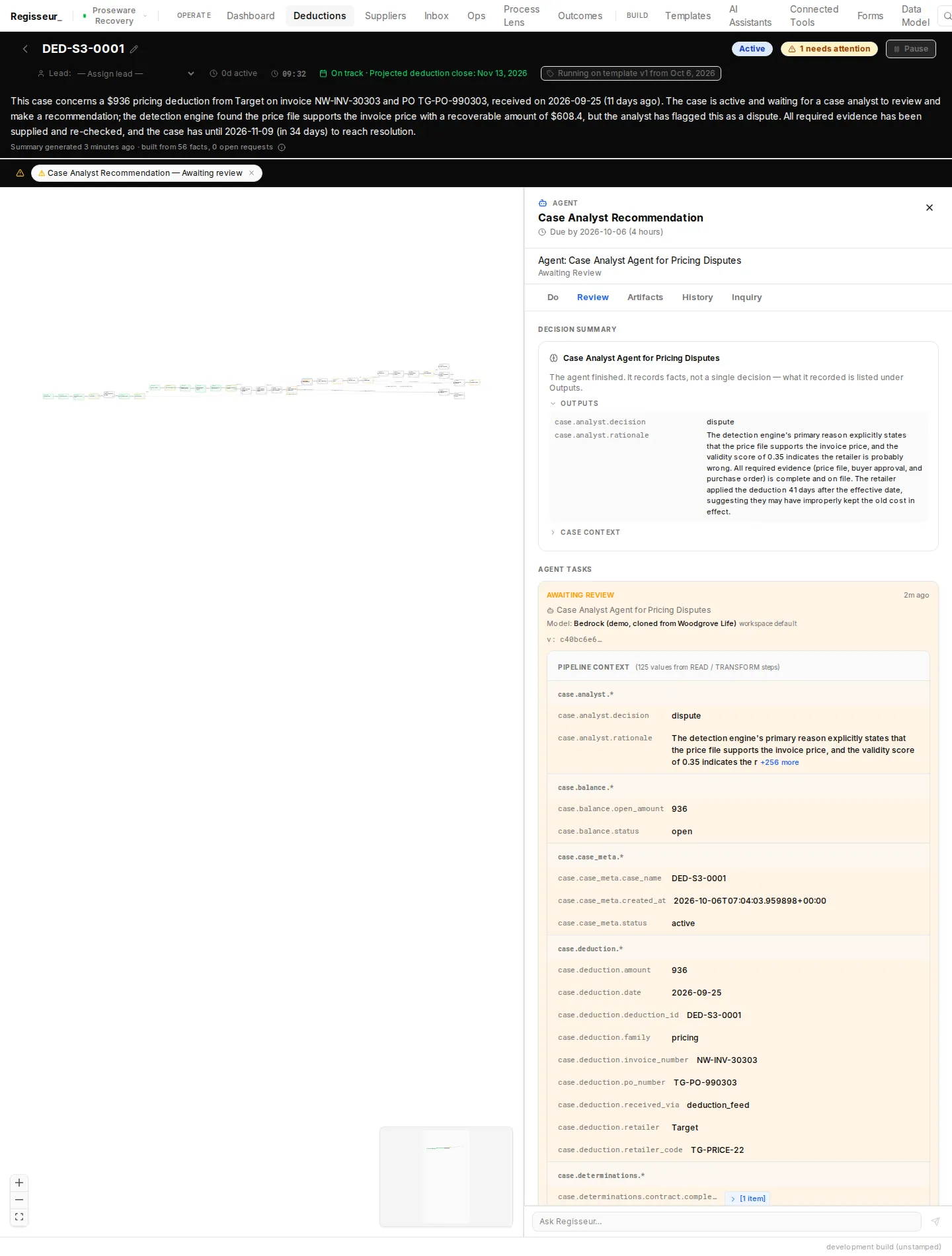
6Always a person: when the case needs judgment
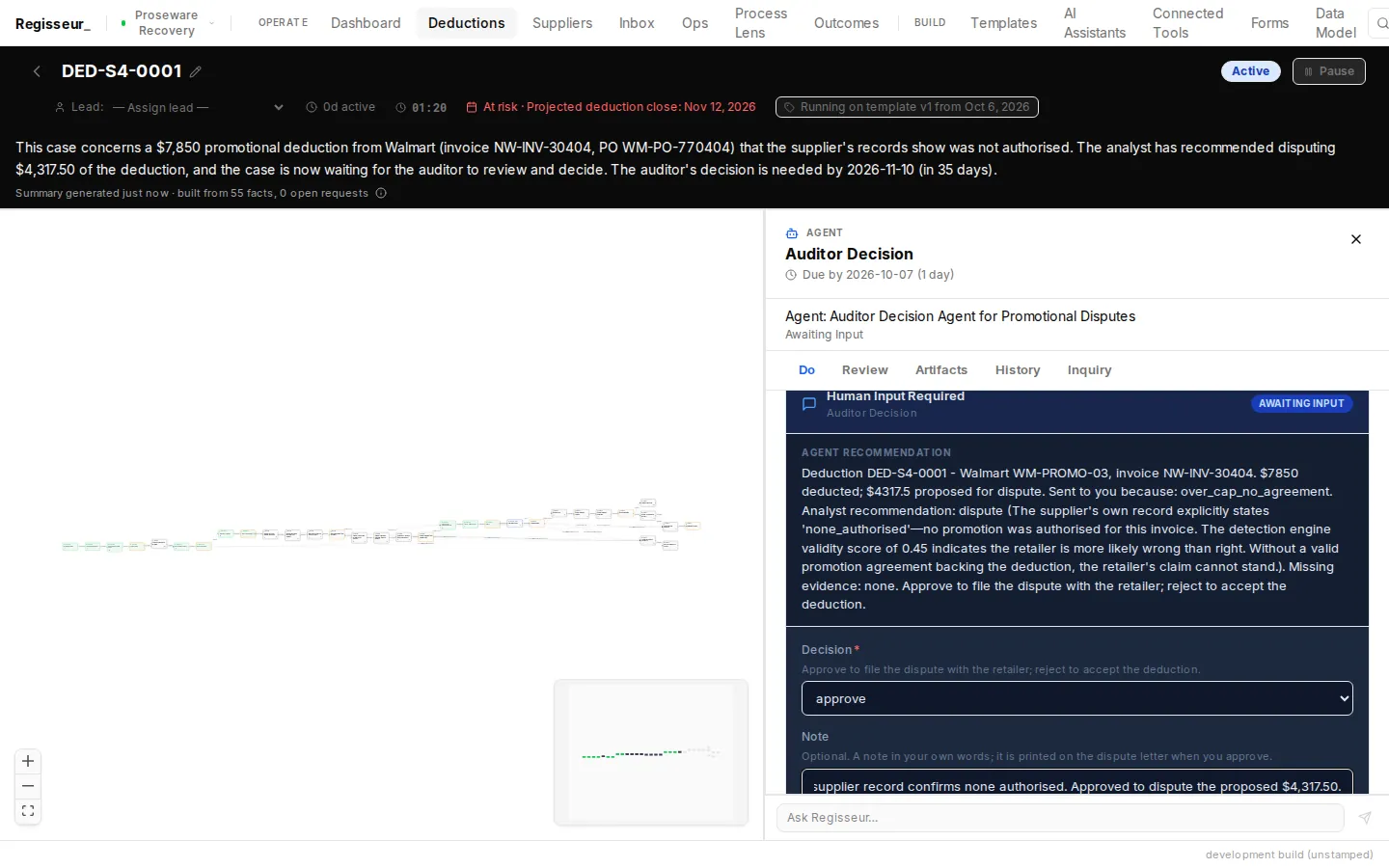
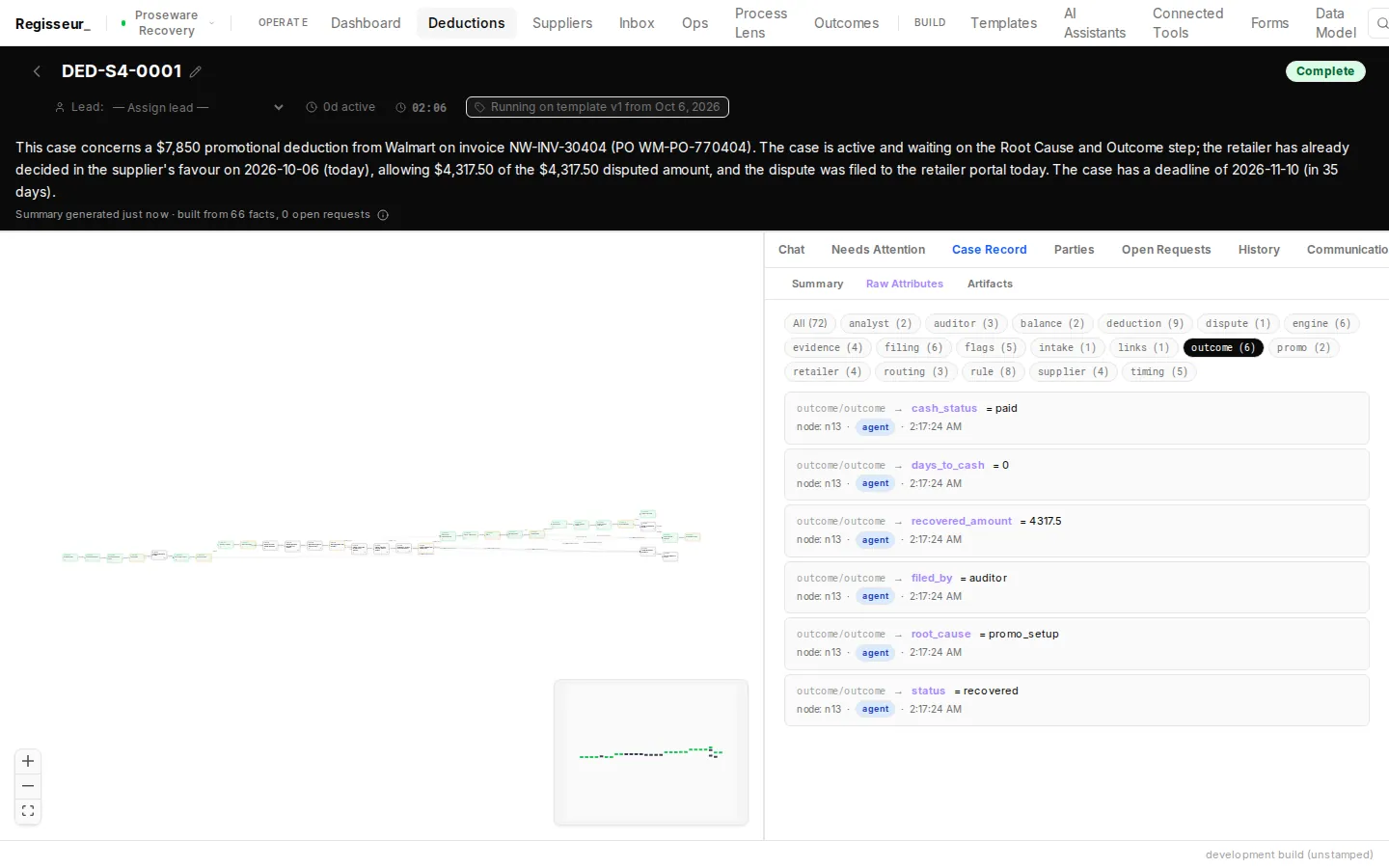
A $7,850.00 promotional deduction, well above the unattended limit, with no promotion agreement on file. Whatever the analyst recommends, a case like this always goes to a person. The reason is recorded on the case ("over the cap, no agreement"). The auditor approved disputing $4,317.50, added a note in their own words, and the filing went out under the auditor's name with that note in the letter. The retailer decided in favour and $4,317.50 was recovered.
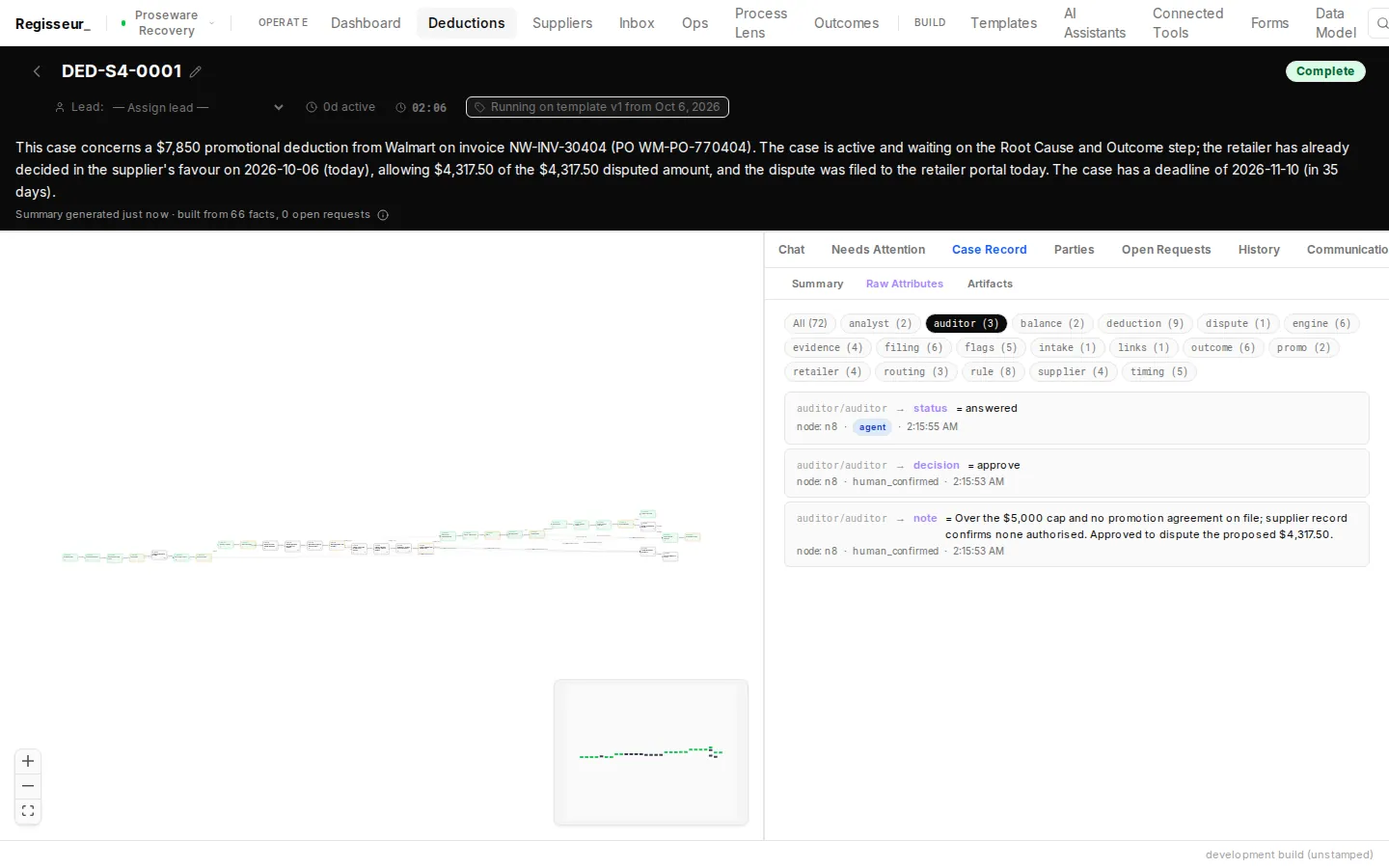
The auditor's note is in the letter
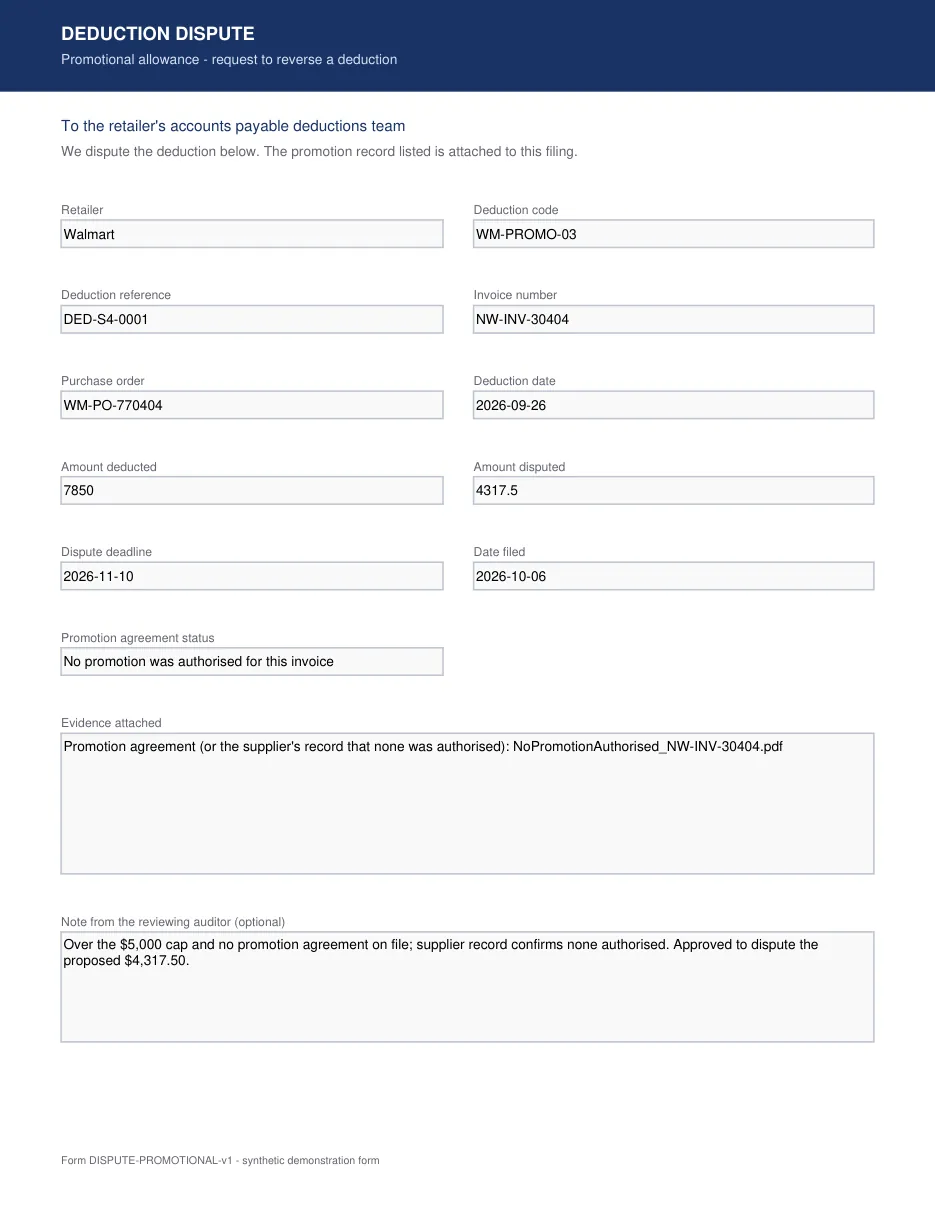
| Letter field values (deduction-recovery-c3-s4-dispute-letter-fields.json) | |
|---|---|
| Retailer | Walmart |
| RetailerCode | WM-PROMO-03 |
| DeductionId | DED-S4-0001 |
| InvoiceNumber | NW-INV-30404 |
| PoNumber | WM-PO-770404 |
| DeductionDate | 2026-09-26 |
| DeductionAmount | 7850 |
| DisputedAmount | 4317.5 |
| FilingDeadline | 2026-11-10 |
| FiledDate | 2026-10-06 |
| PromotionAgreementStatus | No promotion was authorised for this invoice |
| EvidenceList | Promotion agreement (or the supplier's record that none was authorised): NoPromotionAuthorised_NW-INV-30404.pdf |
| AuditorNote | Over the $5,000 cap and no promotion agreement on file; supplier record confirms none authorised. Approved to dispute the proposed $4,317.50. |
7A valid fine becomes a prevention signal
A $1,420.50 on-time-in-full fine from Target was checked and found to be valid: the goods arrived three days after the appointment. The case did not file a doomed dispute. It accepted the fine, tagged the root cause as timing, and the dollars appear in the prevention view for the team that can fix the cause.
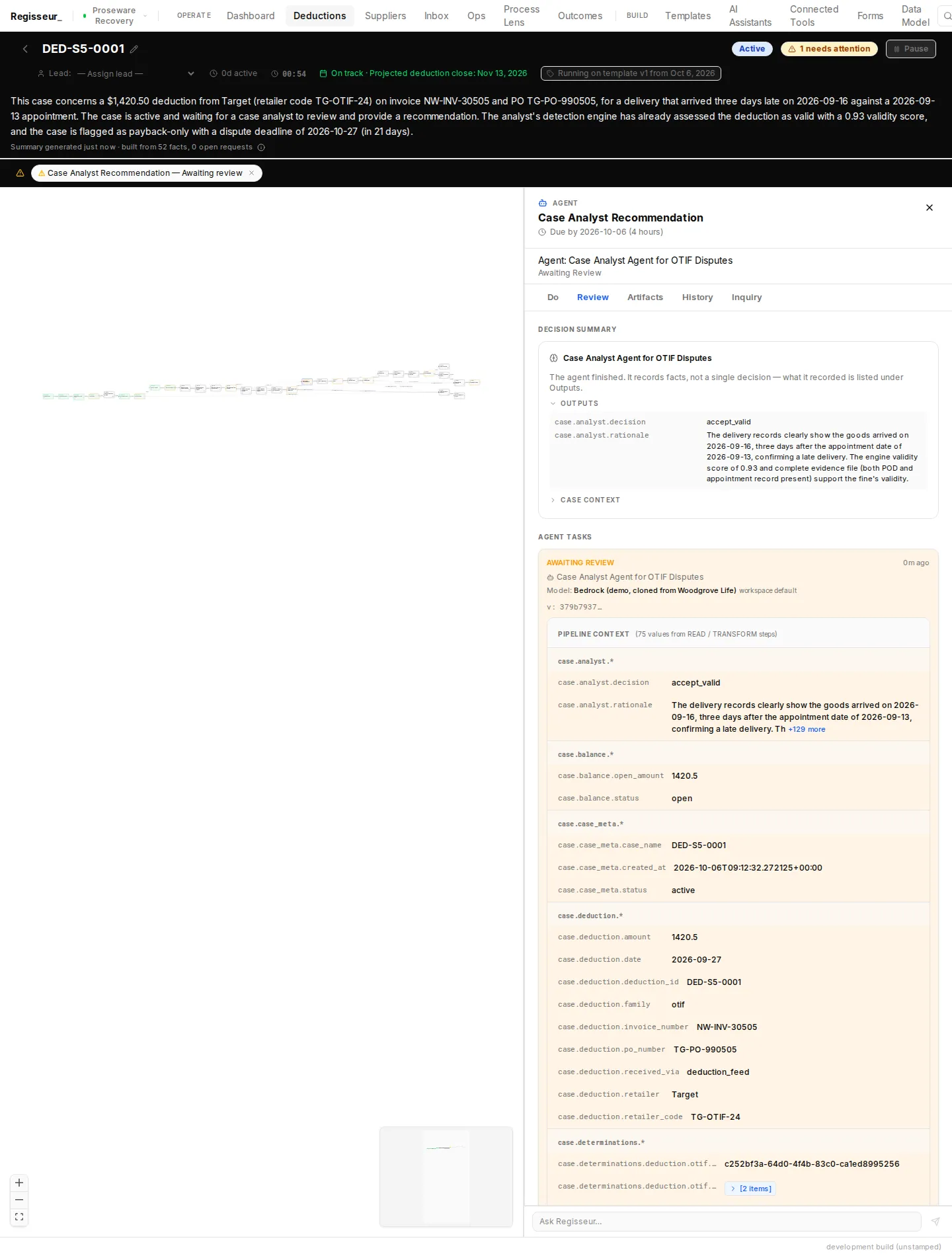
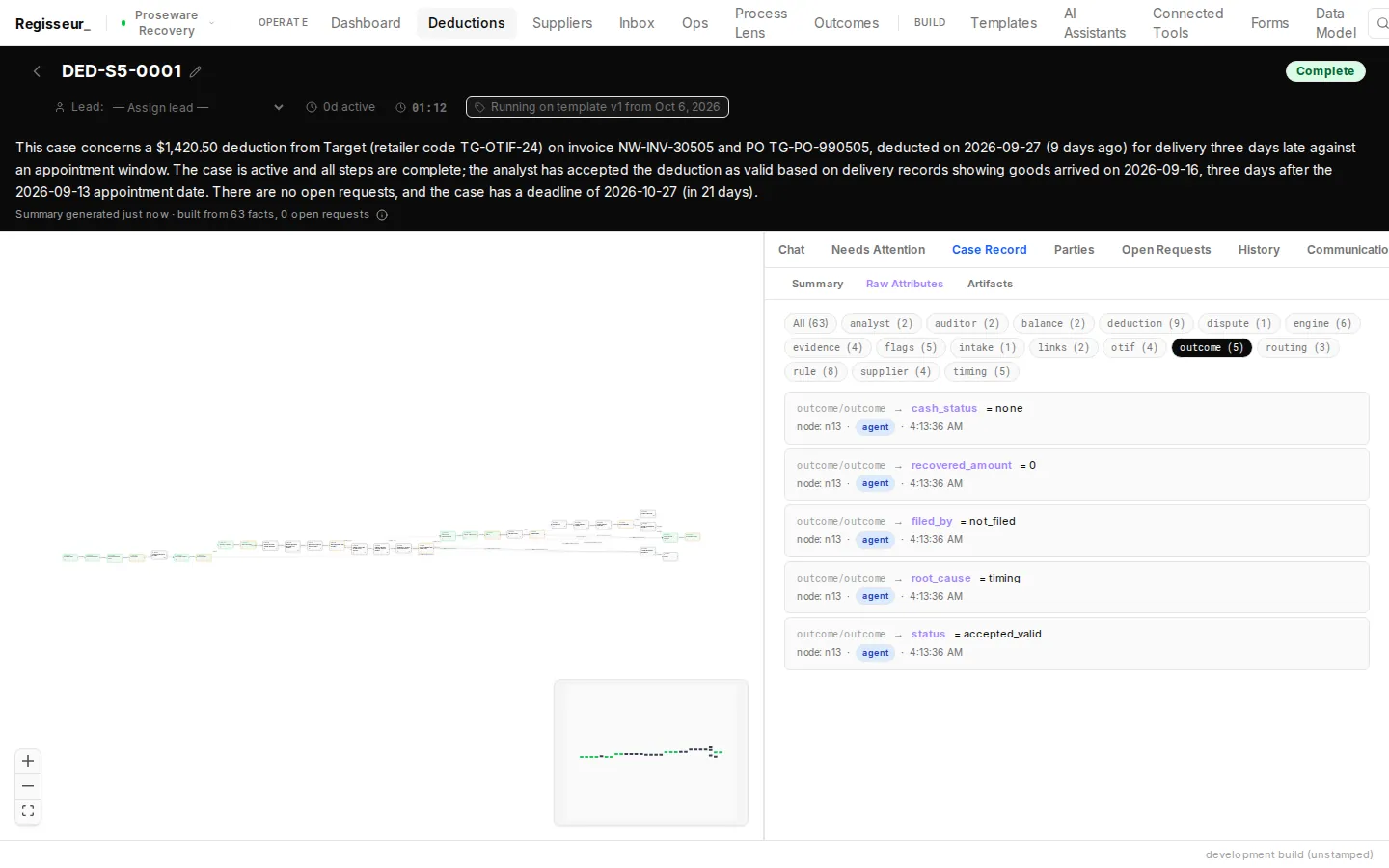
Chart data
| promo setup | $7,850.00 (1 case) |
|---|---|
| dc receiving | $3,619.06 (11 cases) |
| none recorded | $1,760.48 (2 cases) |
| timing (valid, accepted) | $1,420.50 (1 case) |
| price file | $936.00 (1 case) |
The root-cause bars cover every closed case. The one accepted-valid fine (timing) is the leakage the prevention team can act on; the other bars are the causes tagged on recovered disputes.
8Rules change without a release, and autonomy comes back under review
Walmart changes a rule
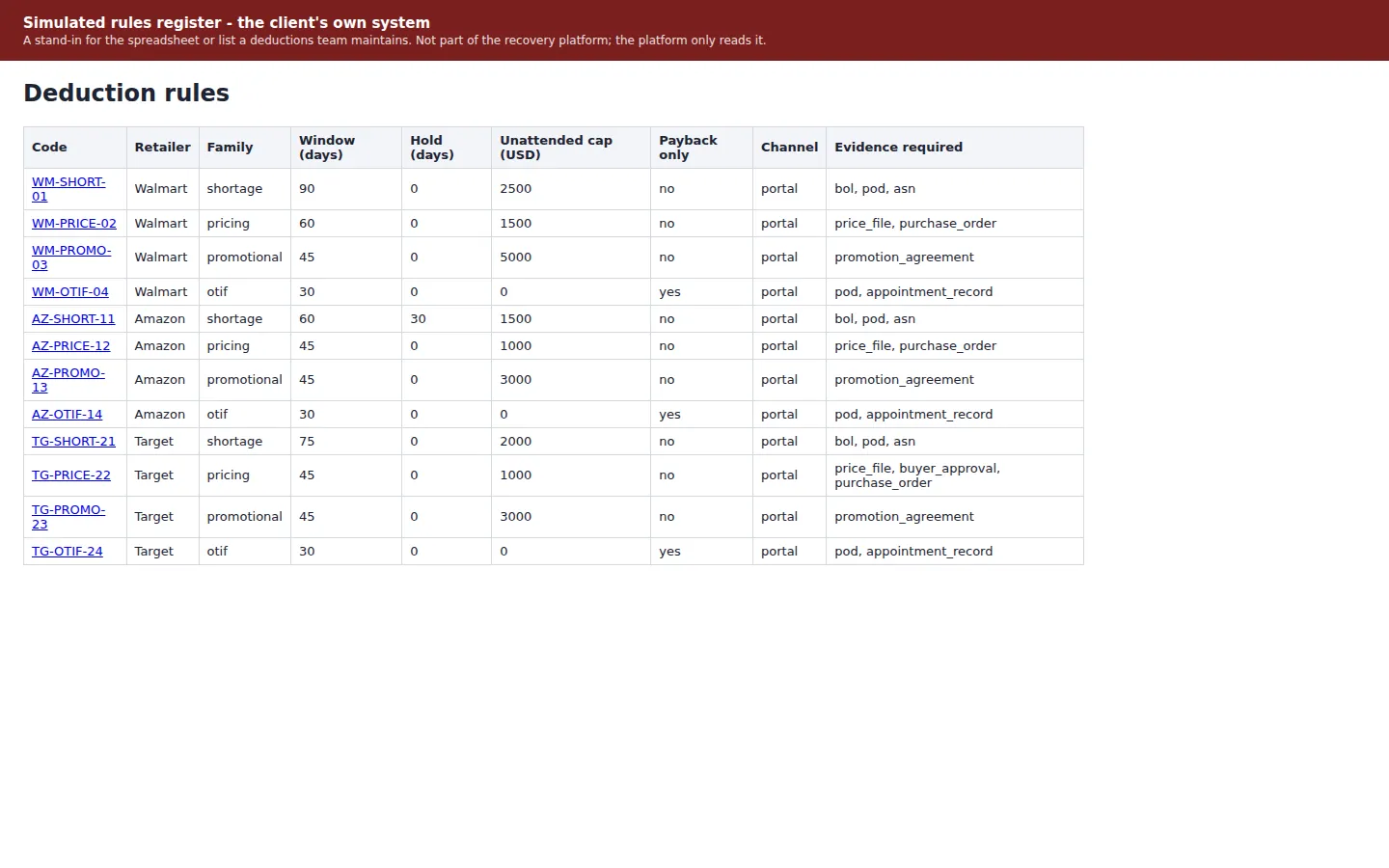
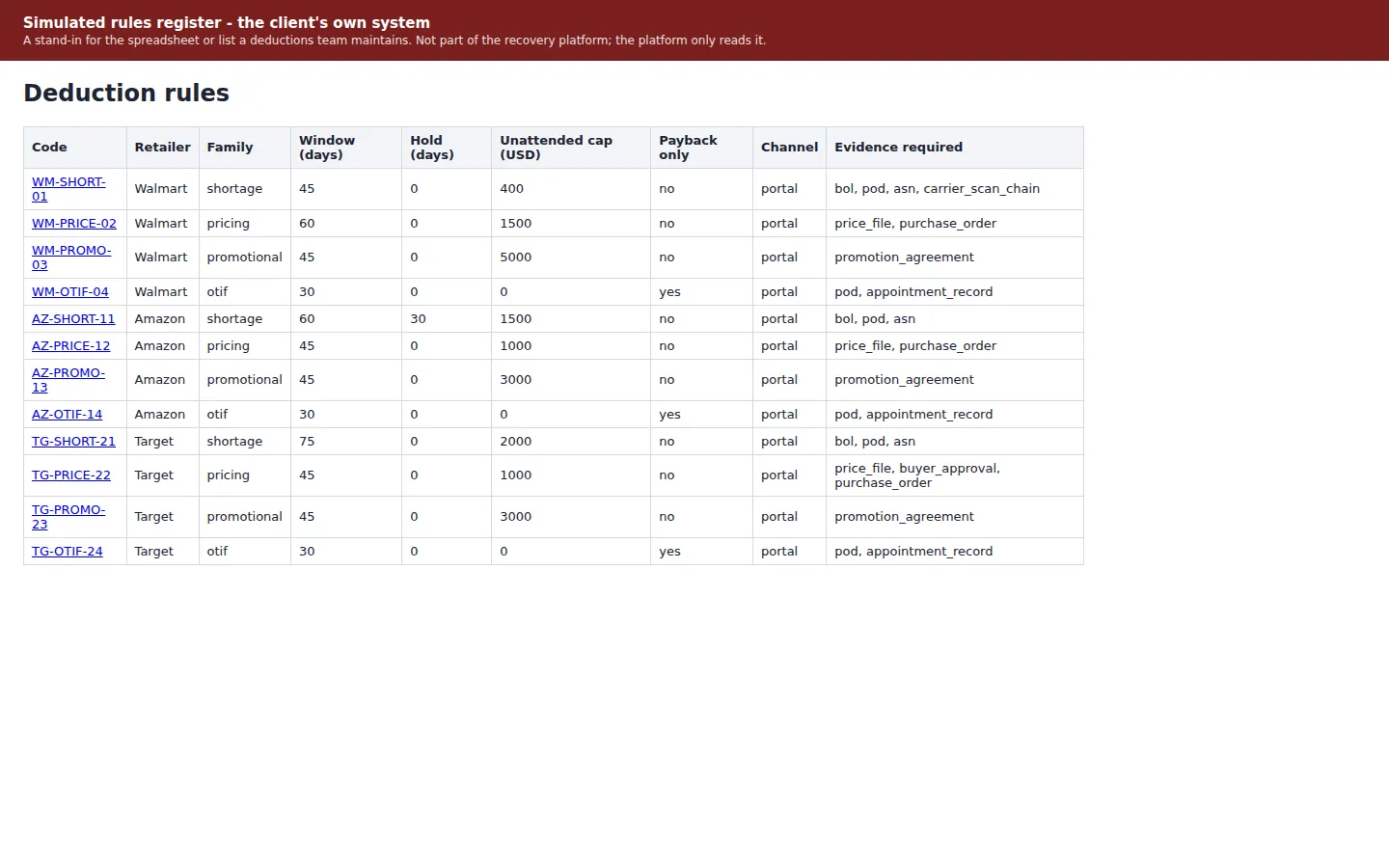
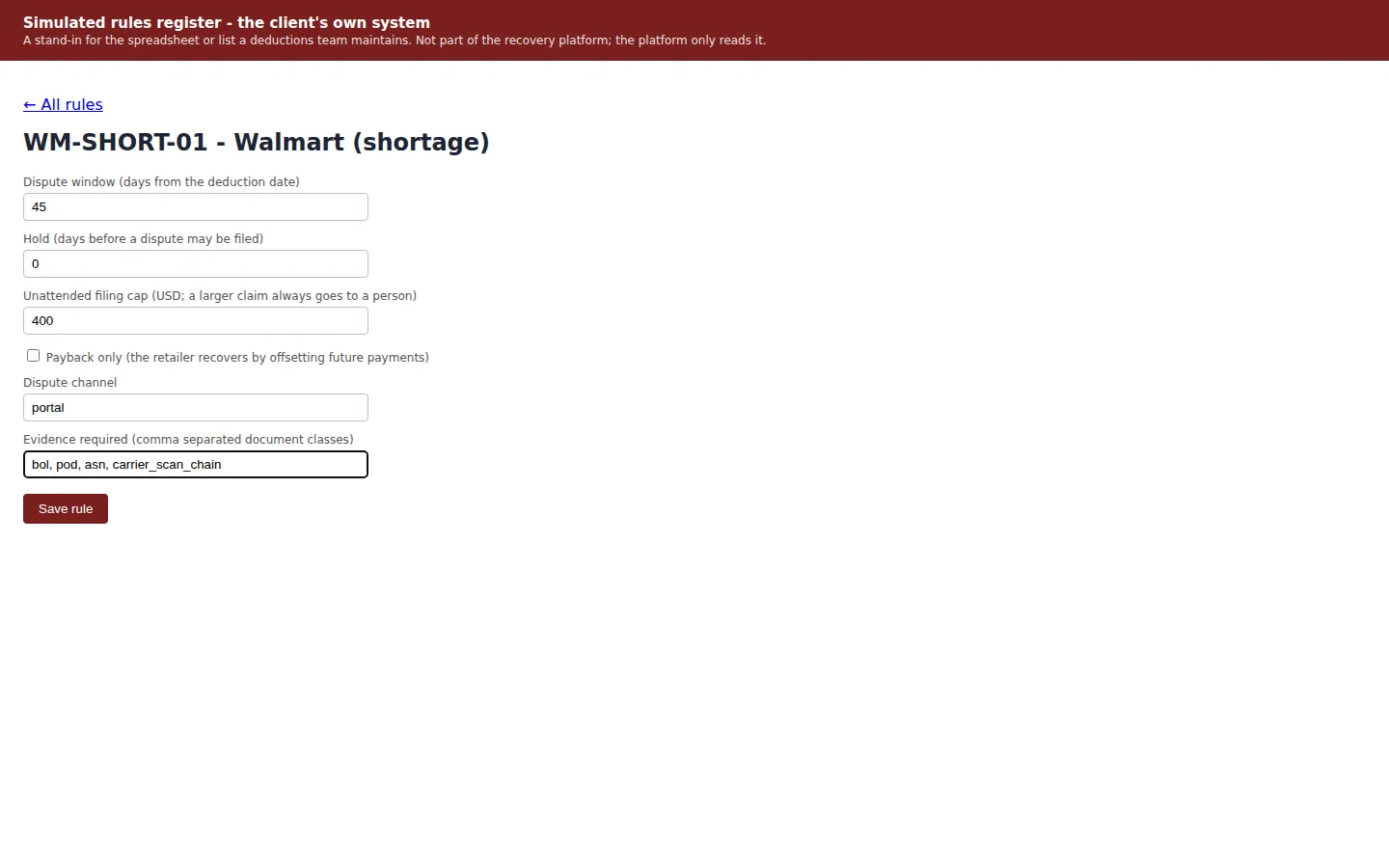
Walmart adds a requirement for shortage disputes: a carrier scan chain must now be attached, the window shortens and the unattended limit drops. The change is made in the client's rules register, with no software release.
| Before (DED-W-01, read when it ran) | After (DED-R-01, read when it ran) | |
|---|---|---|
| window days | 90 | 45 |
| auto cap usd | 2500 | 400 |
| evidence required | bol, pod, asn | bol, pod, asn, carrier_scan_chain |
| hold days | 0 | 0 |
The next case asks for the new document
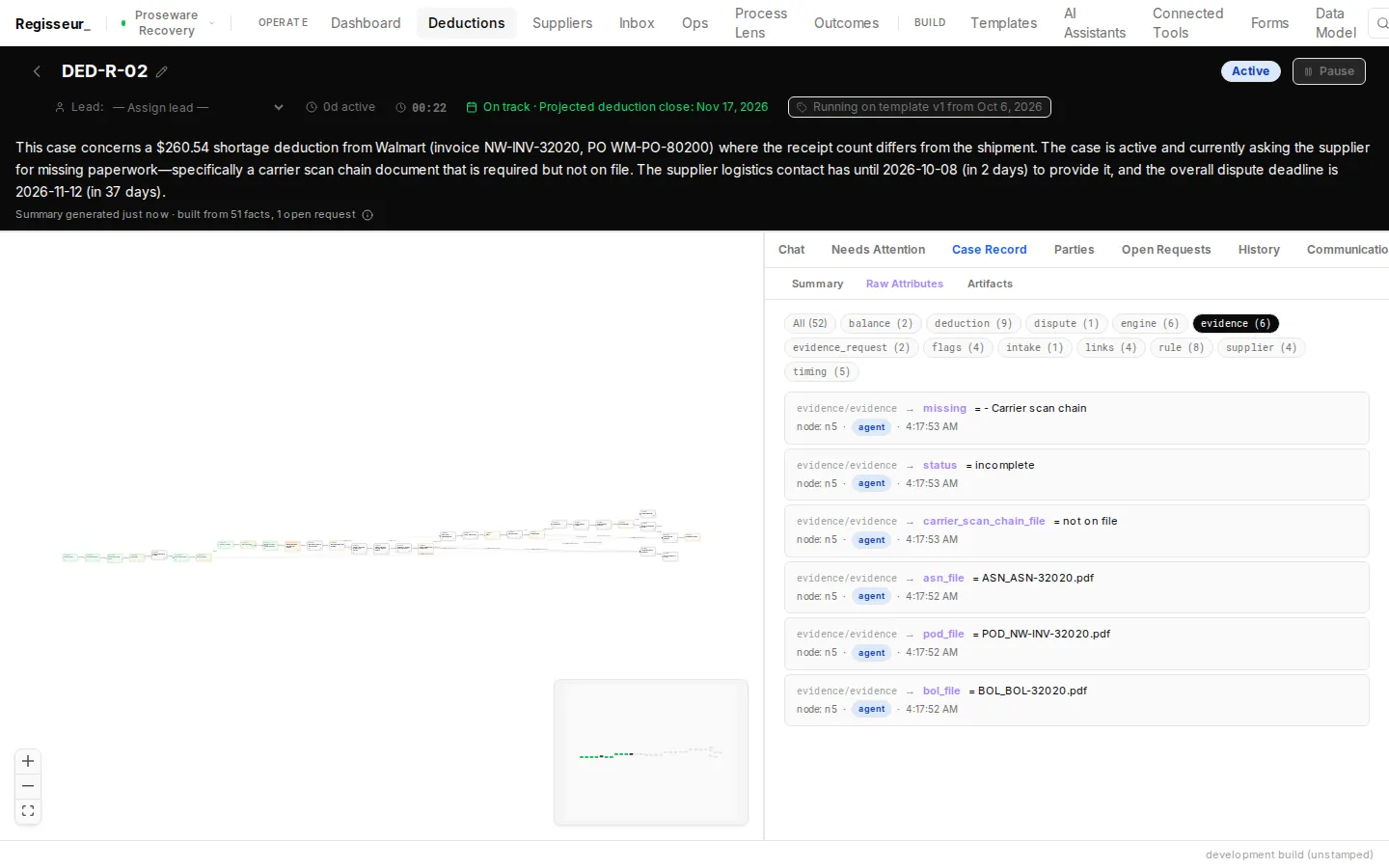
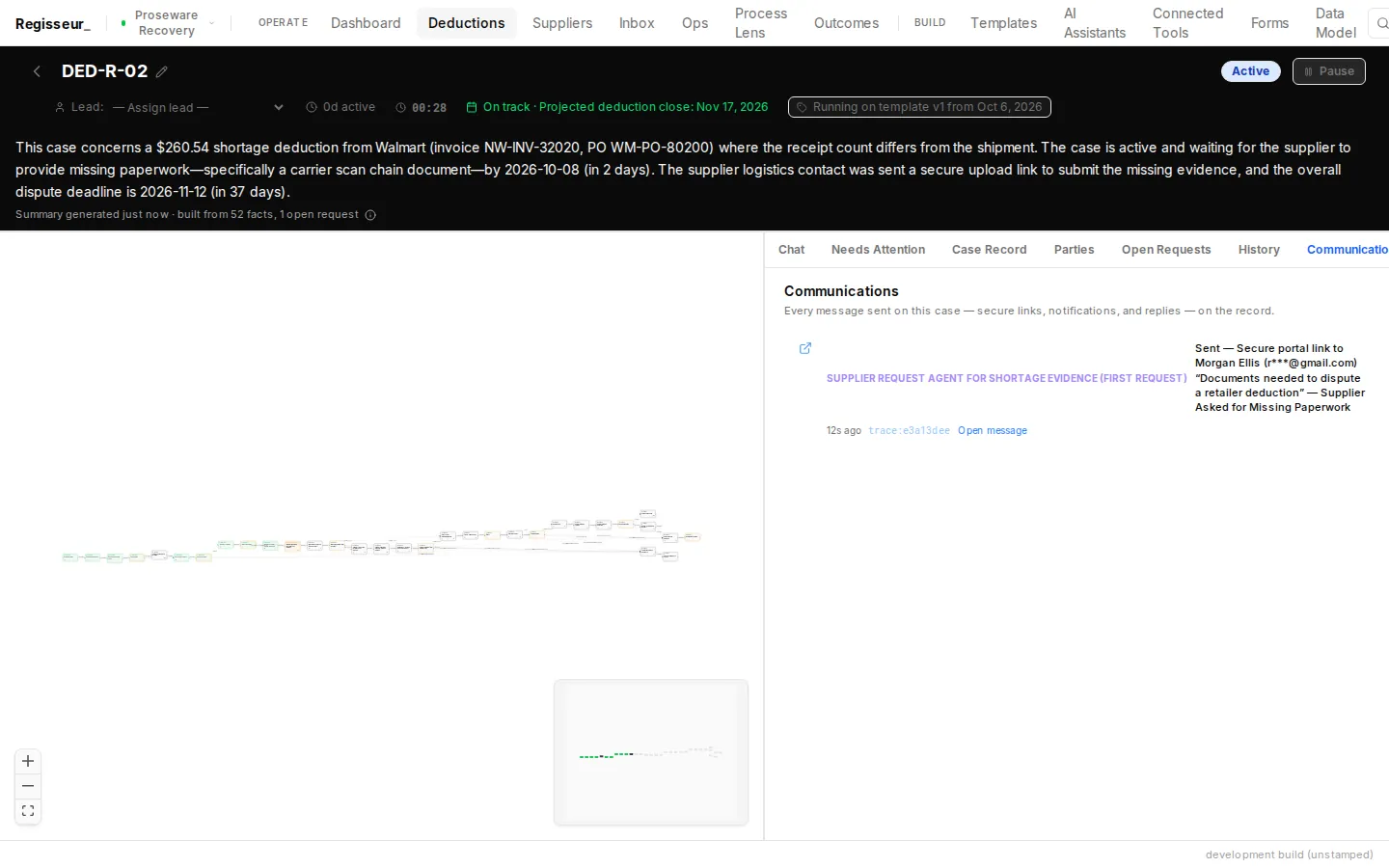
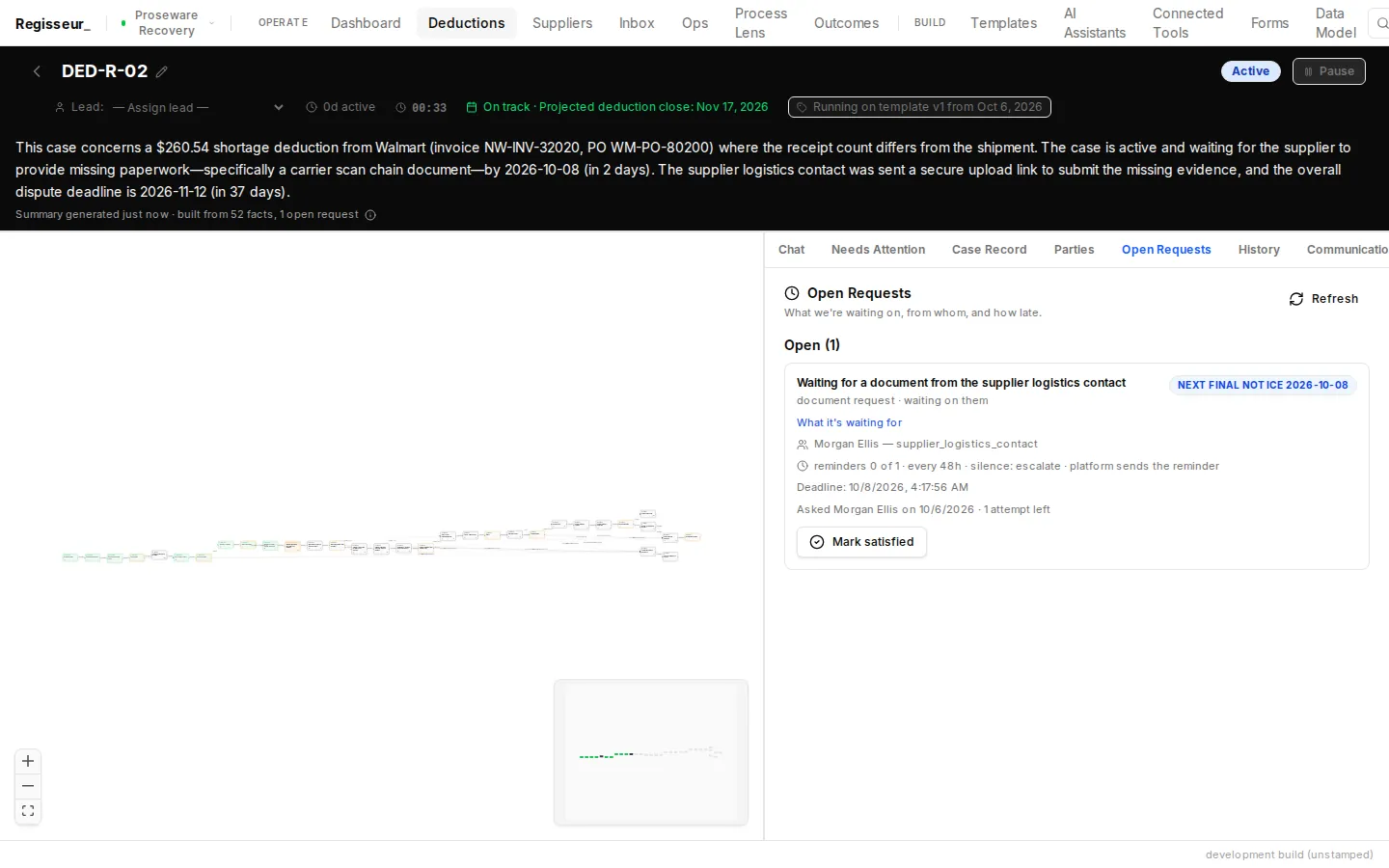
The next Walmart shortage that arrived without a carrier scan chain did what the new rule says: it asked the supplier's logistics contact for it. In the demo that request was left unanswered, so the case is shown waiting.
Putting a person back in the loop with one action
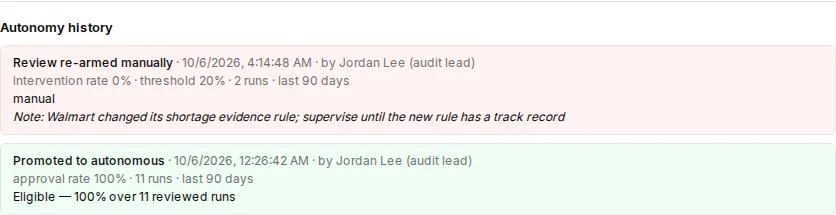
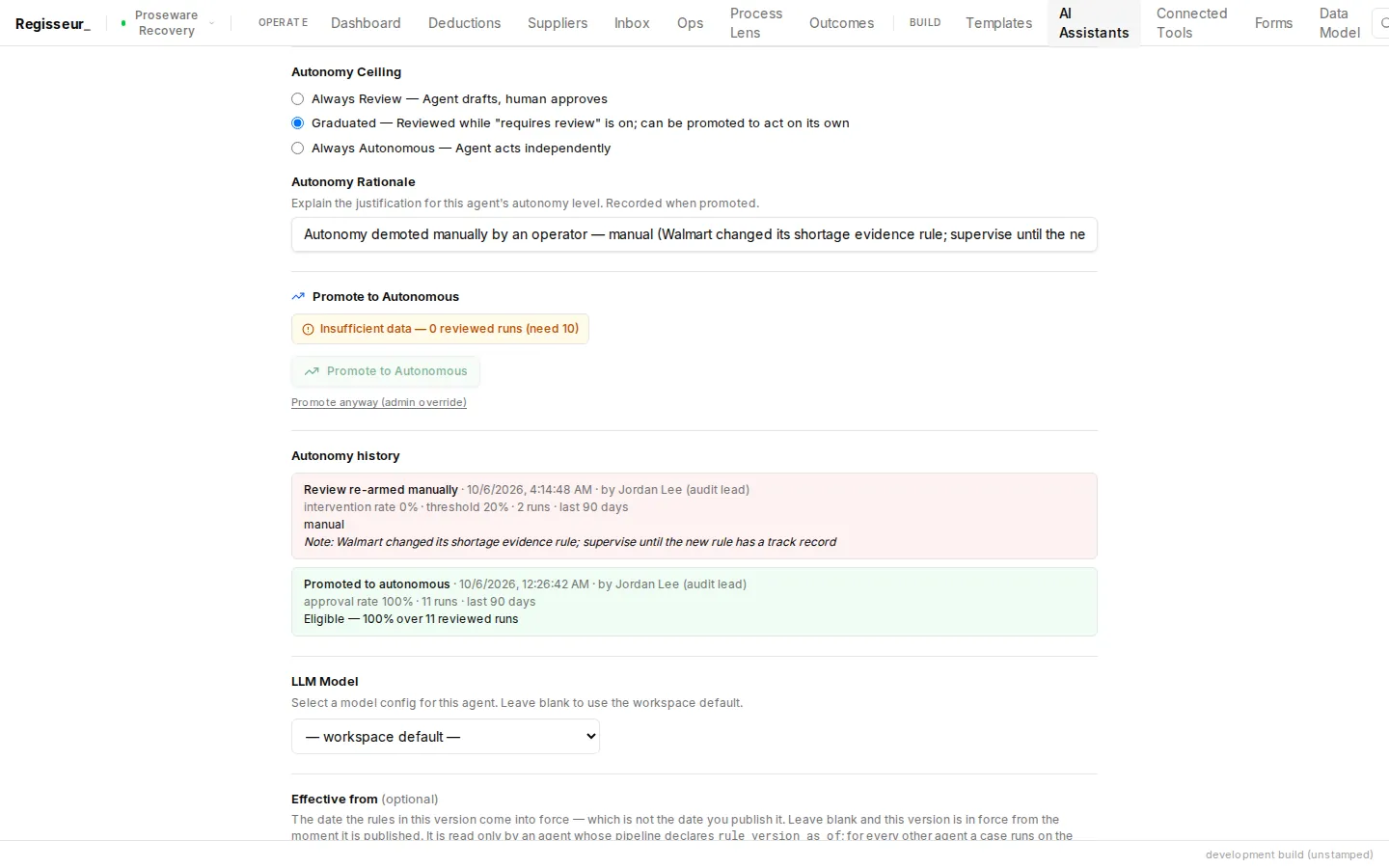
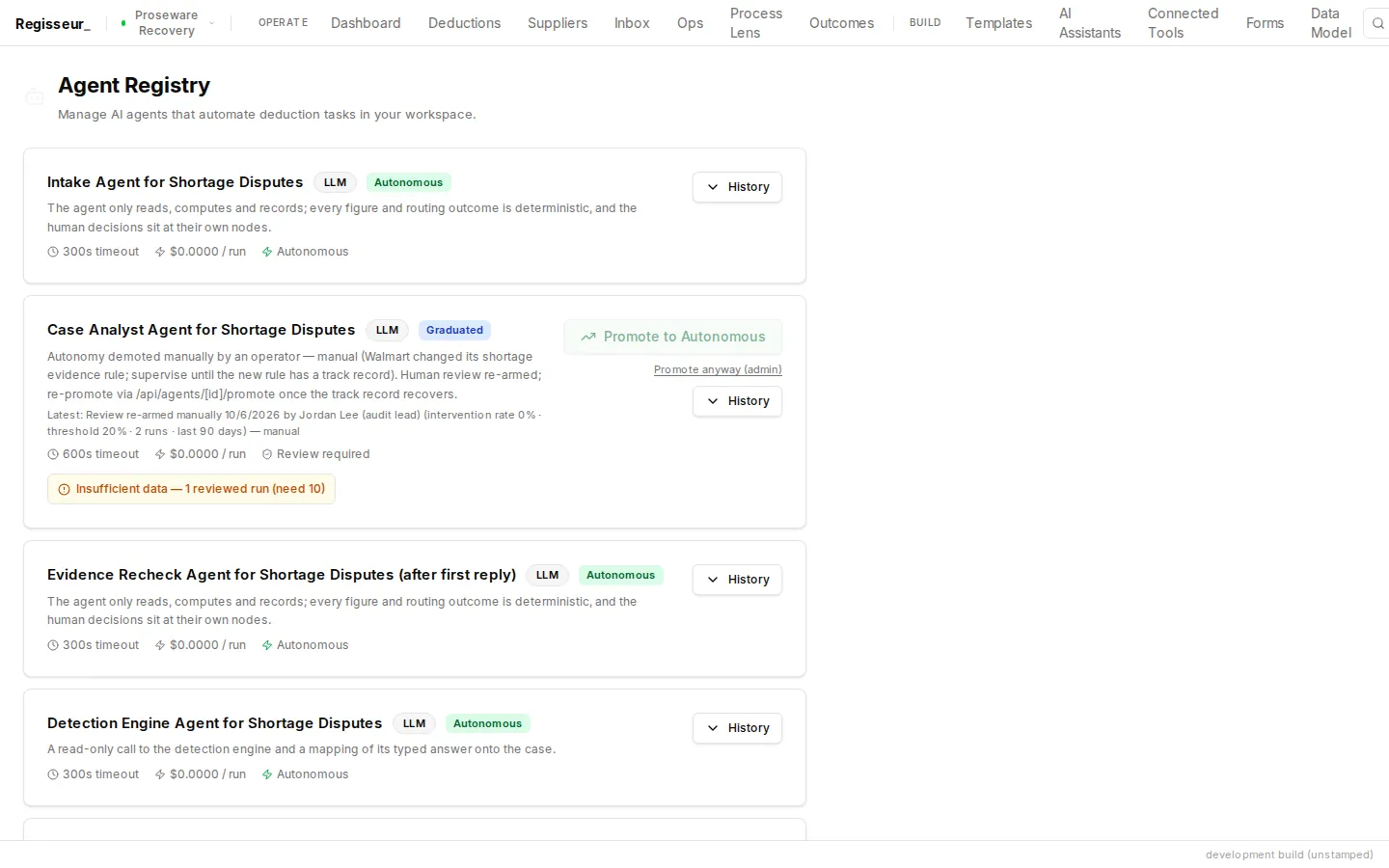
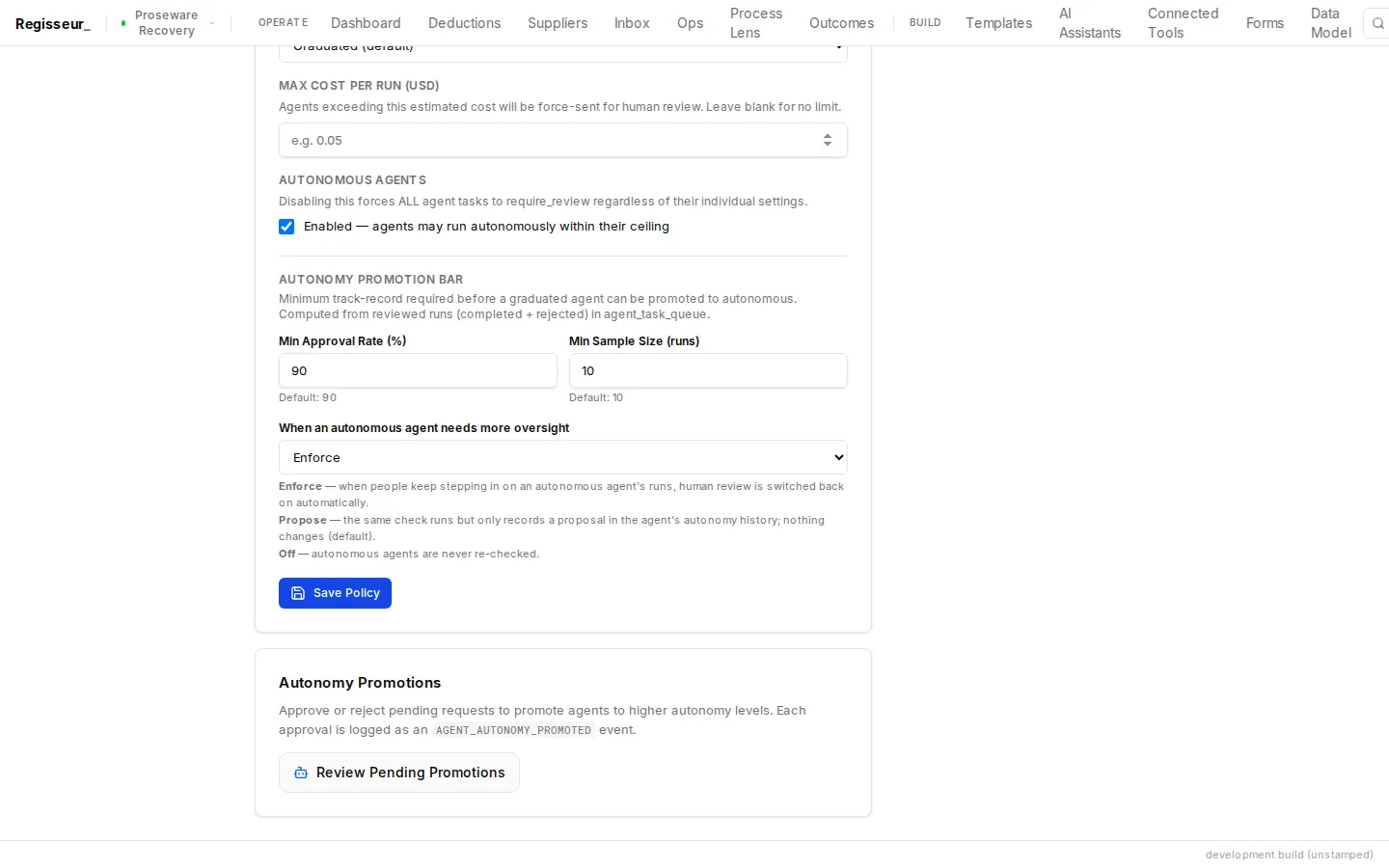
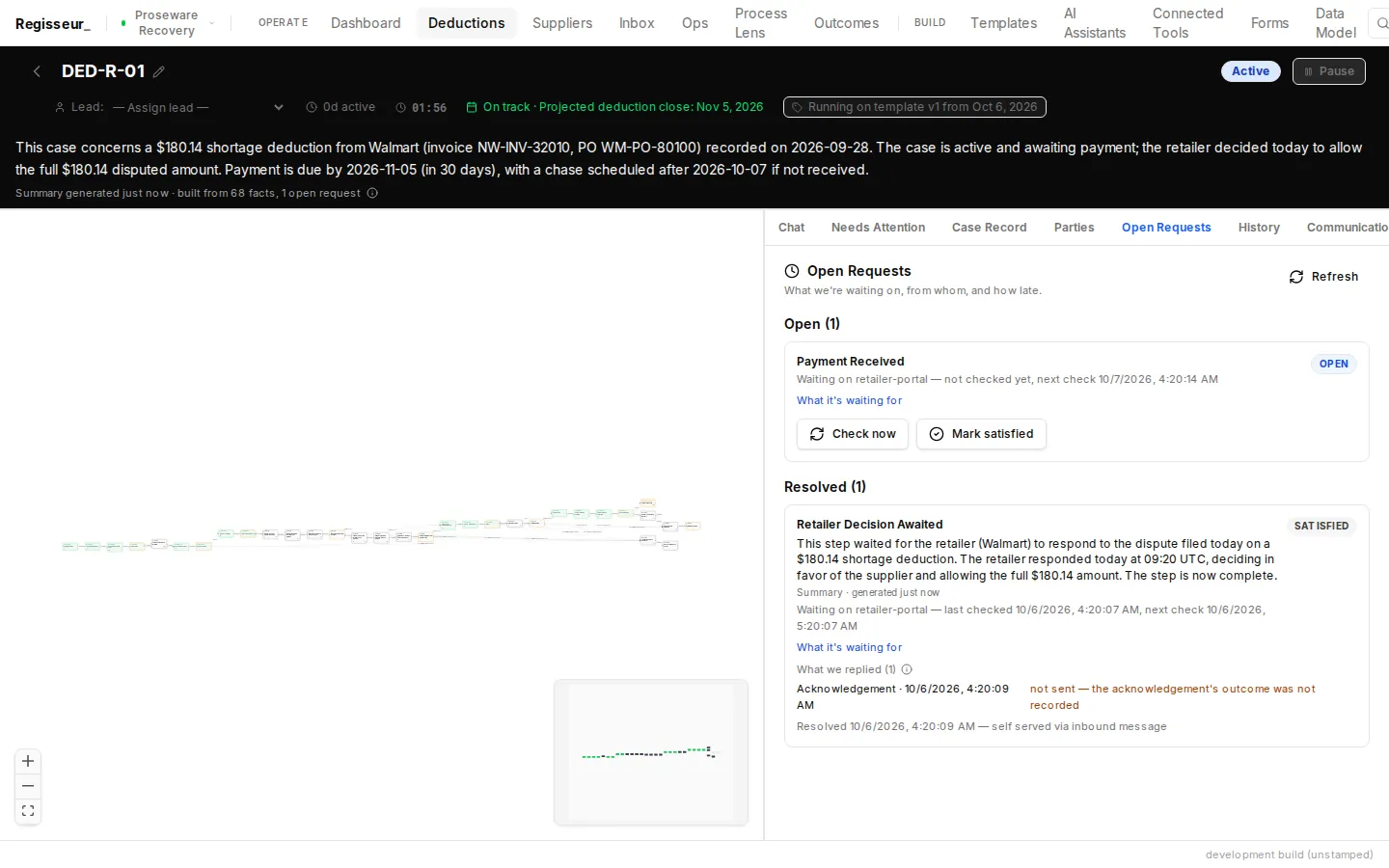
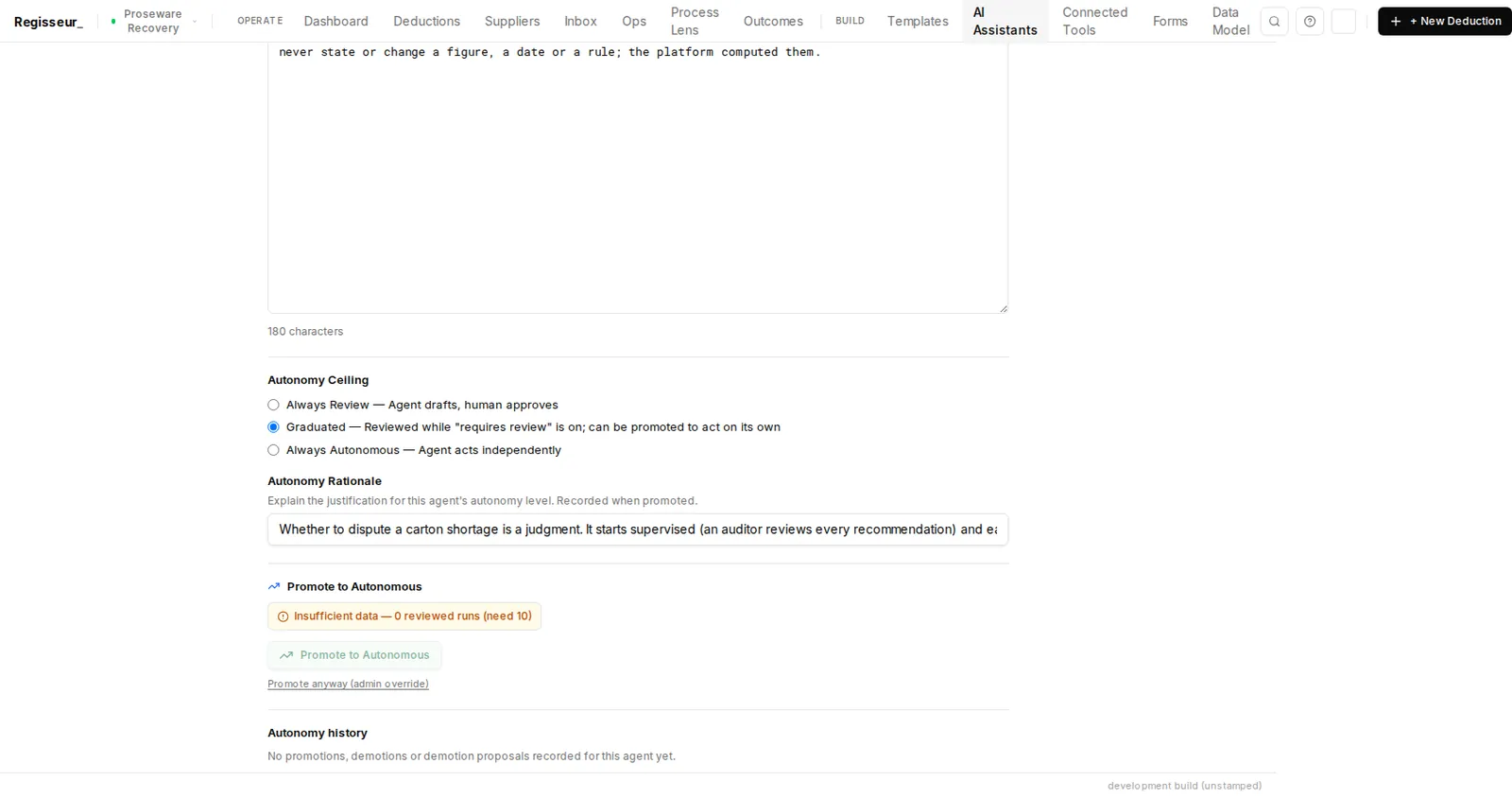
The audit lead, Jordan Lee, pulled the shortage analyst back under review with one action and a reason: "Walmart changed its shortage evidence rule; supervise until the new rule has a track record". The action is recorded with who did it, why, and the measured rate (0% of 2 runs overridden, against a 20% trigger). New shortage cases wait for an auditor again. This was a deliberate manual decision; the automatic trigger had no overrides to react to.

The automatic safety net
Separately, the workspace is set to enforce an automatic safety net: if auditors start overriding an autonomous agent beyond a threshold, it is demoted without anyone having to notice. The check was run once in the demo; it examines every agent in the system and reports totals only (no agent needed demoting). We are not claiming here that the automatic rule fired: this scenario shows the manual pull-back.
The check reported: 405 agents inspected, 0 demoted, 0 flagged for a proposal, 0 failures.
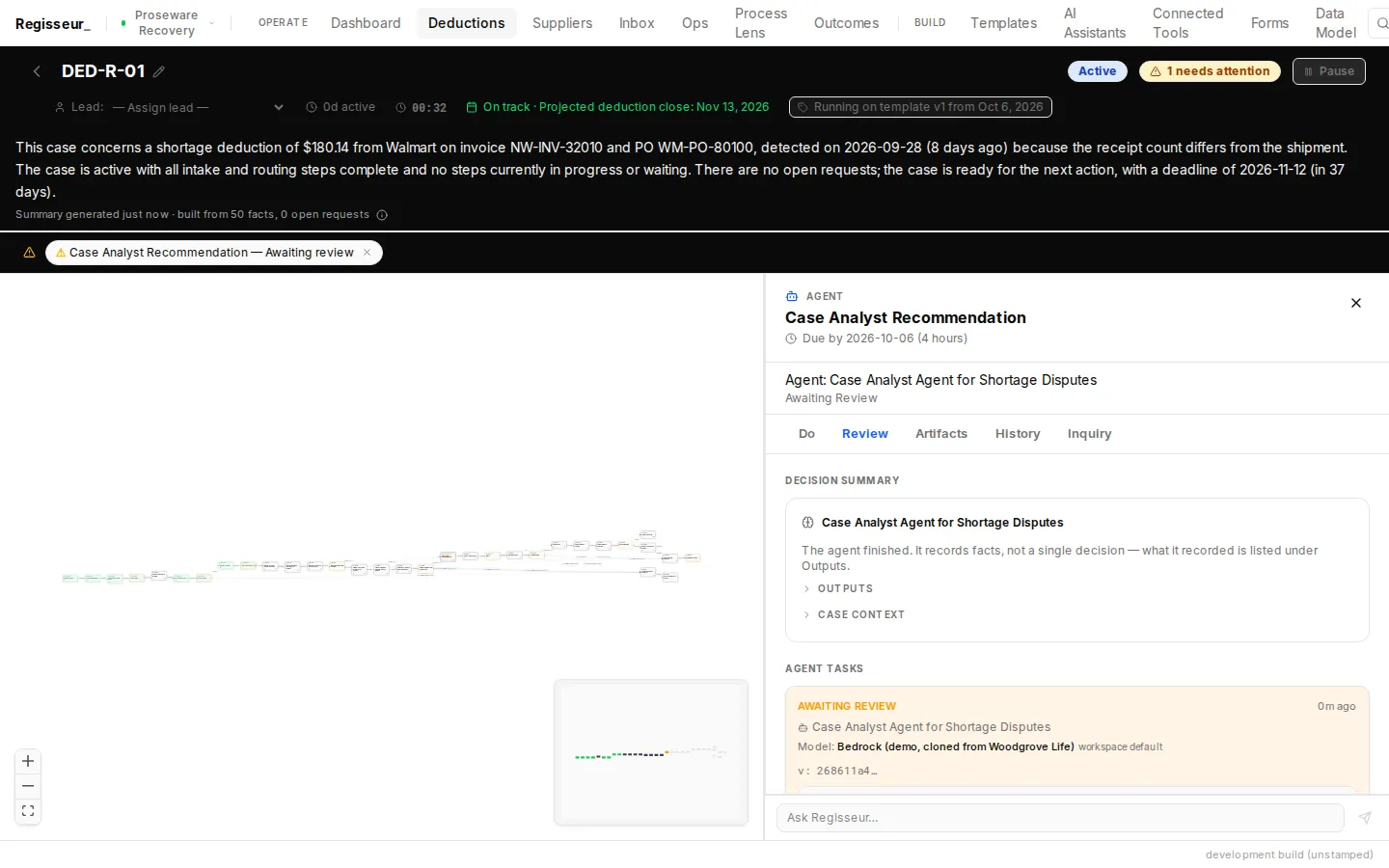
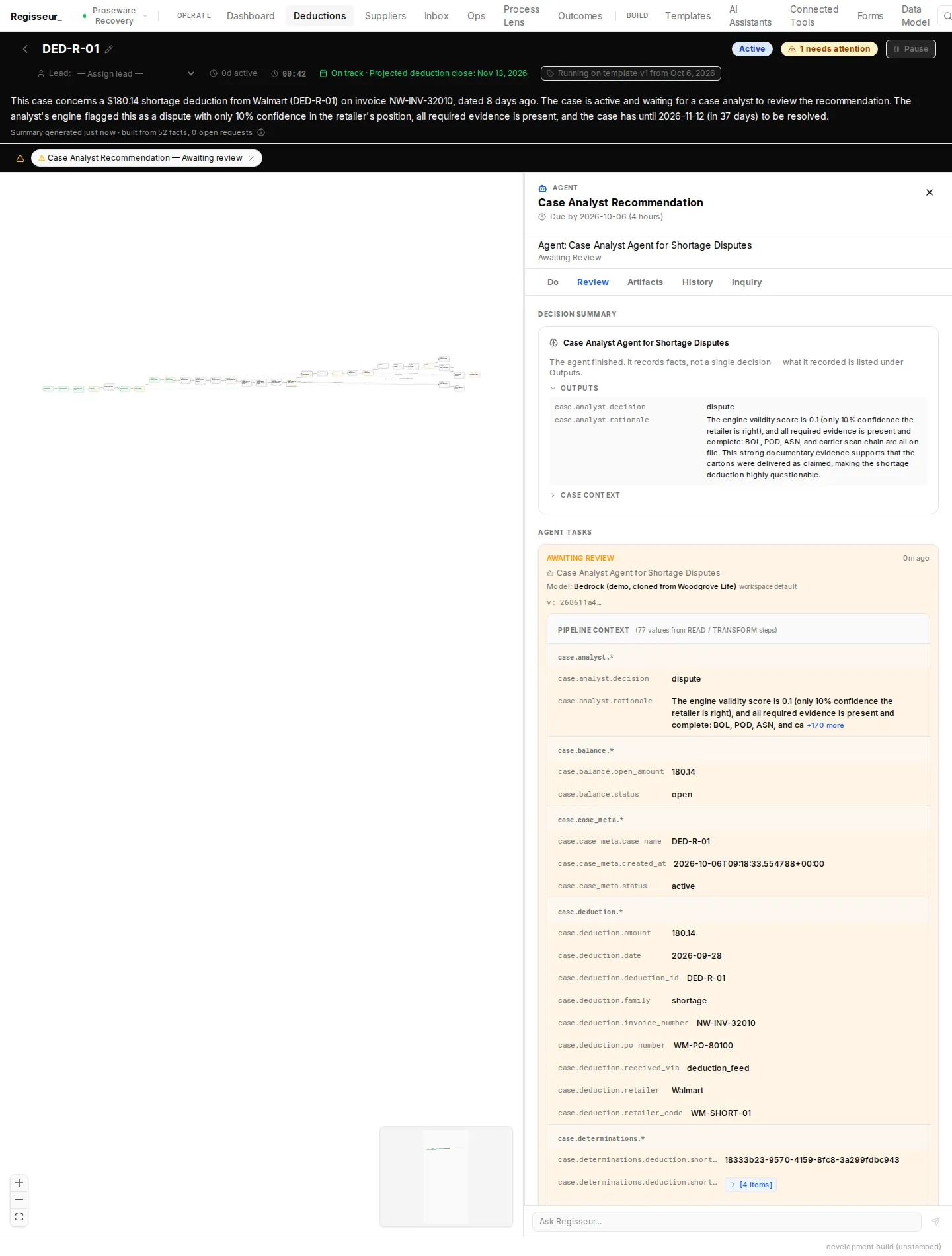
The next case waits for an auditor again
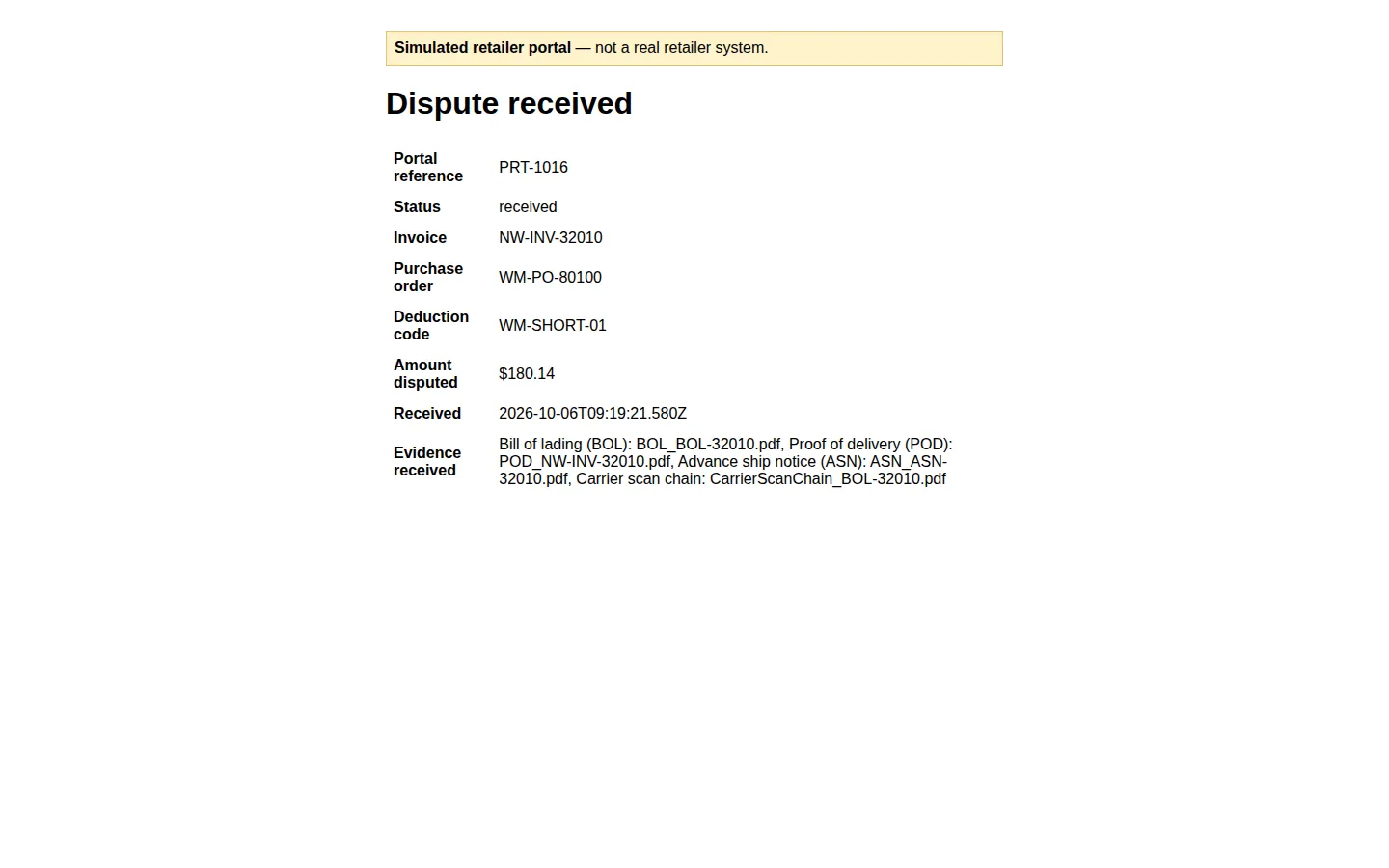
The next shortage, which had the scan chain, waited for an auditor's approval before the agent filed it, as expected after the re-arm. The retailer decided in favour; the case is shown still waiting for the payment to arrive, because the demo did not stage a remittance for it. It is not counted as recovered.
The other three claim families are unaffected by the re-arm; each is still building its record:
9Why was it filed, and by whom?
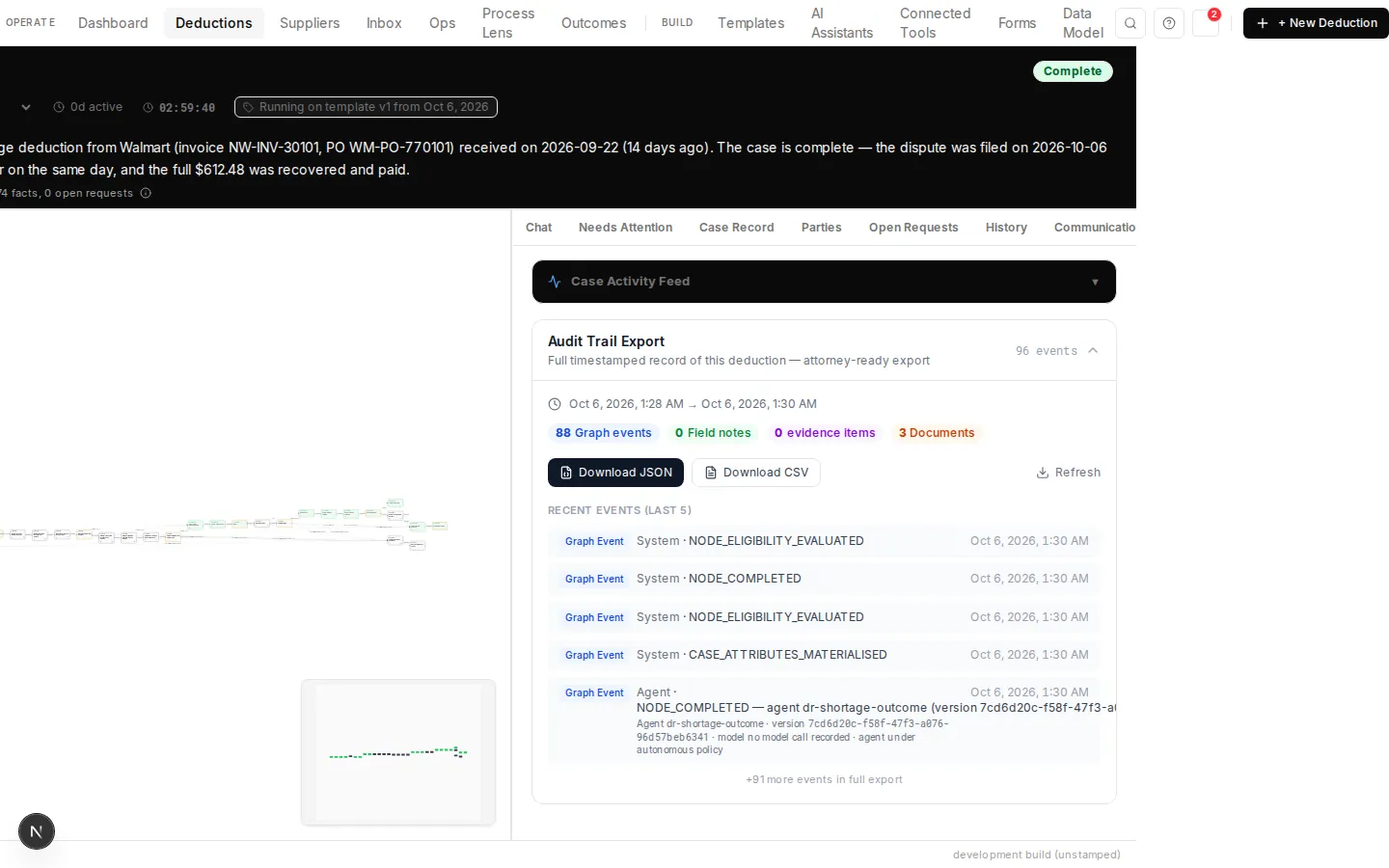
The audit export answers it for any case. Below are excerpts from two exported files.
The autonomous case
| Agent | Case Analyst Agent for Shortage Disputes |
|---|---|
| Version that ran | 0ed9f818-febc-4122-bec2-a842c0496f05 |
| Model | us.anthropic.claude-haiku-4-5-20251001-v1:0 |
| Decision basis | Agent under autonomous policy; decided by: no person |
The case a person decided
| Analyst review | Sam Okafor approved the Case Analyst Agent for Promotional Disputes output at 2026-10-06 07:15:52 UTC (decision basis: human reviewer; model us.anthropic.claude-haiku-4-5-20251001-v1:0) |
|---|---|
| Auditor decision | Alex Rivera submitted the decision at 2026-10-06 07:16:48 UTC (fields: decision, note; the export stores a hash of the values, the note's text is on the case record and in the letter above) |
10The picture across the run
Chart data
| Case | Family | Filed or recorded (UTC) | Human touches |
|---|---|---|---|
| DED-W-01 | shortage | 2026-10-06 03:58:37 UTC | 1 |
| DED-W-02 | shortage | 2026-10-06 04:04:24 UTC | 1 |
| DED-W-03 | shortage | 2026-10-06 04:10:54 UTC | 1 |
| DED-W-04 | shortage | 2026-10-06 04:25:54 UTC | 1 |
| DED-W-05 | shortage | 2026-10-06 04:32:44 UTC | 1 |
| DED-W-06 | shortage | 2026-10-06 04:35:50 UTC | 1 |
| DED-W-07 | shortage | 2026-10-06 04:38:46 UTC | 1 |
| DED-W-08 | shortage | 2026-10-06 04:41:51 UTC | 1 |
| DED-W-09 | shortage | 2026-10-06 04:45:37 UTC | 1 |
| DED-W-10 | shortage | 2026-10-06 04:50:14 UTC | 1 |
| DED-W-11 | shortage | 2026-10-06 04:53:12 UTC | 1 |
| DED-S1-0001 | shortage | 2026-10-06 06:29:06 UTC | 0 |
| DED-S2-0001 | shortage | 2026-10-06 06:55:48 UTC | 0 |
| DED-R-02 | shortage | not filed | 0 |
| DED-R-01 | shortage | 2026-10-06 09:19:21 UTC | 1 |
| DED-S3-0001 | pricing | 2026-10-06 07:13:43 UTC | 1 |
| DED-S4-0001 | promotional | 2026-10-06 07:16:50 UTC | 2 |
| DED-S5-0001 | otif | 2026-10-06 09:13:36 UTC | 1 |
Chart data
| Deductions worked | 18 ($16,026.72 deducted) |
|---|---|
| Disputed (filed) | 16 ($10,085.58 disputed) |
| Won by the retailer | 16 ($10,085.58 allowed, simulated decisions) |
| Cash reconciled | 15 ($9,905.44 recovered) |
| Accepted as valid | 1 ($1,420.50, root cause: timing) |
| Waiting on the supplier | 1 ($260.54 deducted, not yet disputed) |
Chart data
| promo setup | $7,850.00 (1 case) |
|---|---|
| dc receiving | $3,619.06 (11 cases) |
| none recorded | $1,760.48 (2 cases) |
| timing (valid, accepted) | $1,420.50 (1 case) |
| price file | $936.00 (1 case) |
Chart data
| Shortage | $4,979.54 (13 cases) |
|---|---|
| Promotional | $4,317.50 (1 case) |
| Pricing | $608.40 (1 case) |
| OTIF (on-time, in-full) | $0.00 (accepted as valid, not disputed) |
The rule-change marker uses the time the rules-register screenshot was taken.
11About this walkthrough
Everything here ran on the platform, and the screenshots are captured from the running product. These are the places where the demo stands in for something real, so you know what you are looking at:
- The detection engine is a stand-in. It returns scripted scores. What is live is the connection and what the platform does with the answer.
- The retailer portals, the rules register and the supplier document store are simulated and labelled so, and all transaction data is synthetic. Retailer names describe typical process shapes only.
- Retailer decisions are scripted. Every decision (won, in full) and every payment was applied by the demo, so the recovered dollars show the platform handling a case through to cash, not what a retailer would pay. The partial settlement on the Amazon case was also set up by the demo.
- Feed transport. Deduction and payment files were dropped into the platform's intake door by a script, because the demo environment has no file-transfer server. Only the delivery method is substituted; the processing is live.
- Time compression. The Amazon case's 30-day hold was released by running the timer process once as if 427 hours had passed. It is the only place time was compressed.
- The auditors and the audit lead are demo personas whose decisions were performed by the demo script through the screens (one approval used the product's API instead). The auditor's note and the re-arm reason are written text, not a measure of auditor behaviour.
- All email goes to a test inbox. No supplier was contacted.
- The supplier's link came from the email, opened in a separate browser with no login.
- The warm-up had eleven reviewed cases, all approved. The record that earned autonomy is eleven reviews at 100%, a small sample that meets the platform's minimum of ten.
- The pull-back shown is a manual decision. The automatic trigger was not exercised, and two of the new cases are shown still waiting: one for a supplier's document, one for a payment.
- A small synthetic sample. 18 cases on one day: a demonstration, not a benchmark.
- One early promotion attempt failed because of a product defect we then fixed; the successful promotion followed.
- Not claimed: retailer integrations, carriers, or any production volume.
All companies, individuals, cases, and data depicted in this report are fictional and shown for demonstration purposes only. Any resemblance to real entities is coincidental.
12Trust, and what comes next
Trust
- Runs in your own cloud, including Azure: the platform ships as a signed package of containers with its own database and installs into your subscription. Secrets can stay in your Azure Key Vault, and models run on your own keys, including Azure OpenAI.
- Single sign-on: Azure AD (Entra ID) / SAML sign-in with provisioned roles. Not exercised in this drive.
- Signed, versioned package: the workflow package is installed as a signed, versioned unit; every agent change creates a new version (as seen in the promotion and re-arm version ids above). Signing is not shown in this drive.
- Audit export: every case exports its full event trail as a file: shown in the decision record above.
- Workspace halt: an emergency brake that stops all automated work in a workspace. Not exercised in this drive.
Next, not claimed today
- Outcome-fed signals: use denials and win rates as promotion and demotion signals. Today the signal is auditor interventions; denials are recorded and charted only.
- Post-hoc sample review: auto-file with a sample reviewed afterwards. Today there are two tiers: supervised and earned.
Run your process the same way.
Bring one process you run every week. We map it with you: the steps, the decisions that stay with a person, and what agents would do.